









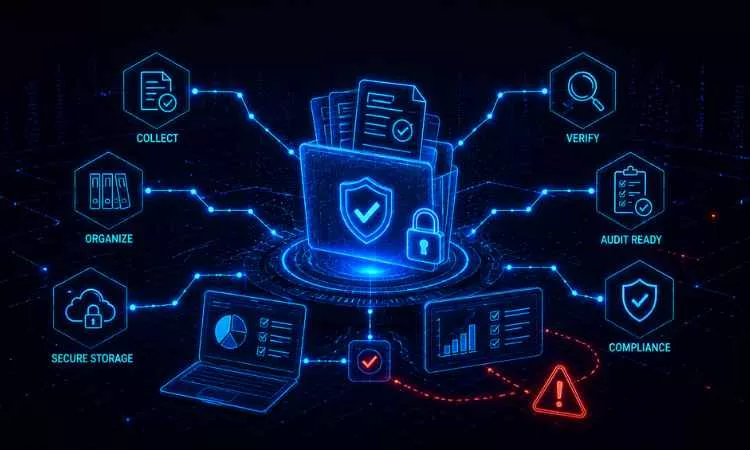
Compliance leaders are judged on one question during every audit cycle: can you prove it? Policies and dashboards carry little weight if an organization cannot produce timely evidence that its controls operate as documented. This is where evidence management becomes central to any compliance program, whether the framework is SOC 2, ISO 27001, PCI DSS, HIPAA, or a regional privacy law. For CISOs and governance leaders, understanding how evidence management works is the difference between a calm audit and a scramble for screenshots the night before an assessor arrives.
Evidence management is the continuous process of collecting, mapping, and validating proof that security controls operate as documented. It is owned jointly by security, IT, and compliance teams, should start the moment a control is implemented, and increasingly relies on automation and continuous controls monitoring rather than manual, pre-audit evidence hunts.
What Is Evidence Management in Compliance?
Evidence management in compliance is the structured process of collecting, storing, organizing, and validating the documentation that proves an organization’s security and compliance controls are functioning as intended. This includes system logs, access reviews, configuration records, policy attestations, training completions, vulnerability scan results, and remediation tickets. Each piece of evidence exists to answer a simple question an auditor will ask: how do you know this control worked, and can you show it consistently over the audit period?
Unlike a one-time checklist, evidence management is an ongoing discipline. Controls change, systems get reconfigured, and staff rotate. Without a deliberate process for capturing evidence as it is generated, organizations end up reconstructing history under deadline pressure, which increases the risk of gaps, inconsistencies, and failed audits.
Evidence quality matters as much as evidence quantity. Auditors increasingly favor artifacts pulled directly from source systems over manually assembled exports, since manual files can be edited after the fact. Storing evidence in read-only or write-once, read-many (WORM) repositories, with tamper-evident timestamps, gives auditors confidence in the record’s integrity and supports non-repudiation if a control is later challenged.
What is the Significance of Evidence Management for Compliance Programs?
Evidence management matters because regulators and auditors do not accept the existence of a control as proof that it works. They require documented, time-stamped evidence that shows the control was applied consistently across the review period. A firewall rule that exists today does not confirm it was enforced six months ago. A training program that is described in a policy document does not confirm employees completed it.
Strong evidence management matters because of the following reasons:
- It reduces the time and cost of audit preparation by eliminating last-minute evidence hunts.
- It lowers the risk of findings, exceptions, or failed certifications caused by missing or stale documentation.
- It builds trust with customers, partners, and regulators who expect verifiable proof of security posture.
- It supports faster response during incidents, since documented control history helps determine what happened and when.
- It creates a defensible record if a breach or compliance failure leads to legal or regulatory scrutiny.
The efficiency gain is measurable. Audit and advisory firms piloting automated evidence collection have reported evidence-gathering time drop by roughly 30 to 50 percent compared with manual coordination. Organizations that treat evidence management as a continuous function, rather than a pre-audit sprint, consistently report shorter audit cycles and fewer surprises. This mirrors the broader shift toward continuous audit readiness, where compliance is maintained year-round instead of assembled once a year.
Who Is Responsible for Evidence Management?
Responsibility for evidence management is distributed across CISOs and security leaders, compliance and GRC teams, IT and engineering, and internal and external auditors. It is rarely owned by a single person, which is why programs often break down. Each role plays a distinct part:
- CISOs and security leaders: They set the strategy and hold teams accountable for producing evidence on schedule.
- Compliance and GRC teams: They maintain the evidence repository and map artifacts to specific framework requirements.
- IT and engineering teams: They generate the raw evidence, such as system logs, patch records, and access control changes.
- Internal audit functions: They periodically test whether the evidence collected supports the control claims being made.
- External auditors: They review the final evidence set during formal assessments and certifications.
A clear ownership model, backed by defined workflows, prevents evidence from scattering across spreadsheets, email threads, and individual laptops. Many organizations formalize this through a governance, risk, and compliance program that assigns accountability at every stage of the evidence lifecycle.
What Types of Evidence Do Auditors Expect?
Auditors typically expect evidence that is timestamped, attributable to a specific system or individual, and consistent across the full review period, instead of a single snapshot. The specific evidence required depends on the framework, but most compliance audits fall back on a common set of artifact categories including:
- Access control logs and periodic access reviews.
- Change management records and approval trails.
- Vulnerability scan results and remediation timelines.
- Security awareness training completion records.
- Incident response logs and post-incident reviews.
- Vendor and third-party risk assessments.
- Policy documents with version history and sign-off dates.
- Configuration baselines for critical systems.
A control that was only evidenced once, weeks before the audit, tends to draw follow-up questions.
When Should Organizations Start Managing Compliance Evidence?
Organizations should start managing compliance evidence the moment a control is implemented, not when an auditor requests proof. Waiting until an audit notice arrives typically means months of retroactive evidence gathering, incomplete records, and rushed documentation that raises red flags rather than confidence.
Organizations preparing for their first certification, such as SOC 2 or PCI DSS, benefit most from establishing evidence collection workflows during the gap assessment phase, well ahead of the formal audit window. For organizations already certified, evidence management should run continuously between audit cycles, so the next renewal requires validation rather than reconstruction.
How Does Evidence Management Work in Practice?
A functioning evidence management process typically follows a repeatable cycle:
- Mapping controls to requirements: Each framework requirement is linked to the specific control and evidence type that satisfies it.
- Collecting evidence continuously: Logs, tickets, and records are captured as they are generated, manually or through automated integrations.
- Centralizing storage: Evidence sits in a single, access-controlled repository rather than scattered across departments.
- Validating completeness: Compliance teams periodically check that evidence exists for every mapped control and flag gaps early.
- Preparing for review: Evidence is packaged in the format auditors expect, with clear traceability back to the underlying control.
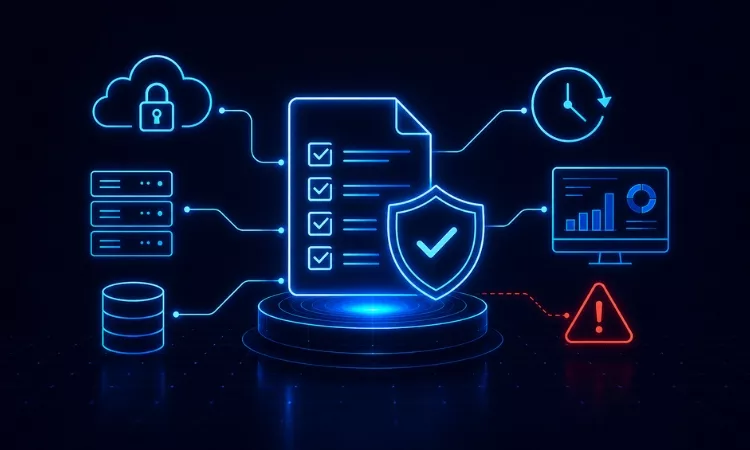
Many organizations now shift parts of this cycle to automation. Automated evidence collection pulls artifacts directly from source systems on a set schedule, reducing manual effort and improving consistency over spreadsheet-based tracking. This is closely tied to continuous controls monitoring (CCM), where API-driven checks validate that a control is active in real time rather than relying on a periodic snapshot. Manual evidence management is becoming harder to defend as frameworks mature, since a single point-in-time export cannot demonstrate that a control held throughout the full audit period.
What Are the Common Challenges in Evidence Management?
Even well-resourced compliance teams run into recurring problems:
- Fragmented ownership, where evidence lives across multiple teams with no central visibility.
- Manual collection, which consumes staff time and is prone to errors or missed deadlines.
- Stale evidence, where documentation exists but was never updated after a system change.
- Framework overlap, where the same control must satisfy multiple regulations, and evidence gets duplicated instead of mapped once.
- Lack of traceability, making it hard to show which evidence supports which requirement.
These issues compound as organizations grow, add frameworks, or expand into new regions with added regulatory obligations.
How Can Organizations Build a Strong Evidence Management Program?
A durable evidence management program combines process, ownership, and technology. Practical steps include establishing a control-to-evidence mapping early, assigning clear accountability across security, IT, and compliance teams, automating collection wherever systems allow it, and scheduling regular internal reviews rather than waiting for the external audit to surface gaps. Organizations that consolidate multiple regulatory requirements into a single framework, such as a synergized compliance approach, often find it easier to manage evidence once instead of repeating the exercise for every standard.
According to NIST’s guidance on cybersecurity frameworks, maintaining consistent, verifiable records of control performance is a foundational element of a mature security program, not an afterthought reserved for audit season. Similarly, ISO/IEC 27001 explicitly requires documented evidence as part of its certification and surveillance audit process, reinforcing that evidence management is a formal requirement across most major frameworks.
Turning Evidence Management Into an Advantage
Evidence management is often treated as a back-office task, something compliance teams handle quietly before an audit. In reality, it reflects how well an organization understands and controls its own security posture. Teams that manage evidence continuously spend less time in audit fire drills and more time strengthening the controls that reduce risk.
Ampcus Cyber helps organizations build audit-ready evidence management programs through our Compliance Compass services, combining structured control mapping with automation to keep evidence current year-round.
| Turn Compliance Evidence into Continuous Assurance. Contact Ampcus Cyber to schedule a Compliance Assessment. |
Enjoyed reading this blog? Stay updated with our latest exclusive content by following us on Twitter and LinkedIn.