










A mid-sized logistics company built an AI agent to reconcile shipment and billing records across three internal systems. Short on time, the security team issued the agent the same service account already used by an overnight batch job. The agent worked well for months, clearing backlogs and flagging mismatched invoices.
Then a routine access review turned up something nobody could explain. The shared service account had modified pricing data in a system it had no business touching. Nobody could say whether the change came from the batch job, a maintenance script, or the AI agent, because all three shared one login, one set of logs, and one credential. The audit trail pointed to a name on a badge, not to the system that acted.
This is the identity gap that shows up in almost every enterprise once an AI agent moves from a pilot into production, and it is the exact problem AI agent identity management exists to solve.
What Is AI Agent Identity Management?
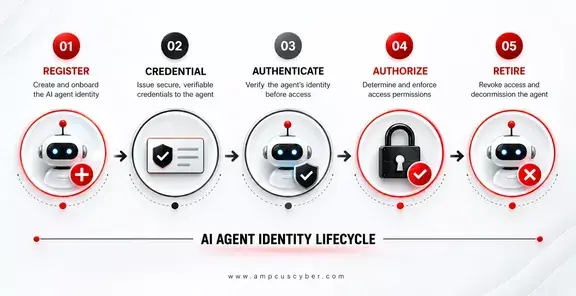
AI agent identity management is the practice of giving every autonomous AI agent its own verifiable identity, separate from the humans and service accounts around it, and governing that identity across its full lifecycle: registration, proof of identity, permitted actions, monitoring, and shutdown.
The Internet Engineering Task Force addresses this directly in its draft standard for AI agent authentication and authorization. The draft introduces the concept of an Agent Identity Management System, or AIMS: the set of functions needed to create an agent’s identity, keep it current, and check what it is permitted to do at any given moment. That framing treats an AI agent the way a mature program already treats a privileged employee, with its own name, credentials, and accountability trail.
Traditional identity and access management was built to verify people logging into applications, not software that plans its own steps and calls tools without asking. AI agent identity management fills that specific gap.
Why Do AI Agents Need Their Own Identity?
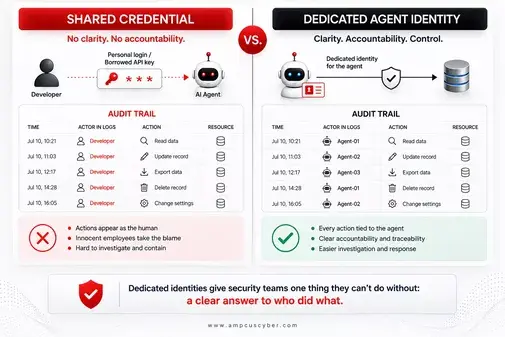
AI agents need dedicated identities because sharing credentials with a human or a service account removes the one thing security teams depend on most: a clear answer to who did what. When a developer hands an agent a personal login or a borrowed API key, every action the agent takes shows up in the logs as if a person did it. If the agent misfires or pulls data it should never touch, the audit trail leads back to an innocent employee instead of the system responsible.
Security researchers are already seeing this gap at scale. A January 2026 survey of 383 IT and security professionals by the Cloud Security Alliance and Oasis Security found that 92% were not confident their existing identity tools could manage AI and non-human identity risk, and 78% had no documented policy for creating or removing an AI agent’s identity once it was no longer needed. That second figure matters as much as the first. Most teams can spin up an agent in an afternoon. Very few can say, with confidence, when it should be switched off.
A distinct, traceable identity solves both problems at once. It restores accountability and gives security teams a lifecycle to manage instead of a shared credential to hope nobody misuses. Organizations running a mature Agentic IAM program treat dedicated agent identity as the starting assumption.
How Does AI Agent Identity Management Work?
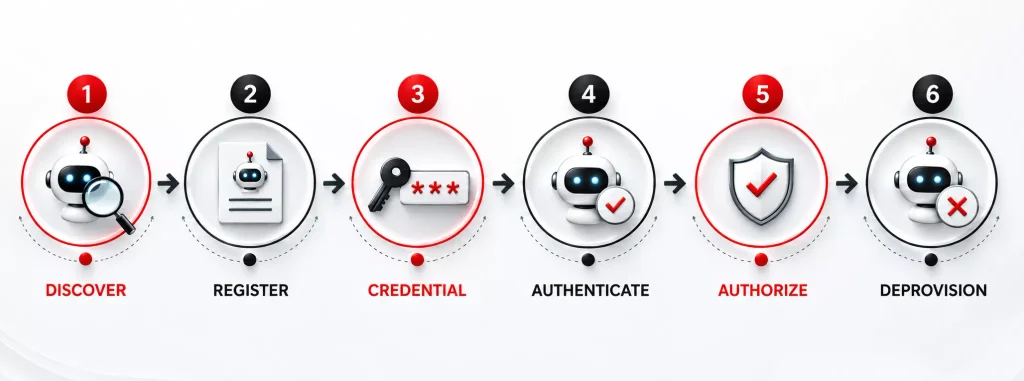
AI agent identity management works through a lifecycle that treats every agent as its own accountable entity, from the day it is created to the day it is switched off. Most programs move through six stages: discover, register, credential, authenticate, authorize, and deprovision.
Discovery comes first: security teams inventory every agent already running, since most enterprises have more unapproved agents than sanctioned ones. Registration gives each agent a unique identifier instead of a shared login. Credentialing typically issues a short-lived certificate or token rather than a static password, so a stolen credential expires quickly.
Authentication then happens continuously, not once at login, since an agent’s context and permissions can shift between one action and the next. Authorization stays scoped to the task at hand, so an agent built to summarize support tickets never inherits blanket access to the entire customer database. Monitoring feeds every agent action into the same logs used for human activity, and deprovisioning removes an agent’s identity the moment its task ends.
This lifecycle applies whether the agent lives in a cloud platform, a SaaS tool, or connects to internal systems through Model Context Protocol. It is worth separating from an older, narrower idea here too.
IBM describes machine identity as a subset tied to a device or certificate, while an agent’s identity has to account for a system that reasons and chains actions on its own, which is why this has grown into its own discipline.
Who Should Own AI Agent Identity Management?
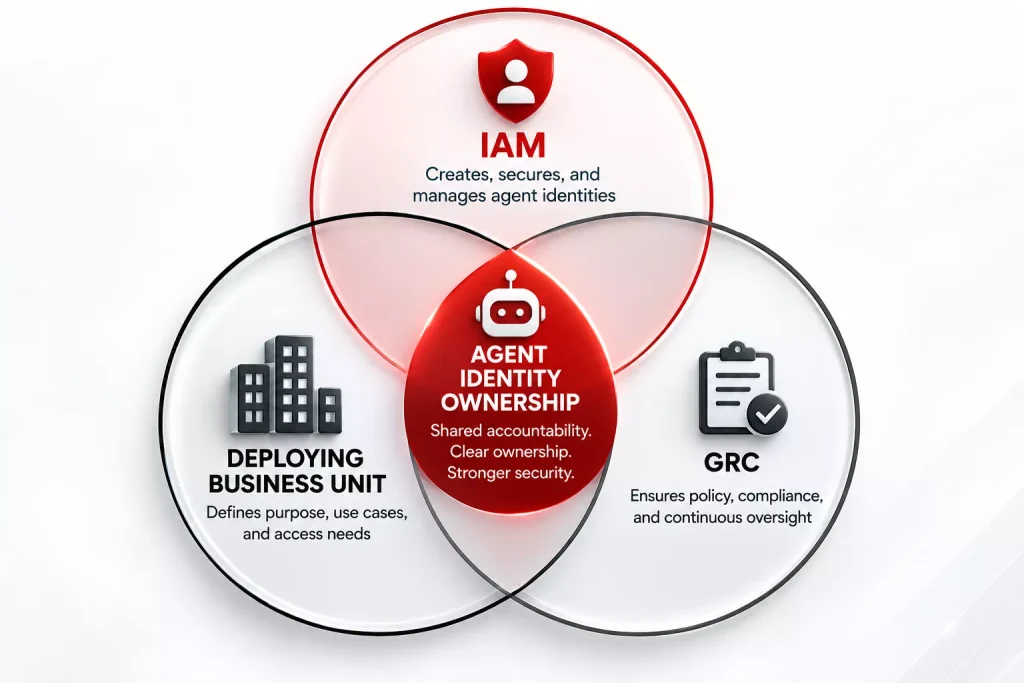
Ownership sits best with the identity and access management team, working alongside the business unit that deployed the agent, since neither group can govern this well alone. IAM brings the credentialing infrastructure and audit discipline built over years of managing human and service accounts. The business unit knows what the agent is supposed to do and when its job is finished.
Many security leaders are adding a third layer: oversight agents that watch other agents in real time. A Governor Agent pattern gives one high-trust system the job of confirming a working agent’s actions stay inside its assigned identity, catching drift faster than a quarterly access review could, without replacing human ownership.
Governance, risk, and compliance teams round out the picture, since AI agents are a form of non-human identity that regulators are starting to ask about, particularly in financial services and healthcare.
When Should Organizations Implement AI Agent Identity Management?
The right time to implement AI agent identity management is before the first agent goes live with write access or sensitive data, not after an audit turns up one nobody can explain. Waiting until an incident forces the question is the most expensive way to build this program, since retrofitting identity onto agents already embedded in production takes far longer than designing it in from the start.
The moment an agent moves from a sandbox into a workflow touching customer data, financial systems, or infrastructure controls, treat it the way a new privileged employee would be treated on day one: with an identity, a defined scope, and a named owner. Teams that wait for scale before building this discipline usually end up managing hundreds of agents with the access hygiene of a five-person startup.
What Happens When AI Agent Identity Goes Unmanaged?
Left unmanaged, AI agent identity turns into orphaned accounts, blurred audit trails, and access nobody remembers granting, the same risks that already exist with human accounts, only faster and at greater scale, since agents can be created in minutes and chain actions together without a person approving each step.
Recall the logistics company from the start of this article. Its shared credential problem was caught only because someone happened to run an access review at the right time. Most organizations get less lucky. An agent with standing access to a system it no longer needs,created for a project that wrapped up months ago, sits quietly until it becomes the entry point an attacker exploit. Treating agent identity as an ongoing lifecycle, not a one-time setup step, is what keeps that quiet risk from becoming a headline.
People Also Ask
Is AI agent identity management the same as Agentic IAM?
No. It covers the lifecycle of a single agent’s identity, from registration through retirement. Agentic IAM is the broader architecture that governs real-time access decisions on top of that identity layer.
Can a service account work as an AI agent’s identity?
It can short term, but it is not advisable. A shared service account erases the audit trail between the agent and anything else using it, the exact problem dedicated agent identities solve.
What standards apply to AI agent identity?
The clearest reference point today is the IETF’s draft AIMS framework, which combines existing workload identity standards with OAuth 2.0 to authenticate and authorize agents as distinct entities.
Who is accountable when an unmanaged AI agent causes harm?
Accountability traces back to whoever owned the credential the agent used, which is precisely why dedicated, traceable agent identities matter.
| Ampcus Cyber helps enterprises design and govern AI agent identity programs as part of a broader identity and access management strategy. Talk to our identity security team to see where your AI agents stand today. |
Enjoyed reading this blog? Stay updated with our latest exclusive content by following us on Twitter and LinkedIn.