









Imagine a payment service calling a fraud detection API at 3 a.m., a CI/CD pipeline deploying code without an engineer at the keyboard, or an AI agent querying a database to complete a task. No person is entering a password or approving a login. Yet each system still needs to prove, “I am who I say I am,” before another system allows it to act.
This is the world of machine-to-machine (M2M) authentication. As enterprises add more APIs, cloud workloads, microservices, automation, and AI agents, machines are constantly communicating with other machines, and every connection creates another identity that needs to be secured.
In this blog, we’ll walk you through what M2M authentication is, how it works, the methods organizations use to authenticate machine identities, the risks of weak machine authentication, and how M2M authentication fits into a broader Zero Trust and identity security strategy.
What is Machine-to-machine (M2M) Authentication?
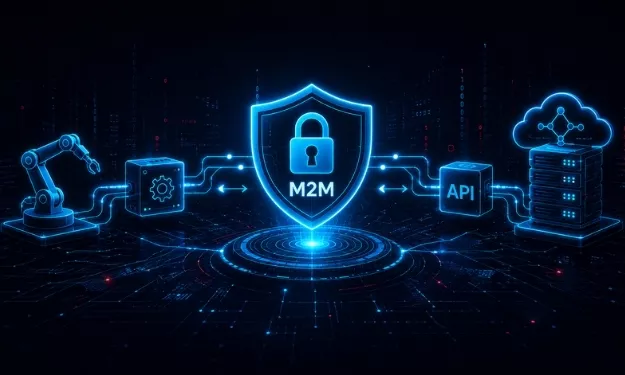
M2M authentication is the process a service, application, or device uses to prove its identity to another system without a person typing a password or approving a login prompt. It relies on credentials built for automation, such as API keys, signed tokens, and mutual TLS certificates, rather than the interactive methods designed for human users.
Modern enterprises run on this kind of communication constantly. A payment service calls a fraud detection API. A CI/CD pipeline pulls secrets from a vault to deploy code. An AI agent queries a database on a schedule with no one watching. Every one of these exchanges needs to prove who is asking before it hands over data or takes an action, and it needs to do so without a human anywhere in the loop.
How Is M2M Authentication Different from Human Authentication?
Human authentication assumes someone is present to respond. A person enters a password, approves a push notification, or completes multi-factor authentication when a system asks for proof. That interaction has no equivalent when the requester is a script running at 3 a.m. or a microservice spinning up inside a container that will be gone in ninety seconds.
M2M authentication must work without anyone in the loop. Credentials must be provisioned in advance, verifiable automatically, and revocable the moment a service is retired or compromised. This changes the security model: instead of asking whether a person is who they claim to be, M2M authentication asks whether a piece of software or infrastructure was issued the identity it is presenting, and whether that identity still deserves the access it is requesting.
What Methods Are Used for M2M Authentication?
Several credential types handle machine identity, each with different trade-offs.
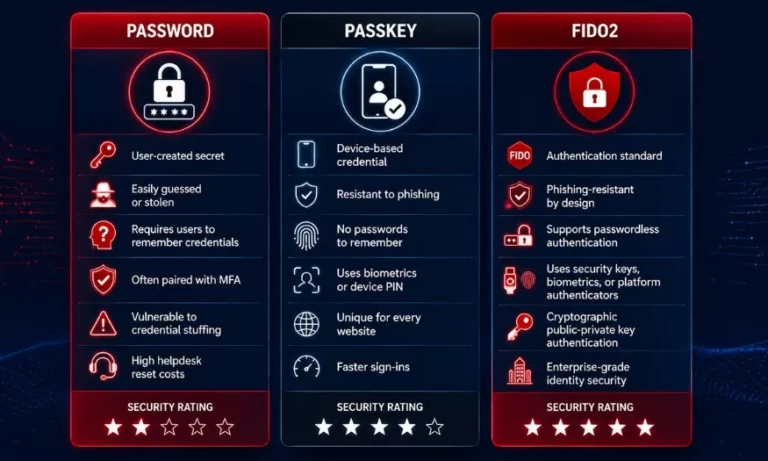
API keys are the simplest option. To define, it is a long, static string a service includes with every request. They are easy to implement and easy to leak, since a key copied into a config file or a public repository works until someone notices and rotates it.
OAuth 2.0’s Client Credentials Flow, defined in RFC 6749, is the most widely adopted enterprise pattern. A service authenticates with a client ID and secret, receives a short-lived access token, and uses that token instead of a long-lived key for each request. Mutual TLS (mTLS) goes further, requiring both sides of a connection to present a certificate, so the client proves its identity before any application data moves. Workload identity frameworks such as SPIFFE issue short-lived, automatically rotated certificates to every service, removing static secrets almost entirely.
Most mature enterprises combine these methods rather than standardizing on one, matching the credential type to how sensitive the connection is.
How Does the OAuth 2.0 Client Credentials Flow Work?
The Client Credentials Flow follows a consistent sequence regardless of which platform implements it.
First, the calling service, known as the client, authenticates to an authorization server using its client ID and client secret, or a private key in more secure implementations. Second, the server validates those credentials and checks what scopes, meaning what specific permissions, the client may request. Third, if the request is valid, the server issues a signed access token, typically a JSON Web Token (JWT), with a short expiration window measured in minutes rather than days. Fourth, the client includes that token in every subsequent request to the target API, which validates the signature and expiration before granting access.
Because the token expires quickly, a leaked token has a limited window in which it can be misused, which is the core security advantage over a static API key that remains valid indefinitely.
Why Does M2M Authentication Matter Now?
Machine identities have quietly become the majority population inside every enterprise network. Palo Alto Networks’ 2026 Identity Security Landscape report found that organizations now manage 109 machine identities for every human identity, and that 96% of respondents said human identities already operate with more access than their role requires, a gap that tends to be worse for machine accounts nobody reviews on a schedule.
Cloud-native architecture is a large part of the cause. A single application might now be built from dozens of microservices, each one calling several others, each connection requiring its own authenticated identity. Add autonomous AI agents that call APIs, query databases, and trigger workflows on their own initiative, a governance challenge covered under Agentic IAM, and the number of machine-to-machine connections a security team must account for grows into the thousands for even a mid-sized organization. Weak M2M authentication is no longer a narrow technical gap; it is one of the largest identity surfaces most enterprises now carry.
What Risks Come From Weak M2M Authentication?
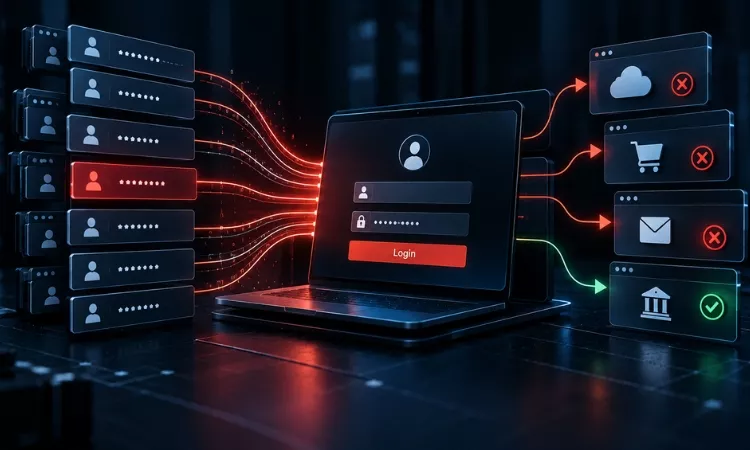
Weak M2M authentication tends to fail in a few predictable ways. Static API keys get hardcoded into scripts, checked into repositories, and copied into automation tools, creating secret sprawl that spreads a single credential across dozens of places nobody tracks. Service accounts often accumulate permissions well beyond what their original task required, because it is easier to grant broad access once than to request narrow access repeatedly.
A stolen or replayed machine credential gives an attacker the same capability the legitimate service had, often with far less monitoring than a human account would trigger, since security teams are more likely to build detection around unusual human logins than around unusual API traffic. The resulting compromise resembles session hijacking in effect: an attacker rides on a trusted identity rather than breaking through a perimeter, and the activity can look routine until the damage is already done.
How Does M2M Authentication Fit Into Zero Trust?
Zero Trust architecture treats every request as untrusted until it is verified, regardless of where it originates, and that principle applies to machine traffic as directly as it applies to human users. NIST SP 800-207, the foundational Zero Trust reference, defines the entities that require continuous authentication and authorization as both human users and non-human subjects such as applications and services.
In practice, this means a microservice calling another microservice inside the same cloud network gets the same scrutiny as an external user logging in from an unfamiliar device: proven identity, scoped permissions, and re-verification rather than standing, implicit trust because the traffic stayed inside the network perimeter. Extending Zero Trust to machine identities closes one of the largest gaps in most enterprise security programs, since internal service-to-service traffic has historically been treated as safe by default simply because it never left the network.
How Should CISOs Govern Machine Identities?
Governing machine identities takes the same discipline as governing human identities, applied to a much larger and faster-moving population.
- Inventory every credential: Discover API keys, service accounts, and certificates across cloud and on-premises systems, including the ones nobody remembers creating.
- Replace static secrets: Move from long-lived API keys toward short-lived tokens, mTLS, or workload identity wherever the platform supports it.
- Apply least privilege: Scope every machine identity to the specific action it needs to perform, not the broadest role available.
- Rotate and expire automatically: Build credential rotation into deployment pipelines instead of relying on manual renewal.
- Monitor machine traffic: Extend the same anomaly detection applied to human logins to service-to-service calls and API activity.
These controls belong inside the organization’s broader identity and access management program rather than as a separate initiative, and they extend naturally into cloud security posture work, since most machine identities live and authenticate inside cloud infrastructure.
Key Takeaway
Every enterprise already runs on machine-to-machine authentication, whether it has been governed as a distinct discipline. The services, pipelines, and AI agents exchanging credentials outnumber human users by a wide margin, and that gap is growing. Treating machine identity with the same rigor as human identity, provisioned deliberately, scoped narrowly, and rotated automatically, closes one of the fastest-growing blind spots in enterprise security.
| Talk to Ampcus Cyber’s Identity and Access Management team to inventory your machine identities and build an M2M authentication program that scales with your cloud and AI footprint. |
Enjoyed reading this blog? Stay updated with our latest exclusive content by following us on Twitter and LinkedIn.