









Session hijacking is an attack in which someone takes control of a live, authenticated session between a user and an application by stealing or predicting the session identifier that proves the user is logged in. No password theft, no MFA prompt, no visible login event. The attacker simply inherits access. This blog walks your through everything you need to learn about session hijacking.
What is Session Hijacking?
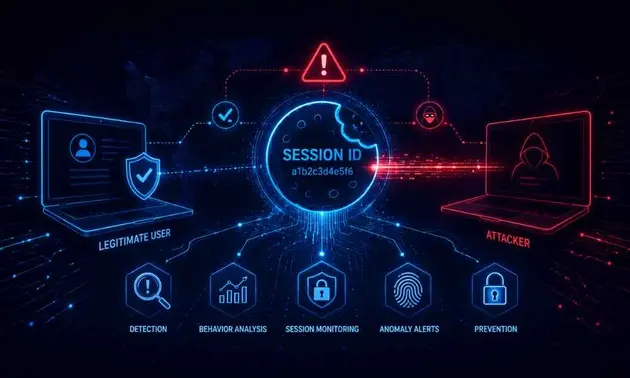
Session hijacking occurs when an attacker captures a valid session ID or cookie and uses it to impersonate an authenticated user, gaining the same access as that user without needing their credentials. It differs from credential theft because the target is the active session itself, not the password.
Once a user logs in, most applications issue a session token, commonly stored as a cookie, so the server doesn’t demand re-authentication on every click. That token is temporarily as powerful as the password, OTP, or certificate used to create it, according to the OWASP Session Management Cheat Sheet. Anyone holding it holds equivalent access, which is exactly why attackers target sessions instead of passwords.
The scale of this shift is measurable. SpyCloud’s 2026 Identity Exposure Report recorded 8.6 billion stolen session cookies recaptured from criminal infrastructure in 2025 alone, and found that identity-based attacks, including session hijacking, accounted for 64% of all reported incidents in 2024. Separately, Microsoft’s Digital Defense Report attributes roughly 80% of Multi Factor Authentication-bypass breaches to session-token theft carried out through adversary-in-the-middle phishing kits. Passwords and MFA are holding up.
How Does Session Hijacking Work?
The attack unfolds in three stages, mentioned below:
1) The attacker captures a valid session identifier through packet sniffing on unsecured Wi-Fi, cross-site scripting that reads cookies from the browser, infostealer malware, or a phishing proxy positioned between the user and the real login page.
2) The attacker imports that identifier into a browser or client they control.
3) They send requests using the stolen session, and the server responds as if the legitimate user made them.
MITRE ATT&CK documents this under Steal Web Session Cookie (T1539), noting that cookies can be pulled from disk, from browser process memory, or straight off the wire, and that open-source adversary-in-the-middle frameworks have made the technique easy to run at scale against corporate accounts.
What is the difference between Session Hijacking, Session Fixation, and Man-in-the-Middle:
These terms get used interchangeably, but they describe different points of attack.
| Attack Type | What the Attacker Targets | When It Happens | Primary Defense |
| Session Hijacking | An identifier from an already active session | Mid-session, after the victim has logged in | Session regeneration, short timeouts, HttpOnly/Secure cookies |
| Session Fixation | A session ID the attacker sets in advance | Before login; victim authenticates into an attacker-known ID | Regenerate session ID immediately after authentication |
| Man-in-the-Middle (MITM) | Traffic between the user and the server | During transmission, any point in the session | TLS/HTTPS enforcement, certificate pinning, no HTTP/HTTPS switching |
Session hijacking and MITM often overlap in practice: an attacker positioned on the network can intercept traffic (MITM) specifically to steal the session cookie riding inside it (hijacking). Session fixation, by contrast, doesn’t require interception at all; the attacker plants the trap before the victim ever logs in.
Why Does Session Hijacking Matter for Enterprises?
Session hijacking bypasses the two controls organizations lean on most: passwords and multi-factor authentication. Because the attacker inherits an already-authenticated session, they can move laterally, exfiltrate data, register new MFA devices, or create OAuth grants that survive a password reset, all before anyone notices unusual login behavior. For regulated organizations, a hijacked session touching cardholder data or personal information can trigger obligations under PCI DSS, ISO 27001, or SOC 2, and complicates response because the logs show a “legitimate” authenticated user rather than an obvious break-in.
What Are the Warning Signs of a Hijacked Session?
Analysts should watch for sessions that behave inconsistently with the user they claim to represent: a sudden change in IP address or geography mid-session, a shifting User-Agent string without a matching device change, two active sessions from different locations at once, unexpected privilege escalation, or new MFA device registrations with no corresponding help desk ticket. No single signal confirms an attack, but the pattern is what correlation rules and trained analysts are built to catch.
How Can Organizations Detect Session Hijacking?
Detection depends on visibility into session behavior, not just login events. A SIEM platform that correlates authentication logs, IP reputation, and device fingerprints can flag anomalies like impossible travel or duplicate active sessions in near real time. Binding session identifiers to properties such as IP address, User-Agent, and device fingerprint gives detection systems a baseline to measure deviation against, a practice OWASP specifically recommends for session hijacking detection. Regular network vulnerability assessments also help surface weak session handling, such as predictable IDs or missing cookie flags, before an attacker finds them first.
How Can Organizations Prevent Session Hijacking?
Prevention starts at the cookie. Applications should enforce HttpOnly and Secure flags, apply SameSite restrictions, and never switch a session between HTTP and HTTPS mid-flow, since that switch can expose the identifier in clear text. Session IDs should regenerate after login and after any privilege change, with both idle and absolute timeouts enforced server-side, since client-side timers can be manipulated.
Layering multi-factor authentication on top of session controls raises the bar further, particularly phishing-resistant methods like FIDO2 keys. It’s worth being direct with leadership here: MFA does not stop a session that’s already been stolen post-authentication, which is precisely the gap AiTM kits exploit. Unpatched session-handling flaws add another layer of exposure; tracking these alongside broader zero-day vulnerability management keeps session security from becoming a blind spot in patch prioritization. Aligning the whole program with structured guidance from NIST security standards gives governance leaders a defensible, auditable baseline instead of scattered controls.
Session integrity isn’t a checkbox item. It sits at the intersection of identity, network monitoring, and application logic, and it’s increasingly a line item in enterprise incident reports rather than a theoretical risk.
Worried an attacker could already be riding an active session in your environment?
| Ampcus Cyber’s managed detection and response team can run a session security assessment and show you where you’re exposed. |
Enjoyed reading this blog? Stay updated with our latest exclusive content by following us on Twitter and LinkedIn.