









Enterprise attack surfaces now grow faster than most security teams can inventory them. Cloud workloads launch in minutes, SaaS integrations multiply, and software supply chains pull in thousands of open-source components, each carrying its own weaknesses. Public disclosure of a flaw often leads to active exploitation within days, which leaves little room for slow, manual response. For CISOs and governance leaders, the central question is whether the organization can find, rank and close the weaknesses that matter before attackers use them. Vulnerability management is the discipline built to answer that question. This guide explains what it is, how the lifecycle works, which metrics show progress, and which tools fit each stage.
What Is Vulnerability Management in Cybersecurity?
Vulnerability management is a continuous, risk-based process for identifying, evaluating, treating and reporting security weaknesses across an organization’s assets. A periodic vulnerability scan produces a list. Vulnerability management turns that list into owned, prioritized work with measurable outcomes. Its scope covers operating systems, applications, network devices, cloud configurations, containers and the infrastructure that supports AI workloads. In our assessments, the most common gap is not the scanner. Most organizations own one but lack an asset inventory they trust, so findings arrive without business context. The Ampcus Cyber Knowledge Hub covers the governance side of that foundation in more depth.
Why Does Vulnerability Management Matter for Enterprises?
It shortens the period in which known weaknesses can be exploited, and that exposure window is the most useful measure of program health. Attackers favor unpatched systems, misconfigurations and exposed services because they are cheap to find and reliable to use. The CISA Known Exploited Vulnerabilities catalog lists weaknesses confirmed in active exploitation, and enterprises outside federal scope use it as a practical starting queue. Compliance obligations point the same way. PCI DSS v4.0 Requirement 6.3.3 requires critical or high-severity patches within one month of release, and ISO/IEC 27001:2022 Annex A control 8.8 addresses the management of technical vulnerabilities.
What Are the Stages of the Vulnerability Management Lifecycle?
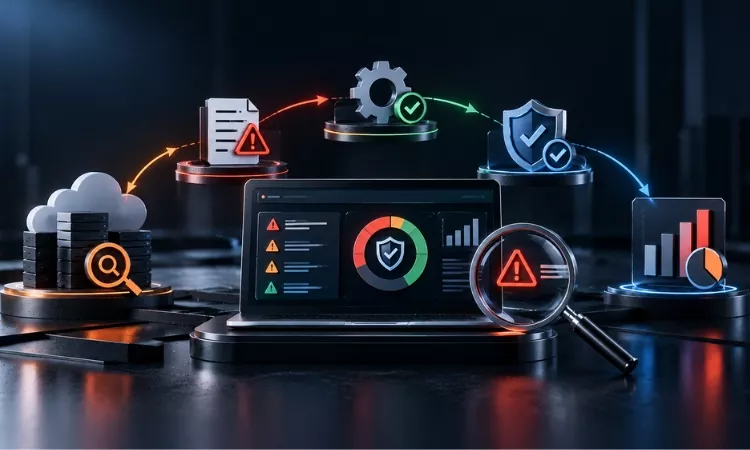
The lifecycle has six stages: discover, prioritize, assess, remediate, verify and report. Each stage produces a defined output that feeds the next, which makes the cycle measurable from end to end. The NIST SP 800-40 Rev. 4 guidance on enterprise patch management supports this sequencing.
- Discover: Maintain an asset inventory and run authenticated scans against it. Authenticated scans read installed packages and configuration settings that unauthenticated scans cannot see.
- Prioritize: Rank findings by exploitability, asset criticality and exposure.
- Assess: Confirm the finding is valid and determine the business impact on the affected system.
- Remediate: Patch, reconfigure, isolate, or formally accept the risk with a named owner and an expiry date.
- Verify: Rescan to confirm closure. A ticket marked “done” does not prove the weakness is gone.
- Report: Feed trend data into governance reporting for leadership review.
Image idea: A circular lifecycle diagram with each stage labeled and the output of each stage shown on the arrow.
When Should Organizations Run Vulnerability Scans?
Run scans continuously for internet-facing and cloud assets, and on a fixed cadence for internal infrastructure, with additional scans after every significant change. Cadence should follow asset risk, not a single calendar rule for the whole estate. PCI DSS v4.0 Requirement 11.3 sets a floor: internal and external scans at least quarterly, with external scans performed by an Approved Scanning Vendor and repeated after significant change. Organizations with payment environments and fast-moving cloud estates usually exceed that floor because quarterly cycles leave long gaps during which new exposures stay invisible.
How Should Teams Prioritize Vulnerabilities Beyond CVSS Scores?
Combine CVSS with exploitation intelligence and asset context. CVSS measures technical severity in isolation, so a critical base score on an isolated lab server can outrank a medium flaw on a payment gateway. The FIRST Exploit Prediction Scoring System (EPSS) estimates the probability that a vulnerability will be exploited in the next 30 days, and the KEV catalog confirms exploitation that has already occurred. A finding that is severe, exploited in the wild and reachable from the internet should move to the top of the queue within hours. The Threat Vulnerability Radar from Ampcus Cyber applies this layered view so that remediation capacity goes to the findings most likely to be used.
Image idea: A 2×2 matrix plotting CVSS severity against EPSS probability, with asset criticality shown as bubble size.
Which Metrics Show That Vulnerability Management Is Working?
Track exposure duration, remediation speed by severity, SLA compliance, scan coverage and recurrence. These five metrics answer the questions boards ask: how long are we exposed, are policies enforced, and are fixes lasting?
| Metric | What It Measures | Why It Matters |
| Mean time to remediate (MTTR) | Days from discovery to verified closure, by severity | Quantifies the exposure window for risk committees |
| SLA compliance rate | % of findings closed within policy timeframes | Tests whether the policy is enforced in practice |
| Asset scan coverage | % of inventoried assets scanned within the defined period | Unscanned assets carry risk that no dashboard shows |
| Recurrence rate | % of closed findings that reappear within 90 days | Reveals broken patch processes or configuration drift |
| Risk acceptance age | Count and age of open exceptions | Prevents accepted risks from expiring unnoticed |
What Tools Do Enterprises Use for Vulnerability Management?
Most programs combine five tool categories: asset discovery, vulnerability scanning, patch or configuration management, ticketing and workflow, and risk aggregation. Scanners such as Tenable, Qualys and Rapid7 are common choices in the scanning category, but feature lists matter less than integration. A scanner that cannot push findings into the ticketing system with asset owner data attached creates the same manual triage burden that the program was meant to remove. Selection should start with the lifecycle gaps you already have, then test how each candidate tool exchanges data with the systems around it.
Who Owns Vulnerability Management Inside an Organization?
Security operations or a dedicated vulnerability management function usually owns discovery and prioritization. Infrastructure, application and cloud teams’ own remediation, because they control the change windows and configurations. The CISO or governance lead owns the policy, the risk acceptance thresholds and the board reporting. This separation matters because it prevents the team that finds a weakness from also being the only team accountable for fixing it. Each remediation owner needs a defined SLA, a named escalation path and visibility into their own backlog.
Where Does Vulnerability Management Support Compliance Frameworks?
Vulnerability management produces much of the evidence that auditors request. Scan records, remediation tickets and exception approvals together demonstrate control operation under PCI DSS v4.0, ISO/IEC 27001:2022 and SOC 2 Trust Services Criteria. The ComplyX governance platform from Ampcus Cyber is designed to map these records to individual control requirements, so that evidence is collected as work happens rather than rebuilt before each audit. Mapping the lifecycle to controls once, and then keeping that mapping current, removes most of the friction in assessment preparation.
Image idea: A table linking each lifecycle stage to the evidence artifact produced for PCI DSS 6.3.3, ISO 8.8 and SOC 2 CC7.1.
Where Can an Enterprise Get Help Building a Vulnerability Management Program?
Ampcus Cyber aligns vulnerability management to its T-SAMA framework (Train, Scope, Assess, Mitigate, Audit). Scoping and assessment map to discovery and prioritization, mitigation maps to remediation, and audit maps to verification and reporting. Teams without a full-time security leader can use the vCISO as a Service engagement to set ownership, metrics and governance cadence. The T-SAMA methodology is a practical starting point for mapping gaps before tools are selected.
Ready to move from scan backlogs to measurable exposure reduction?
| Contact Ampcus Cyber to scope a vulnerability management program aligned to your compliance obligations. |
People Also Ask
Is vulnerability management the same as vulnerability assessment?
No. Vulnerability assessment is one stage that identifies and evaluates weaknesses at a point in time. Vulnerability management is the continuous program that includes assessment, plus prioritization, remediation, verification and reporting.
What is the difference between a vulnerability and a risk?
A vulnerability is a weakness in a system. Risk is the likelihood that the weakness is exploited multiplied by the business impact if it is. Prioritization exists to convert vulnerabilities into risk-ranked work.
How often should critical vulnerabilities be patched?
PCI DSS v4.0 requires critical and high-severity patches within one month of release. Many enterprises set shorter internal targets for internet-facing assets and for any vulnerability listed in the CISA KEV catalog.
Which metric should a CISO report to the board first?
Start with mean time to remediate for critical findings, trended quarterly against a defined threshold. It translates technical activity into exposure duration, which boards can act on.
Enjoyed reading this blog? Stay updated with our latest exclusive content by following us on Twitter and LinkedIn.