










TL;DR
- Vulnerability scanning identifies known weaknesses such as missing patches, outdated software, exposed services, and insecure configurations across an environment.
- Attack path validation tests whether weaknesses can be connected and exploited to move from an entry point toward a critical asset.
- Security teams need both approaches, scanning provides broad visibility, while validation adds contextual evidence about exploitability, attack chains, and potential business impact.
An Organization Have Thousands Of Vulnerabilities And Still Can Miss Critical Attack Path?
A security team at a large enterprise receives its monthly vulnerability report. The numbers look familiar: thousands of findings spread across servers, applications, cloud workloads, endpoints, and network devices. The team starts with the highest CVSS scores and notices, a lower-severity vulnerability on an internet-facing system connects with excessive permissions, a poorly segmented network, and a privileged service account.
Individually, these weaknesses may not trigger the highest remediation priority. Together, they can create a route toward a critical system. This is where the difference between finding vulnerabilities and validating attack paths becomes important.
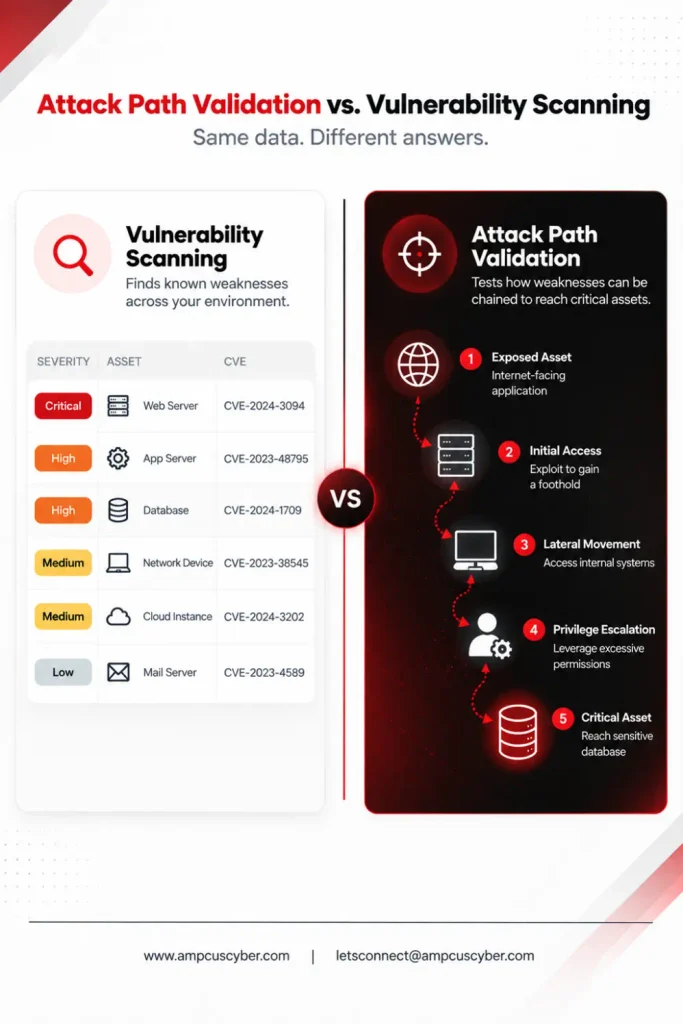
Vulnerability scanning answers, “What weaknesses exist?” Attack path validation asks, “Can an attacker use these weaknesses together to reach something that matters?”
NIST SP 800-115 recognizes vulnerability scanning as one component of a broader technical security testing and assessment process. Modern exposure management extends that thinking by examining relationships between vulnerabilities, identities, permissions, configurations, and critical assets.
What Is Vulnerability Scanning And What Does It Find?
Vulnerability scanning is an automated process that identifies known security weaknesses across systems, applications, devices, and infrastructure. A scanner typically looks for conditions such as: Known CVEs, missing security patches, unsupported software versions, open ports and exposed services, weak configurations, insecure protocols, certificate issues, vulnerable software components, and known application security weaknesses.
NIST describes vulnerability scanning as a technique that can identify hosts, open ports, and known vulnerabilities while also noting the possibility of false positives.
The strength of scanning is breadth and repeatability. A security team can scan thousands of assets far faster than a human tester could inspect each one. That makes vulnerability scanning essential for maintaining visibility and supporting vulnerability management.
However, a scan finding does not automatically prove that an attacker can use the weakness to achieve a meaningful objective. For example, a scanner might identify a critical vulnerability on a server. The server may still be isolated behind segmentation, require strong authentication, lack a viable route to sensitive systems, or have compensating controls that prevent exploitation.
What Is Attack Path Validation And How Does It Work?
Attack path validation tests whether a potential sequence of weaknesses can form a viable route to a target under realistic conditions.
An attack path generally connects:
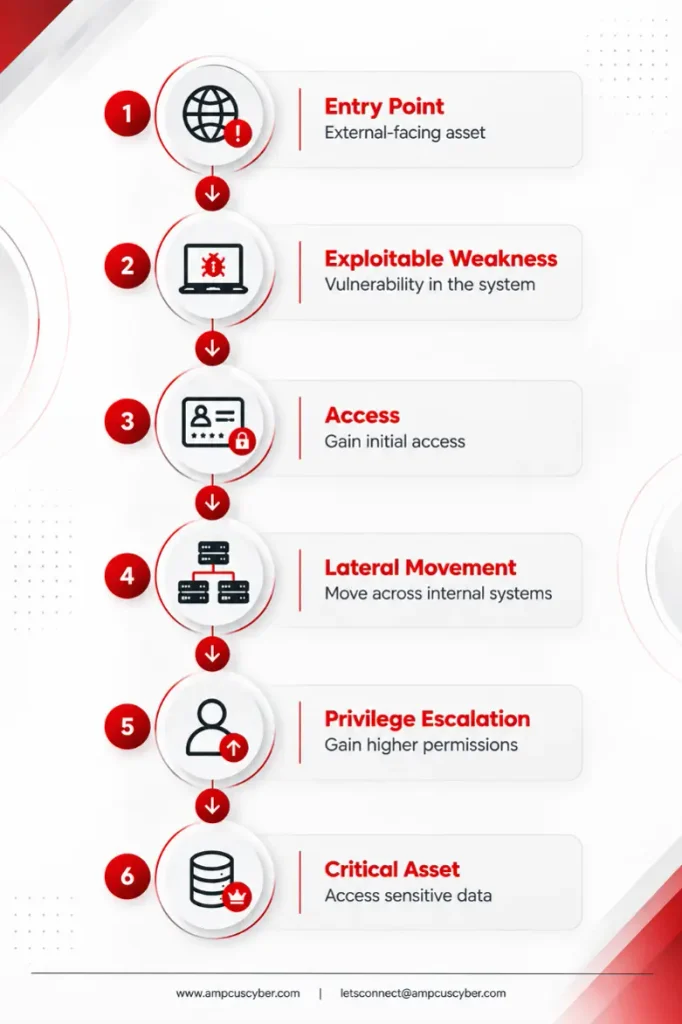
The important distinction is that validation goes beyond identifying individual weaknesses. It examines whether those weaknesses can interact.
For example:
- An internet-facing application contains a vulnerability.
- The compromised application has access to an internal service.
- That service exposes credentials or enables privilege escalation.
- The resulting identity has excessive permissions.
- Those permissions provide access to a sensitive database.
A vulnerability scanner may report several individual findings. Attack path analysis can reveal the relationship between them.
Attack path validation takes the additional step of testing whether the proposed route is realistically exploitable. Adversarial exposure validation approaches use controlled simulations to assess reachability, exploitability, attack chaining, and downstream impact without treating every theoretical path as an established compromise.
This distinction is particularly important for CISOs because the resulting evidence can support remediation decisions based on demonstrated exposure rather than vulnerability count alone.
What Is The Difference Between Attack Path Validation And Vulnerability Scanning?
The simplest difference is what each method is trying to prove.
| Security Activity | Vulnerability Scanning | Attack Path Validation |
| Primary purpose | Find known weaknesses | Validate exploitable attack routes |
| Approach | Broad and automated | Contextual and adversarial |
| Main focus | Individual vulnerabilities | Connected weaknesses and attack chains |
| Output | Vulnerability findings | Validated attack paths and evidence |
| Context | Asset and vulnerability context | Asset, identity, permission, network and control context |
| Exploitability | Usually inferred or separately assessed | Tested or simulated |
| Frequency | Continuous or scheduled | Continuous, recurring, or change-triggered |
| Best question answered | “What is vulnerable?” | “What can an attacker actually reach?” |
| Remediation value | Supports vulnerability prioritization | Supports attack-path disruption and risk reduction |
Attack path analysis can connect vulnerabilities with misconfigurations and permissions to show how an attacker could potentially reach critical assets. The two methods therefore should not be treated as competing technologies.
Why Does Vulnerability Scanning Miss Attack Chains?
Vulnerability scanning can miss attack chains because most scanner findings describe individual technical conditions rather than the complete sequence an attacker would need to compromise a target.
Consider three findings:
- A medium-severity vulnerability on an application server.
- Excessive permissions assigned to a service account.
- Weak network segmentation between application and database tiers.
Each finding may receive a different remediation priority. The combination could be far more important. Attackers do not need to exploit the highest-scoring vulnerability first. They can combine weaknesses that create the shortest or most practical route to their objective. Attack path analysis is designed to expose these relationships by modeling how vulnerabilities, identities, permissions, and other exposures connect.
This is also why a large vulnerability backlog does not necessarily tell leadership where the organization’s greatest exposure lies. The better question is: “Which vulnerabilities create or enable a path to a critical business asset?”
Does Attack Path Validation Replace Vulnerability Scanning?
No. Attack path validation complements vulnerability scanning because the two activities provide different evidence.
A mature vulnerability management program still needs broad discovery and recurring scanning. Organizations need to know where vulnerable software, outdated systems, insecure configurations, and exposed services exist. Attack path validation adds another layer. It can help determine:
- Which findings are reachable?
- Which weaknesses can be chained?
- Which identities create privilege escalation opportunities?
- Which controls stop the attack?
- Which paths reach critical assets?
- Which remediation action can break multiple attack paths?
CISA also recommends using vulnerability scanning as part of exposure reduction and vulnerability management while emphasizing the importance of identifying exposed assets and mitigating their associated risks.
When Should Security Teams Use Attack Path Validation?
Attack path validation becomes particularly useful when security leaders need evidence about actual exposure rather than theoretical exposure.
Common use cases include:
- Prioritizing Large Vulnerability Backlogs: When remediation teams face thousands of findings, attack path context can identify vulnerabilities that sit on routes toward critical assets.
- Validating Security Controls: Teams can test whether segmentation, authentication, endpoint controls, identity restrictions, and other defensive mechanisms prevent an attacker from progressing.
- Testing Cloud And Hybrid Environments: Cloud environments introduce relationships between identities, workloads, roles, permissions, APIs, and services. Attack path analysis can help expose combinations that are difficult to understand through isolated vulnerability findings.
- Supporting Continuous Security Validation: A new deployment, permission change, exposed asset, or configuration update can introduce a new attack route. Continuous validation helps security teams identify these changes before they become overlooked exposure.
How Should CISOs Combine Vulnerability Scanning And Attack Path Validation?
The practical approach is to use scanning for coverage and validation for context and assurance. A useful workflow looks like this:
- Discover assets and exposures: Maintain visibility across infrastructure, applications, cloud environments, identities, and external-facing assets.
- Scan continuously: Identify known vulnerabilities and configuration weaknesses.
- Map relationships: Connect vulnerabilities with identities, permissions, network paths, and critical assets.
- Prioritize attack paths: Identify routes that could create material business impact.
- Validate exploitability: Test whether selected paths are realistically reachable and exploitable within defined safety boundaries.
- Break the chain: Remediate the vulnerability, reduce excessive privilege, strengthen segmentation, or improve another control that interrupts the path.
- Retest: Confirm that the attack path has been disrupted.
This creates a stronger feedback loop than treating vulnerability management as a simple list of CVEs.
It also gives governance leaders a more useful conversation with technology teams: Which exposure can we eliminate, which control can break the path, and what evidence proves the risk has been reduced?
Ready to move beyond vulnerability counts and understand which weaknesses can form real attack paths?
| Talk to Ampcus Cyber about continuous attack path validation and advanced penetration testing to identify, validate, and disrupt exploitable routes before attackers can use them. |
People Also Ask:
Is Attack Path Validation The Same As Vulnerability Scanning?
No. Vulnerability scanning identifies known weaknesses, while attack path validation examines whether weaknesses can combine into a realistic and exploitable route toward a target.
Is Attack Path Analysis The Same As Attack Path Validation?
No. Attack path analysis can model and visualize potential attack routes. Attack path validation adds evidence by testing whether selected paths are realistically exploitable or can be disrupted by existing controls.
What is the CISA KEV catalog?
The CISA Known Exploited Vulnerabilities catalog is a public list of vulnerabilities with confirmed exploitation in the wild. Many security teams treat any KEV-listed flaw on an exposed asset as a top remediation priority.
Can Vulnerability Scanners Detect Attack Paths?
Some modern exposure management platforms can use vulnerability data with identity, asset, cloud, and network context to model potential attack paths. A scanner focused primarily on identifying individual vulnerabilities does not provide the same level of attack-chain validation.
Does Attack Path Validation Replace Penetration Testing?
No. Penetration testing remains valuable for deeper, scoped adversarial assessment. Attack path validation can complement penetration testing by providing repeatable and more frequent validation across changing environments. NIST SP 800-115 treats vulnerability scanning and penetration testing as distinct security testing techniques with different capabilities and purposes.
Why Is Attack Path Validation Important For Vulnerability Management?
It helps security teams understand which vulnerabilities participate in meaningful attack chains, allowing remediation decisions to consider exploitability, connectivity, identity relationships, and business-critical assets rather than severity alone.
Enjoyed reading this blog? Stay updated with our latest exclusive content by following us on Twitter and LinkedIn.