










TL;DR
- AI red teaming simulates real adversarial attacks on generative AI applications to expose risks like prompt injection, data leakage, and model manipulation before production deployment.
- It combines traditional application security testing with new AI-specific attack techniques, mapped to frameworks such as the NIST AI RMF, OWASP Top 10 for LLM Applications, and MITRE ATLAS.
- CISOs and governance leaders use AI red teaming results to meet regulatory expectations under the EU AI Act, ISO/IEC 42001, and internal AI governance policies, while building stakeholder trust in AI systems.
A mid-sized fintech company launched an AI chatbot for account queries, dispute filings, and transaction summaries. Weeks after launch, a security researcher found that a carefully worded message could override the chatbot’s system instructions. The model exposed internal prompt logic and, in one case, surfaced data it was never meant to reveal. No firewall or web application scanner caught it, because the flaw lived in the model’s behavior, not the network. The company had invested heavily in standard penetration testing, yet the AI layer stayed untested against adversarial manipulation.
This scenario repeats across banking, healthcare, insurance, and SaaS as generative AI moves from pilots into production. Traditional security testing was not built to catch prompt injection, model manipulation, or unsafe content generation. That gap is why AI red teaming has become a required discipline for any organization deploying generative AI at scale.
What Is AI Red Teaming And Why Does It Matter For Generative AI Security
AI red teaming is the structured practice of simulating adversarial attacks against AI models and applications to uncover security and safety weaknesses before real attackers exploit them. It matters because generative AI systems introduce risks that did not exist in traditional software, including prompt injection, model manipulation, and unsafe or biased outputs. A red team acts like an adversarial user, probing the AI system the way a malicious actor would, then documents every exploit path and unsafe behavior for remediation. Ampcus Cyber’s AI Red Teaming & Security Testing service applies this approach across AI models, GenAI applications, and agentic systems.
How Is AI Red Teaming Different From Traditional Penetration Testing
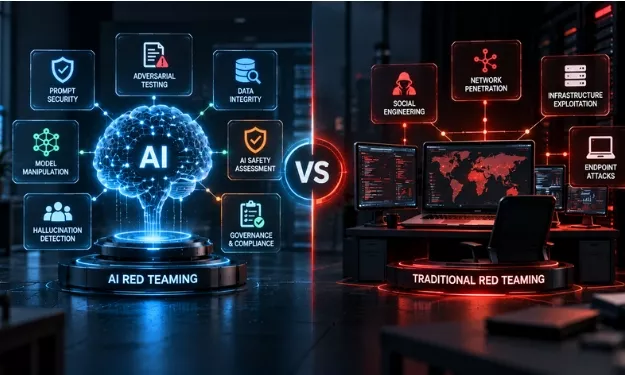
AI red teaming differs from traditional penetration testing because it targets model behavior, not just network and application infrastructure. Traditional penetration testing looks for misconfigurations, unpatched software, and access control flaws using deterministic methods, where the same input produces the same result every time. Generative AI systems behave probabilistically, meaning the same prompt can generate different outputs on separate attempts. This requires red teamers to run repeated adversarial probes, test multiple conversation paths, and evaluate both security risks and responsible AI risks such as harmful or biased content. Legacy application flaws, like an outdated software component processing AI-generated files, still apply and must be tested alongside these newer, model-specific risks.
What Security Risks Does AI Red Teaming Uncover In Generative AI Applications
AI red teaming uncovers risks across the model, the application layer, and the data pipeline feeding the AI system. The most common findings include:
- Prompt injection, where crafted inputs override system instructions and extract restricted data
- Data leakage through model outputs, including training data or sensitive context exposure
- Insecure output handling that allows generated content to trigger downstream code execution
- Model manipulation and jailbreaking that bypasses safety guardrails
- Agent and tool misuse in agentic AI systems, including memory poisoning and multi-agent trust boundary violations
- Legacy application vulnerabilities in AI pipelines, such as outdated dependencies or unsanitized inputs
Attackers also target training data directly. Ampcus Cyber’s knowledge hub article on what AI data poisoning is explains how corrupted training data and RAG pipelines can undermine model integrity long before an application goes live.
How Does The AI Red Teaming Process Work Step By Step
AI red teaming follows a structured process that starts with mapping the AI system and ends with validated remediation. The typical workflow includes:
- Mapping the AI ecosystem, including models, data flows, integrations, and third-party dependencies.
- Defining threat scenarios based on how the application is used and who can access it.
- Running adversarial probes against the model, application, and supporting infrastructure.
- Documenting exploit paths, unsafe outputs, and control weaknesses with evidence.
- Prioritizing findings by business risk and exploitability.
- Validating fixes through retesting before production deployment.
This process should run continuously, not as a one-time exercise, since model updates and new integrations reintroduce risk over time.
Which Frameworks And Standards Guide AI Red Teaming Programs
AI red teaming programs are guided by frameworks that give security teams a consistent language for AI risk. The NIST AI Risk Management Framework structures AI risk work around four functions: govern, map, measure, and manage. The OWASP Top 10 for LLM Applications catalogs the most critical risks in large language model applications, including prompt injection and system prompt leakage. MITRE ATLAS documents real-world adversarial tactics against AI systems, like how MITRE ATT&CK documents tactics against traditional IT environments.
Organizations pursuing certification under ISO/IEC 42001 can reference Ampcus Cyber’s whitepaper on implementing the ISO 42001 AI management system standard to connect red teaming results with formal governance documentation.
What Are Common AI Red Teaming Techniques For Testing GenAI Applications
Red teamers use a mix of manual and automated techniques to stress test generative AI applications. Common techniques include:
- Direct and indirect prompt injection through user inputs, uploaded files, or connected tools.
- Jailbreak testing using role-play scenarios and instruction override attempts.
- Data extraction probes to test whether the model reveals training data or system prompts.
- Multi-turn conversation attacks that build context across several exchanges to bypass guardrails.
- Automated adversarial testing using open-source frameworks that scale probing across thousands of prompts.
- Supply chain and dependency testing for AI pipelines processing external files or media.
Agentic AI systems require additional testing for tool misuse and multi-agent trust boundaries, since a compromised agent can pass bad instructions to other agents in the workflow.
How Often Should Enterprises Run AI Red Teaming Exercises
Enterprises should run AI red teaming exercises before launch, after major model or prompt changes, and on a recurring schedule throughout the AI system’s lifecycle. A single pre-launch assessment is not enough, because model providers update underlying systems, teams add new integrations, and attackers develop new techniques. Many organizations align AI red teaming cadence with their broader vulnerability management program, supplementing scheduled assessments with continuous monitoring for new attack patterns.
What Business Value Does AI Red Teaming Deliver For CISOs And Governance Leaders
AI red teaming gives CISOs and governance leaders evidence-based confidence to approve AI deployments instead of relying on vendor assurances alone. The direct business value includes:
- Reduced breach and reputational risk from AI systems generating harmful or exposed content.
- Audit-ready documentation to support regulatory requirements under the EU AI Act and ISO/IEC 42001.
- Faster, safer AI adoption because risks are identified and fixed before scaling.
- Stronger vendor and board confidence backed by structured testing evidence.
Governance leaders building broader AI oversight programs can pair red teaming with a virtual CISO service to translate technical findings into board-level risk reporting.
How Can Organizations Build A Sustainable AI Red Teaming Program
Organizations build a sustainable AI red teaming program by combining internal capability with specialist expertise and clear governance ownership. Practical steps include:
- Assigning clear ownership between security, data science, and compliance teams.
- Training internal staff through structured programs, such as the Certified AI Red Teaming & Penetration Testing Specialist workshop.
- Integrating red teaming checkpoints into the AI development lifecycle, not just pre-launch.
- Partnering with specialized providers for independent, adversarial testing and framework alignment.
Teams facing resource constraints often close the gap by reading about how AI security debt accumulates in Ampcus Cyber’s blog on AI security debt in enterprise AI adoption, which explains how skipped assessments compound risk over time.
Generative AI applications carry risks that traditional security testing was never designed to catch, and closing that gap requires structured, expert-led AI red teaming.
| Talk to Ampcus Cyber’s AI security specialists to assess your generative AI applications before attackers do it for you. |
People Also Ask:
Is AI red teaming the same as AI safety testing?
AI red teaming overlaps with AI safety testing but goes further by including adversarial security scenarios, such as data exfiltration and system compromise, alongside content safety checks.
Do small and mid-sized companies need AI red teaming?
Yes. Any organization deploying customer-facing or data-connected generative AI applications faces the same prompt injection and data exposure risks as large enterprises, regardless of company size.
Can AI red teaming be automated?
Automated tools can scale adversarial probing across many test cases, but human-led red teaming remains essential for context-aware attack scenarios and nuanced risk judgment.
Enjoyed reading this blog? Stay updated with our latest exclusive content by following us on Twitter and LinkedIn.