









A single malicious file hash buried in an endpoint log, one unfamiliar IP address reaching out from a finance server, or a registry key that changed overnight rarely sets off alarms on its own. Yet these small artifacts are often the first proof that an attacker has already gained a foothold inside the network. Security teams call these artifacts indicators of compromise and recognizing them quickly is what separates a contained incident from a breach that reaches the board, regulators, and headlines.
Indicators of compromise are far more than a technical footnote. They shape incident response timelines, feed regulatory disclosure decisions, and determine how fast an organization can move from suspicion to containment. This guide explains what an IOC is, the main types of security teams track, common real-world examples, and how to build a program that turns scattered artifacts into a durable detection capability.
What Is an Indicator of Compromise (IOC) in Cybersecurity?
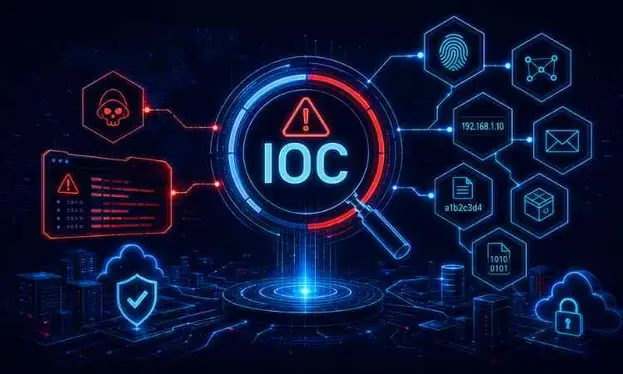
An indicator of compromise is forensic evidence that a system, network, or account has already been breached or manipulated by an attacker. IOCs are artifact based. They include specific, observable data points such as a malicious file hash, a command-and-control IP address, a suspicious domain name, or an unauthorized registry key.
Because an IOC confirms that something has already happened, it is inherently a reactive signal. Security teams use IOCs to validate a suspected compromise, scope the damage, and trace how the attacker gained access. Threat intelligence platforms, SIEM tools, and endpoint detection and response (EDR) systems continuously match live telemetry against known IOC databases, often correlated with broader cyber threat intelligence, to surface these artifacts before they cause deeper harm.
Why Do Indicators of Compromise Matter for Enterprise Security Teams?
Speed of detection is one of the clearest predictors of breach cost. According to IBM’s 2025 Cost of a Data Breach Report, organizations took an average of 241 days to identify and contain a breach in 2025, and breaches contained within 200 days cost substantially less than those that dragged on longer. Every additional day an attacker operates undetected widens the opportunity for lateral movement, data exfiltration, and reputational damage.
IOCs give security teams a documented, repeatable way to close that window. When IOCs are captured, catalogued, and fed into detection tooling, the same attack pattern can be identified and blocked far faster the next time it appears, whether at the same organization or across an industry sharing group. For governance leaders, this translates directly into a stronger audit trail. Documented IOC handling demonstrates that the organization can detect, evidence, and respond to incidents within a defined, measurable process backed by continuous security monitoring, a detail regulators and auditors increasingly expect to see.
What Are the Main Types of Indicators of Compromise?
IOCs generally fall into four categories, each surfaced by a different set of tools and telemetry sources.
| IOC Type | Description | Common Detection Source |
| File-Based | Malicious file hashes, unexpected file names, or unauthorized binaries dropped on a system | EDR, sandboxing tools |
| Network-Based | Malicious IP addresses, domains, or unusual traffic patterns communicating with external infrastructure | SIEM, IDS/IPS, DNS logs |
| Host-Based | Unauthorized registry changes, new scheduled tasks, modified system files, or unexpected privilege escalation | Endpoint logs, host-based monitoring |
| Behavioral | Deviations from a user’s or system’s normal activity, such as impossible-travel logins or abnormal data access volume | UEBA, identity and access logs |
Each type offers a different vantage point into the same underlying question has this environment already been compromised, and if so, where.
What Is the Difference Between an IOC and an IOA?
IOCs are frequently confused with indicators of attack, or IOAs, but the two answer different questions.
| Aspect | Indicator of Compromise (IOC) | Indicator of Attack (IOA) |
| Focus | Artifacts left behind after a compromise | Behaviors and techniques used during an active attack |
| Timing | Evaluated after the fact | Detected in real time, as the attack unfolds |
| Example | A known-malicious file hash or C2 domain | A document spawning a scripting process, then reaching out externally |
| Durability | Easy to evade by changing the artifact | Harder to evade because it targets attacker behavior, not tools |
Mature security operations use both. IOCs enable fast, scalable matching against known threats, while IOAs, often mapped to frameworks such as MITRE ATT&CK, help detect novel attacks that have never been catalogued. Organizations that rely on operational threat hunting typically combine both indicator types to close detection gaps.
What Are Common Examples of Indicators of Compromise?
Some of the most frequently observed IOCs in enterprise environments include:
- Unusual outbound network traffic to unfamiliar or geographically unexpected destinations
- Anomalous activity on privileged or administrator accounts, especially outside normal working hours
- Multiple failed login attempts followed by a successful one from an unrecognized location
- Sudden spikes in database read volume or unexplained large file transfers
- Mismatches between application traffic and the ports it typically uses
- Unexpected changes to system files, registry keys, or configuration settings
- DNS requests to newly registered or known malicious domains
- Signs of impossible travel, where the same account authenticates from two distant locations within an implausible timeframe
Individually, several of these signals could have an innocent explanation. Correlated together across systems, they typically point to a genuine compromise.
How Do Security Teams Detect and Use IOCs?
Effective IOC-driven response follows a consistent operational pattern. An alert fires when telemetry matches a known IOC or crosses a defined threshold. An analyst validates whether the match represents a genuine threat, then assesses scope: which systems are affected, what data may have been touched, and how the attacker gained entry. Containment follows, isolating affected endpoints or blocking malicious connections, and remediation removes the artifact and closes the access vector.
The final, and often the most valuable, step is feeding newly discovered IOCs back into detection rules and threat intelligence platforms, so the same pattern is caught automatically next time. Standards such as STIX and TAXII allow organizations to structure and share IOC data across SIEM and SOAR platforms, turning one incident’s findings into protection for the entire environment.
What Are the Limitations of Relying on IOCs Alone?
IOCs are indispensable, but they are not sufficient on their own. Because they are artifact based, attackers can evade them simply by recompiling malware to change a hash or rotating command-and-control infrastructure. The volume of IOCs generated daily can also overwhelm analysts, and static IOC lists carry a limited shelf life as adversaries adapt.
This is why leading security programs pair IOC monitoring with behavior-based threat hunting, which focuses on indicators of behavior rather than static artifacts alone and helps detect attackers whose tools have never been seen before.
How Can Organizations Build a Mature IOC Program?
A durable IOC program combines three elements: continuous ingestion of curated threat intelligence feeds, automated correlation across SIEM and EDR telemetry, and a documented workflow that connects detection to containment, remediation, and governance reporting. Enterprises in regulated sectors should also ensure IOC handling and escalation timelines are defensible enough to withstand audit or regulatory scrutiny, not just fast enough to stop an attacker.
For CISOs building or maturing this capability, partnering with a managed detection and response provider can accelerate both coverage and consistency, particularly across hybrid and multi-cloud environments where in-house visibility often has gaps.
Turning Indicators of Compromise Into Faster, Defensible Response
Indicators of compromise remain one of the most practical tools a security team has for proving, scoping, and stopping a breach in progress. Their real value, however, is only realized when they are captured consistently, correlated automatically, and paired with the behavioral detection capabilities needed to catch what static artifacts alone will miss.
| Ampcus Cyber helps enterprises build IOC-driven detection programs backed by 24×7 managed threat detection and response. Talk to our team about strengthening your threat detection posture. |
Enjoyed reading this blog? Stay updated with our latest exclusive content by following us on Twitter and LinkedIn.