









A mid-size hospital network had an incident response plan that looked complete on paper, with escalation paths, contact lists, and a communications template ready to go. Then a ransomware attack hit the scheduling system on a Friday evening. The on-call engineer could not reach the person listed as decision authority for taking systems offline, because that person had left the company four months earlier and the plan was never updated. Legal, communications, and IT leadership each believed someone else owned the decision to notify patients. The plan existed. It had simply never been tested against a real clock.
That gap between a documented plan and a rehearsed one is exactly what cyber crisis simulations are built to close. The question most security and governance leaders face next is which type of exercise closes that gap for their organization.
What Is a Cyber Crisis Simulation?
A cyber crisis simulation is a structured exercise that puts an organization’s incident response plan under realistic pressure to see whether people, processes, and communication hold up during a cyberattack. Unlike a technical penetration test, the simulation is not primarily about finding a vulnerability in code. It is about finding gaps in decision-making, escalation, and coordination before a real incident exposes them.
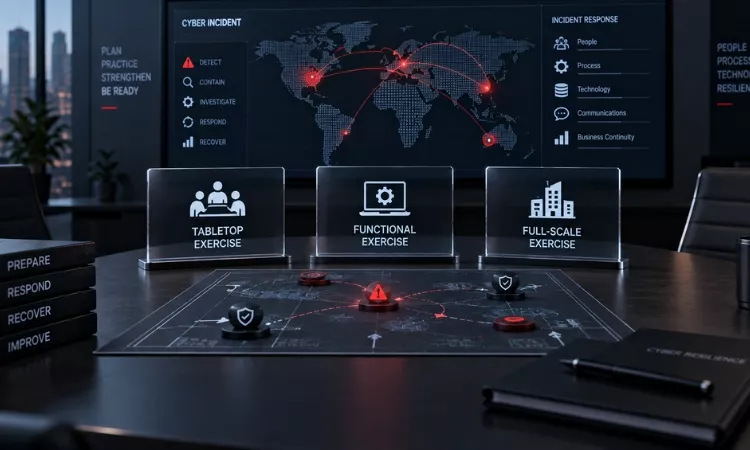
These exercises range from a conversation around a table to a live, time-pressured drill that touches real systems. NIST SP 800-84 groups this range into three broad categories, discussion-based, functional, and full-scale, each suited to a different stage of organizational readiness.
What Is a Tabletop Exercise?
A tabletop exercise is a discussion-based simulation where stakeholders talk through their roles and decisions in response to a hypothetical incident, without touching any live systems. A facilitator introduces the scenario in stages, such as a ransomware note appearing on a file server, and participants explain what they would do, who they would notify, and within what deadline.
Nothing is executed for real, which makes tabletop exercises the lowest-cost, lowest-risk starting point. They work especially well for senior leadership, legal, and communications teams, since the format tests judgment and coordination rather than technical execution. Most first-time exercise programs start here.
What Is a Functional Exercise?
A functional exercise moves beyond discussion and has teams actively perform their real roles in response to a simulated incident, using actual tools and communication channels. Instead of describing what they would do, participants isolate a test endpoint, page the on-call engineer through the real system, or draft an actual customer notification.
Functional exercises validate specific capabilities rather than the entire response plan. An organization might run one focused purely on detection and containment, or another on the crisis communications workflow. This narrower scope keeps them manageable while testing execution, not just knowledge, which is the gap a tabletop cannot close.
What Is a Full-Scale Exercise?
A full-scale exercise is a realistic, time-pressured simulation that mobilizes the complete incident response capability, often including simulated media inquiries and regulator contact across every function with a role in the response. It is the closest an organization can get to a live incident without an actual breach.
Full-scale exercises test the entire organization at once: technical containment, executive decision-making, legal exposure, and public communication, all under a compressed timeline. Given the coordination and cost involved, these typically run once a year or after a major change, once tabletop and functional exercises have already validated the underlying plan.
How Do Tabletop, Functional, and Full-Scale Exercises Compare?
The right exercise depends on what an organization needs to validate and how mature its response plan already is.
| Factor | Tabletop | Functional | Full-Scale |
| Format | Discussion-based | Partial real-world execution | Full real-world execution |
| Systems touched | None | Test or limited production | Live or near-live environment |
| Primary audience | Leadership, legal, comms | Technical and operational teams | Entire organization |
| Cost and effort | Low | Moderate | High |
| Best used for | First exercise, plan review | Testing one capability at a time | Validating the complete response |
A useful rule of thumb: use a tabletop when a plan has never been tested, a functional exercise when a plan has been tested on paper but not in practice, and a full-scale exercise only once the organization has a mature program behind it.
How Often Should Organizations Run Cyber Crisis Simulations?
Most frameworks recommend running a cyber crisis simulation at least annually, with additional exercises triggered by major change. Regulated sectors such as financial services and healthcare often face stricter cadence requirements, sometimes quarterly or biannual. Beyond the calendar, three triggers should always prompt a fresh exercise: a significant change to infrastructure or the plan, a leadership transition affecting decision authority, and any real incident that exposed a gap.
Cadence matters less than consistency. An organization that runs one well-executed tabletop a year and acts on every finding will be better prepared than one that runs an elaborate full-scale exercise once and never revisits the gaps it revealed.
What Makes a Cyber Crisis Simulation Effective?
An effective cyber crisis simulation starts with two to four specific objectives instead of a vague goal like “test our incident response.” An objective such as confirming the on-call engineer can isolate a compromised endpoint within 30 minutes gives the exercise something concrete to measure. Objectives should drive the scenario design, not the reverse.
Participation matters as much as format. Effective simulations involve senior leadership, IT and security teams, legal counsel, communications, and HR, since real incidents rarely stay inside one department. During the exercise, track indicators such as time to convene the response team, time to the first containment decision, and adherence to notification deadlines.
The value of the exercise lives in what happens afterward. A hot wash immediately following the session, followed by a documented after-action report with findings, plan gaps, and owners assigned to each fix, is what turns the simulation from an anecdote into an improvement in incident response planning. Without that report, the exercise stays a one-day event instead of a lasting capability.
A documented incident response plan is only an assumption until tested under pressure. Tabletop, functional, and full-scale exercises validate that assumption at different levels of realism, and organizations that recover fastest from a real cyberattack are almost always the ones that rehearsed it first, whether through a ransomware event scenario or a broader business continuity disruption.
Ready to find out whether your incident response plan holds up under real pressure?
| Talk to Ampcus Cyber’s Cyber Crisis Simulation team about designing an exercise built around your environment. |
People Also Ask
Is a tabletop exercise the same as a cyber crisis simulation?
A tabletop is one type of cyber crisis simulation. The category also includes functional and full-scale exercises, which involve progressively more real-world execution.
How long does a cyber crisis simulation take?
A tabletop usually runs two to four hours. Functional exercises span a half day to a full day, and full-scale exercises often run a full day or longer.
What framework should guide a cyber crisis simulation program?
NIST SP 800-84 is the most referenced federal guide for planning and evaluating these exercises, and CISA publishes ready-to-use tabletop packages built on it.
Does a cyber crisis simulation replace a red team exercise?
No. A red team exercise tests whether an attacker can breach your defenses. A crisis simulation tests whether you can respond once a breach has happened. Mature programs run both.
Enjoyed reading this blog? Stay updated with our latest exclusive content by following us on Twitter and LinkedIn.