




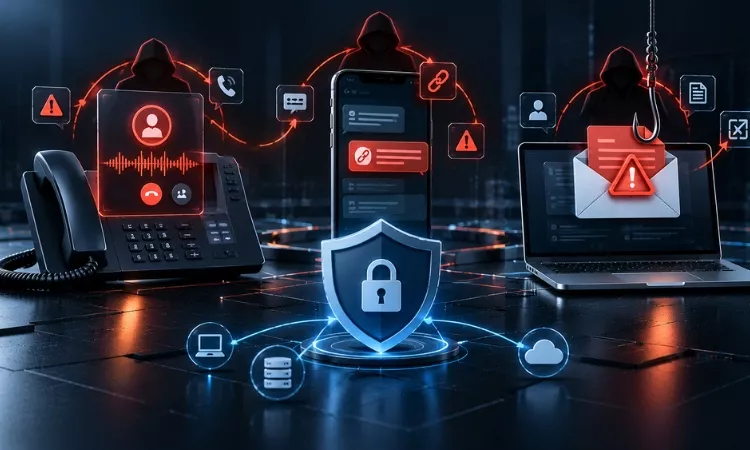
Social engineering remains one of the most reliable ways into enterprise environments because it targets people rather than unpatched software. Attackers no longer depend on a single channel. Email, SMS, and phone calls each reach employees through habits they trust, and each channel requires a different defense.
The practical question is whether controls, training, and verification procedures cover all three channels without leaving gaps between them. This guide explains how each attack works, where the three differ, and which controls reduce exposure.
What Is the Difference Between Phishing, Smishing, and Vishing?
Phishing, smishing, and vishing are the same social engineering method delivered through different channels. Phishing uses email and web links, smishing uses SMS and messaging apps, and vishing uses voice calls. Each attack impersonates a trusted party to get the target to disclose credentials, approve a payment, install malware, or share sensitive data. The channel changes the detection surface, which is why a single control rarely covers all three.
| Attack | Primary Channel | Typical Lure | Primary Objective |
| Phishing | Email, web links. | Fake invoices, shared document alerts, password reset notices. | Credential theft, malware delivery, business email compromise. |
| Smishing | SMS, messaging apps. | Parcel delivery exceptions, bank fraud alerts, toll payments. | Credential capture, card data, malicious app installation. |
| Vishing | Phone, VoIP calls. | Fake IT support, bank fraud teams, executive impersonation. | Password resets, MFA approvals, fraudulent wire transfers. |
How Does a Phishing Attack Work?
A phishing attack sends a message that imitates a trusted sender and pushes the recipient toward a malicious link, attachment, or request. The message creates urgency, the recipient acts, and a credential form or payload follows. Modern phishing kits host convincing login pages behind valid TLS certificates. Adversary-in-the-middle proxies go further by relaying the victim’s password and one-time code to the real service in real time, then capturing the session cookie. Organizations that rely only on one-time codes often discover this gap during incident response rather than during planning. Public guidance from CISA and the FBI Internet Crime Complaint Center consistently lists phishing among the most reported initial access methods.
How Does a Smishing Attack Work?
Smishing works because text messages feel personal and get read quickly. A typical lure reports a failed delivery or a suspended account and asks the recipient to tap a shortened link. Mobile browsers display less of the address bar than desktop browsers, so lookalike domains are harder to identify at a glance. Smishing also reaches personal phones, which often sit outside corporate email filtering. When staff approve work requests or use phones for authenticator apps, that personal device becomes part of the attack path, even though corporate controls cannot inspect it fully.
How Does a Vishing Attack Work?
Vishing depends on conversation and urgency. An attacker calls while posing as IT support, a bank fraud team, or a senior executive, then creates pressure to act immediately. Caller ID spoofing is inexpensive, and AI voice cloning has reduced the effort needed to imitate a known voice from short audio samples. The most damaging variant targets help desks. The attacker requests a password reset or MFA re-enrollment, and the agent who wants to be helpful becomes the access path. Public reporting on the 2023 MGM Resorts incident linked the initial access to a social engineering call to the service desk, which illustrates how a single conversation can bypass technical layers entirely.
Why Are Voice and Text Attacks Harder to Detect?
Email gateways inspect headers, attachments, and URLs with automated tooling. Voice calls and text messages mostly sit outside that inspection. There is no file to scan, so detection depends on user judgment, call logs, and behavioral signals such as an unexpected MFA prompt at an odd hour. Attackers move to the channel with the weakest telemetry. A defense that monitors only email leaves two of the three attack paths largely unobserved, and that imbalance is a common finding in social engineering reviews.
Which Controls Stop Phishing, Smishing, and Vishing?
The most effective program combines identity controls, email authentication, mobile protection, and verification procedures. Five controls deliver the largest reduction in exposure:
- Deploy phishing-resistant MFA: FIDO2 security keys and passkeys bind authentication to the legitimate domain, so a proxy cannot relay a valid response. PCI DSS v4.0 Requirement 8.4.2 requires MFA for all access into the cardholder data environment, and phishing-resistant methods give that requirement real assurance.
- Enforce email authentication: SPF, DKIM, and a DMARC policy set to reject block spoofed sender domains. The DMARC standard is defined in RFC 7489. PCI DSS v4.0 Requirement 5.4.1 specifically requires anti-phishing mechanisms to protect personnel from phishing attacks.
- Enable number matching for push approvals: Push fatigue attacks rely on reflexive approvals. Number matching requires the user to enter a code displayed on the login screen, which breaks that reflex.
- Filter SMS on managed devices: Mobile threat defense products and carrier-level spam filtering reduce smishing exposure. In the United States, employees can forward suspicious texts to 7726 (SPAM) to report them.
- Require out-of-band verification for payment changes: Any change to bank details or payment instructions must be confirmed through a number already on file, never through a number supplied in the request.
How Should Organizations Protect the Help Desk From Vishing?
Help desks need identity proofing before any credential change. A workable standard includes a verified callback to the employee’s registered device, manager approval for privileged account resets, and a logged reason for every MFA re-enrollment. Scripts should never accept a caller’s claim of identity as sufficient. Threat groups known for help desk social engineering exploit the trust the function exists to provide, so the help desk should be treated as a security control point. That change affects how it is measured. Track the percentage of resets completed under full verification, not only the average handling time.
How Should Organizations Train Staff to Recognize These Attacks?
Training works when it reflects how attacks arrive. An annual slide deck does little against a convincing vishing call. Run simulations across all three channels, including simulated smishing and controlled vishing exercises, and measure reporting rates alongside click rates. Reporting shows whether staff escalate suspicious contact, which is the behavior that shortens response time. PCI DSS v4.0 Requirement 12.6.3.1 requires security awareness training that covers phishing and related attacks, and ISO/IEC 27001:2022 Annex A control 6.3 addresses awareness, education, and training for personnel.
Which Compliance Frameworks Require Phishing Controls?
Phishing controls map to several frameworks at once. PCI DSS v4.0 Requirements 5.4.1, 8.4.2, and 12.6.3.1 cover anti-phishing mechanisms, MFA, and awareness training. ISO/IEC 27001:2022 covers awareness and access management in its Annex A controls. NIST SP 800-63B defines authenticator assurance levels and the concept of phishing resistance that many federal and regulated buyers reference. Auditors look for operating evidence, not policy language alone. DMARC aggregate reports, MFA configuration exports, simulation results, and help desk verification logs together demonstrate that these controls run every day.
How Can Ampcus Cyber Help Reduce Social Engineering Exposure?
Ampcus Cyber approaches this risk through its T-SAMA framework (Train, Scope, Assess, Mitigate, Audit). Train covers role-based awareness and multi-channel simulations. Scope identifies which users, devices, and help desk functions sit on each channel. Assess tests call handling and reset procedures under realistic pretexts. Mitigate deploys phishing-resistant authentication and email controls. Audit verifies that the resulting evidence is produced and retained. The Threat Vulnerability Radar tracks campaigns that target the organization’s domains and brands, while vCISO as a Service engagements assign ownership and build the board reporting cycle.
Ready to close the gaps between your email, mobile, and voice defenses?
| Contact Ampcus Cyber to scope a social engineering assessment aligned to your compliance obligations. |
People Also Ask
What is the main difference between phishing and vishing?
Phishing uses email or web links to deceive the target, while vishing uses phone calls. Both rely on impersonation and urgency, but vishing adds real-time conversation, which allows the attacker to adapt to the target’s responses.
Can MFA stop smishing and vishing?
Standard MFA can be defeated by real-time proxies and push fatigue. Phishing-resistant MFA, such as FIDO2 keys and passkeys, combined with number matching, provides much stronger protection against all three attack types.
How can a user tell if a text message is smishing?
Look for urgency, unfamiliar sender formats, and links that do not match the organization’s known domain. Never sign in through a link in an unexpected message. Navigate to the service directly or use the official app.
Should organizations train staff on vishing if they already run phishing simulations?
Yes. Email simulations do not test voice interactions. Vishing exercises and help desk pretext tests measure a different set of behaviors and reveal gaps that email-only programs miss.
Enjoyed reading this blog? Stay updated with our latest exclusive content by following us on Twitter and LinkedIn.