









Learn what NIST security standards are, how NIST CSF, SP 800-53, RMF, and AI RMF improve cybersecurity, reduce risk, and strengthen compliance.
Every week seems to bring news of another ransomware attack, cloud misconfiguration, software supply chain compromise, or third-party data breach. While organizations continue investing in new security tools, many still struggle with a more fundamental question: How do you know whether your cybersecurity program is effective?
That question is precisely what the National Institute of Standards and Technology (NIST) set out to answer.
What Are NIST Security Standards?
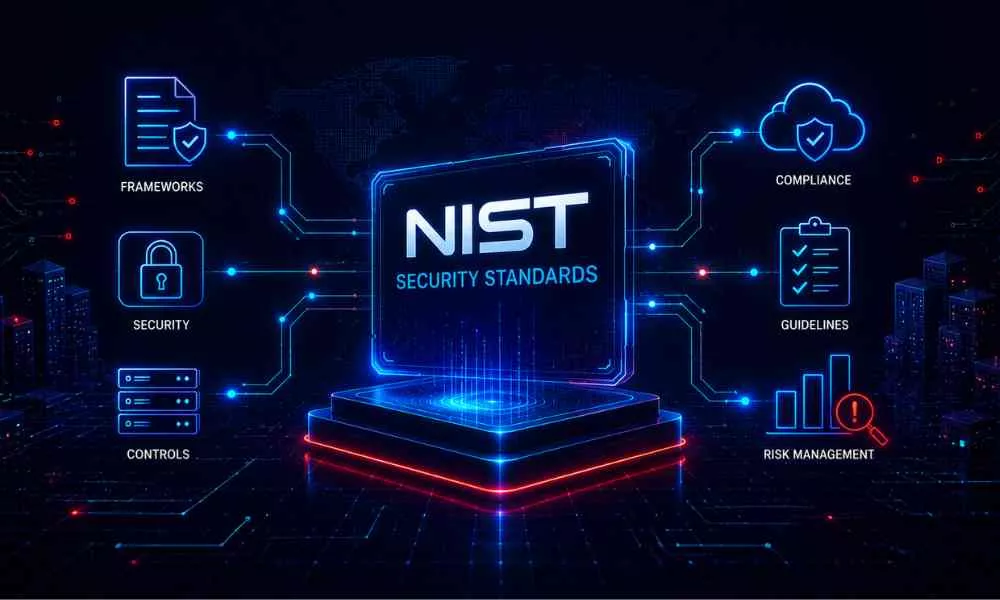
NIST security standards are a collection of cybersecurity frameworks, guidelines, and technical publications that help organizations identify, manage, and reduce cybersecurity risk through a structured, risk-based approach. Rather than prescribing a rigid checklist of controls or recommending specific technologies, NIST provides practical guidance that organizations can adapt to their unique business objectives, threat landscape, and security maturity.
Originally developed for U.S. federal agencies, NIST guidance has evolved into one of the world’s most widely adopted cybersecurity references. Today, organizations across healthcare, finance, manufacturing, technology, retail, and critical infrastructure rely on NIST to strengthen cyber resilience, improve governance, support regulatory readiness, and build long-term security programs that evolve alongside emerging threats.
Whether you’re developing a cybersecurity strategy for the first time or refining an existing program, understanding how NIST works provides a strong foundation for making informed security decisions.
NIST Security Standards: A Glance
| Aspect | Overview |
| Developed by | National Institute of Standards and Technology (NIST) |
| Primary objective | Improve cybersecurity risk management |
| Applicable to | Organizations of every size and industry |
| Most recognized framework | NIST Cybersecurity Framework (CSF) 2.0 |
| Key publications | CSF 2.0, SP 800-53, SP 800-171, RMF, AI RMF |
| Mandatory? | Generally voluntary unless required by contracts, federal programs, or industry regulations |
What Is NIST?
NIST security standards are a collection of cybersecurity frameworks, guidelines, and technical publications developed by the National Institute of Standards and Technology (NIST). They help organizations identify, assess, manage, and reduce cyber risk using a flexible, risk-based approach.
Popular frameworks include NIST Cybersecurity Framework (CSF) 2.0, NIST SP 800-53, NIST SP 800-171, the Risk Management Framework (RMF), and the AI Risk Management Framework (AI RMF).
Organizations across industries use them to strengthen security, improve governance, support compliance, and enhance cyber resilience.
Unlike commercial security frameworks that may focus on specific technologies or products, NIST develops practical guidance through collaboration with government agencies, industry leaders, researchers, and academia. The result is a collection of frameworks that help organizations make informed security decisions based on business risk rather than technology trends.
One of the reasons NIST has become the global benchmark for cybersecurity is that it recognizes a simple reality: every organization faces different risks. A hospital protecting patient records, a bank processing financial transactions, and a manufacturer operating industrial control systems all have different priorities. Instead of prescribing identical security measures for everyone, NIST encourages organizations to assess their own environment and implement controls that align with their specific risks.
Why Organizations Choose NIST?
Many cybersecurity frameworks focus primarily on compliance, helping organizations demonstrate that certain requirements have been met. NIST takes a different approach by treating cybersecurity as an ongoing risk management process rather than a periodic audit exercise.
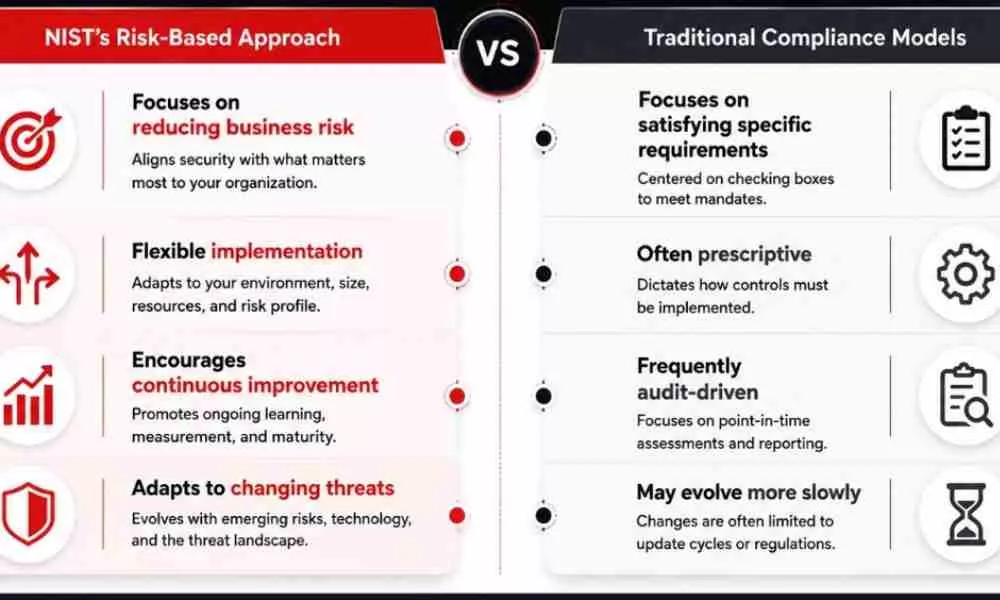
This philosophy makes NIST particularly valuable for organizations operating in rapidly changing environments. As cloud adoption grows, artificial intelligence becomes more widespread, and supply chains become increasingly interconnected, security programs need to evolve continuously rather than relying on static controls.
How Organizations Use NIST?
A common misconception is that organizations adopt a single NIST publication and become “NIST compliant.” In reality, businesses often combine several NIST resources to build a comprehensive cybersecurity program.
Imagine a retail company preparing to launch a new e-commerce platform.
Before purchasing additional security tools, its security team uses the NIST Cybersecurity Framework (CSF) to assess its overall cybersecurity maturity and identify areas that require improvement. The assessment reveals weaknesses in identity management, third-party vendor oversight, and incident response planning.
Next, the team references NIST SP 800-53 to determine which security controls can address those gaps. Throughout implementation, the Risk Management Framework (RMF) helps evaluate whether those controls remain effective as new systems are introduced, while continuous monitoring provides ongoing visibility into emerging risks.
Rather than serving as a one-time compliance exercise, NIST becomes a framework for making better cybersecurity decisions over time.
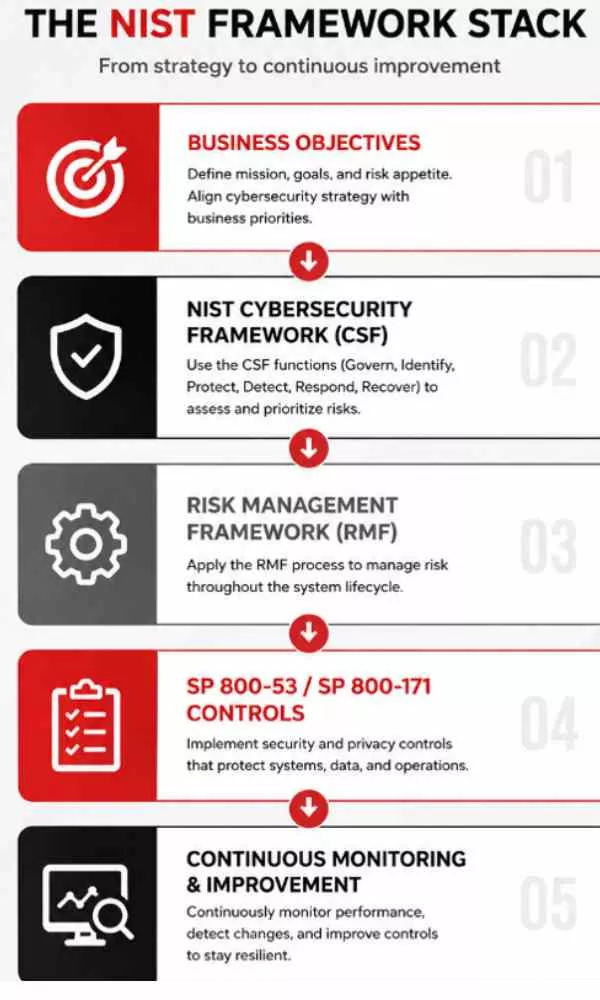
How NIST Frameworks Work Together?
Think of the NIST ecosystem as a layered security strategy rather than a collection of independent documents.
What are the Core NIST Frameworks?
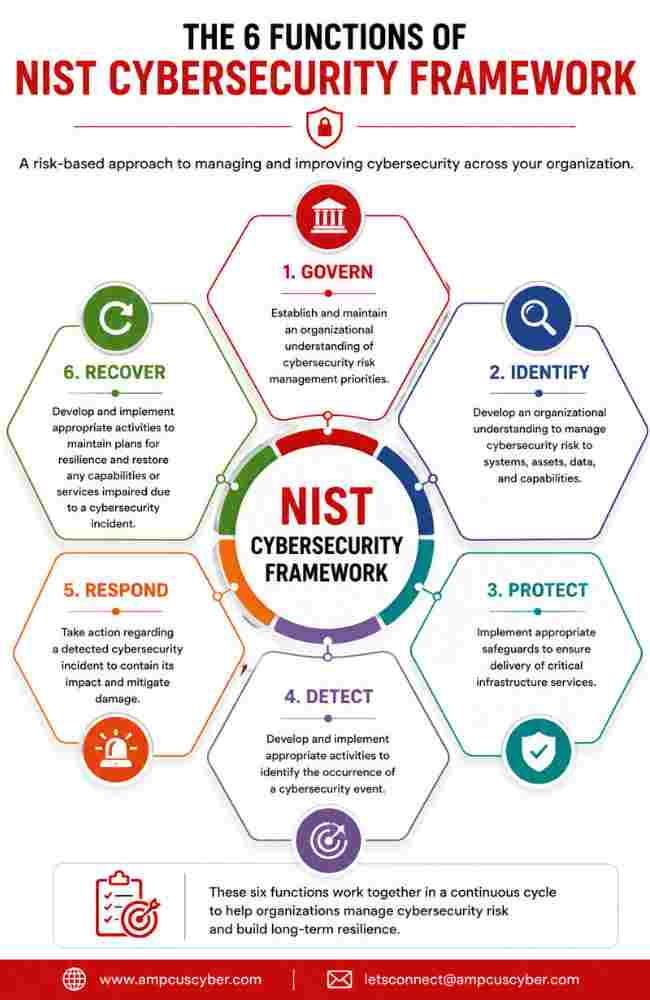
For many organizations, the Cybersecurity Framework serves as the starting point for building a cybersecurity strategy.
Rather than focusing on individual technologies, CSF organizes cybersecurity into six core functions:
Why it matters?
CSF creates a common language that executives, security teams, auditors, and business leaders can all understand, making it easier to align cybersecurity initiatives with organizational goals.
Organizations often begin their NIST journey with CSF because it provides strategic direction before technical controls are selected.
What is NIST SP 800-53? How it Turns Strategy into Security Controls
Once an organization understands its risks, the next challenge is determining which controls should be implemented.
NIST SP 800-53 answers that question by providing one of the industry’s most comprehensive catalogs of security and privacy controls. These controls span areas such as access management, incident response, configuration management, supply chain security, audit logging, and system integrity.
Rather than telling organizations which products to purchase, SP 800-53 defines the security outcomes they should achieve, allowing flexibility in how those outcomes are implemented.
One of the most common implementation mistakes is attempting to deploy every available control. Successful organizations prioritize controls based on business risk and implementation maturity.
What is NIST SP 800-171? How it Protects Sensitive Government Information?
Organizations that handle Controlled Unclassified Information (CUI) face additional security expectations.
SP 800-171 provides guidance specifically for non-federal organizations that process or store sensitive government information. It is widely adopted by defense contractors, aerospace suppliers, and organizations supporting federal programs.
For many businesses operating within government supply chains, implementing SP 800-171 is essential for maintaining contracts and demonstrating security readiness.
What is Risk Management Framework (RMF)?
Security isn’t something that happens once a year during an audit. The Risk Management Framework embeds cybersecurity into the entire system lifecycle by guiding organizations through preparation, control selection, implementation, assessment, authorization, and continuous monitoring.
Instead of viewing cybersecurity as a destination, RMF encourages organizations to treat it as an ongoing operational process that adapts as technology and threats evolve.
What About the Emerging Guidance for AI and Privacy?
As organizations embrace artificial intelligence and increasingly data-driven operations, NIST continues to expand its guidance beyond traditional cybersecurity.
The AI Risk Management Framework (AI RMF) helps organizations build trustworthy AI systems by addressing governance, transparency, accountability, and risk management throughout the AI lifecycle.
Similarly, the NIST Privacy Framework provides practical guidance for managing privacy risks alongside cybersecurity objectives, helping organizations protect sensitive information while supporting evolving regulatory expectations.
What are the Common Misconceptions About NIST?
Despite its widespread adoption, several misconceptions continue to discourage organizations from leveraging NIST guidance effectively.
“NIST is only for U.S. government agencies.”
While NIST originated within the federal ecosystem, organizations worldwide use its frameworks because they provide practical, vendor-neutral guidance that can be adapted across industries.
“Implementing NIST requires buying new security tools.”
Technology plays an important role, but NIST places equal emphasis on governance, policies, processes, employee awareness, and continuous improvement.
“NIST is a certification.”
Unlike some standards, NIST itself is not a certification for most private organizations. Instead, it provides the guidance that organizations use to strengthen their cybersecurity programs and support broader compliance efforts.
To Conclude
Strong cybersecurity isn’t built by implementing every available security control or purchasing the latest security technology. It begins with understanding which risks matter most and developing a structured approach to managing them consistently.
That philosophy sits at the heart of NIST security standards. Rather than prescribing identical solutions for every organization, NIST provides a flexible framework that helps businesses make informed security decisions based on their unique objectives, operational environment, and evolving threat landscape.
Whether you’re strengthening governance, modernizing your security architecture, preparing for regulatory requirements, or building a long-term cybersecurity strategy, NIST offers a proven foundation for improving cyber resilience.
At Ampcus Cyber, we help organizations translate NIST guidance into practical, measurable security outcomes through cybersecurity assessments, governance consulting, continuous compliance, and risk management services. Our experts work alongside your teams to develop tailored, risk-based strategies that strengthen security while supporting business growth.
Ready to align your cybersecurity program with NIST best practices?
| Connect with NIST CSF Expert to build a roadmap that supports resilience today and prepares your organization for tomorrow’s challenges. |
Enjoyed reading this blog? Stay updated with our latest exclusive content by following us on Twitter and LinkedIn.