









As cloud environments expand, visibility is only the starting point. Security teams also need to understand what a CASB monitor, which policies it can enforce, and how it fits into the wider cloud security architecture. The next sections break down the core capabilities of CASB, from its four security pillars and deployment models to its role in SASE and Zero Trust.
What is Cloud Access Security Briker?
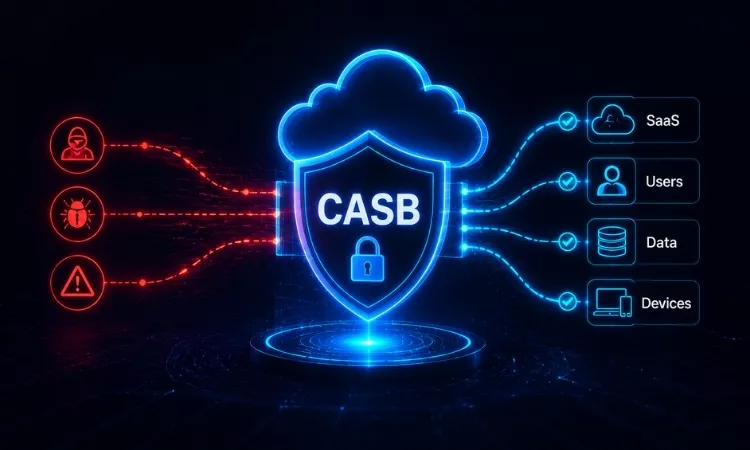
A Cloud Access Security Broker (CASB) is a security policy enforcement point that sits between an organization’s users and the cloud services they access. It gives security and compliance teams visibility into cloud activity, enforces consistent policy across every SaaS, PaaS, and IaaS platform in use, and stops threats that traditional network tools cannot see.
Enterprise data no longer lives inside a single perimeter. Employees sign in to dozens of SaaS applications, developers provision cloud infrastructure independently, and business units test new AI-powered tools without waiting for IT approval. For CISOs managing hybrid and multi-cloud environments, that sprawl turns a basic question, who is accessing what data and under what conditions, into one of the hardest problems in the security program. A CASB was built to answer it.
What Does a CASB Do?
A CASB acts as a checkpoint between users and the cloud services they access, whether that is Microsoft 365, Salesforce, AWS, or a generative AI tool an employee downloaded independently. It inspects traffic moving to and from these services, applies the organization’s security policies, and reports on activity that would otherwise stay invisible to the security team. This function sits at the center of a broader cloud security, extending policy enforcement into services that traditional network security tools cannot reach. A CASB does not replace a firewall, an endpoint agent, or an identity provider. It works alongside these controls, closing the visibility gap that appears the moment data moves from a managed network to a cloud application controlled by a third party.
What Are the Four Pillars of CASB Security?
According to Gartner, the analyst firm that first defined the category, a CASB is a security policy enforcement point placed between cloud service consumers and cloud service providers. Gartner organizes CASB functionality into four pillars, and most vendors build their platforms around all four: Visibility, Compliance, Data Security, and threat protection.
Visibility gives security teams a full inventory of the cloud services in use across the organization, including the unsanctioned applications that make up shadow IT. Compliance applies the organization’s regulatory and internal policy requirements consistently across every cloud service, which matters for frameworks such as PCI DSS, HIPAA, GDPR, and India’s DPDP Rules. Data security protects information at rest and in transit through encryption, tokenization, and data loss prevention controls. Threat protection detects compromised accounts, malware, and abnormal user behavior before that activity turns into a breach.
These four pillars depend on an organization’s existing identity and access management controls rather than working in isolation. A CASB that flags an anomalous login is only useful if that signal reaches the identity platform that can act on it.
How Is a CASB Deployed?
Most CASB platforms support three deployment modes, and many enterprises combine more than one depending on which applications and devices they need to cover.
Forward proxy mode routes outbound traffic through the CASB before it reaches the internet. It gives real-time, deep inspection but requires configuration on managed devices, which limits its reach on personal or contractor-owned endpoints. Reverse proxy mode sits between the user and a specific cloud application, usually integrating through single sign-on, so it covers unmanaged devices without endpoint configuration, though it depends on every application routing through the identity provider correctly. API-based mode connects directly to a cloud application’s own API and scans data already stored in the service rather than intercepting traffic in transit.
API-based scanning is well suited to spotting sensitive files shared through platforms like Google Workspace or Box, and it also helps surface unsanctioned AI tools that employees connect to corporate accounts, a growing concern security teams now track as Shadow AI. Enterprises with mature cloud security programs typically run a hybrid model, pairing API-based scanning for depth with proxy-based enforcement for real-time control.
How Does CASB Fit Into SASE and Zero Trust?
CASB rarely stands alone in a modern security architecture. Gartner positions it as one of the core services inside Secure Access Service Edge, alongside secure web gateway, zero trust network access, and firewall as a service. Organizations consolidating these functions gain a single policy engine instead of managing separate tools with separate rule sets.
CASB also puts Zero Trust principles into practice for cloud applications specifically. Instead of trusting a session because it originates from a managed device or a corporate network, a CASB continuously evaluates context such as user behavior, device posture, and data sensitivity before allowing access to continue. For CISOs building a Zero Trust roadmap, CASB is often the first control that extends those principles beyond the network perimeter and into the SaaS applications where most enterprise data now lives.
Why Do Enterprises Need a CASB Now?
Cloud adoption has outpaced the ability of security teams to track it manually. Research from the Cloud Security Alliance found that many organizations still depend on fragmented tools, including general-purpose CASBs, vendor-native controls, and manual audits, to manage SaaS security, leaving gaps that widen as the number of connected applications grows.
Those gaps carry a measurable cost. IBM’s Cost of a Data Breach Report 2026 found that breaches involving data spread across multiple environments cost an average of USD 5.05 million, more than breaches confined to a single environment, largely because fragmented visibility slows detection and containment.
The pressure is heavier for organizations running multi-cloud environments, where each provider has its own console, its own configuration model, and its own blind spots. A CASB gives these organizations one policy layer that spans AWS, Azure, Google Cloud, and the hundreds of SaaS applications employees use every day, which is the consistency regulators expect under frameworks like the DPDP Rules, GDPR, and PCI DSS.
What Are the Limitations of a CASB?
A CASB is not a complete cloud security program on its own. API-based scanning only covers applications the vendor has built a connector for, so a new or lesser-known SaaS tool can go undetected until support is added. Proxy-based deployment can introduce latency and requires ongoing configuration as new applications and devices join the environment. A CASB also depends on skilled staff to tune its policies; a broker that generates alerts nobody reviews provides little protection. Organizations get the most value when they treat a CASB as one layer within a broader cloud security architecture that includes IAM, endpoint protection, and continuous monitoring, rather than as a single control that solves cloud risk on its own.
How Should CISOs Evaluate and Govern a CASB Program?
CASB selection works best as a joint decision between security, compliance, and the business units generating cloud risk. A short evaluation checklist keeps that conversation grounded:
- Coverage: Does the CASB support the deployment mode your environment needs, including API connectors for the SaaS applications your teams already use?
- Integration: Does it feed alerts into your existing SIEM and identity platforms, or does it become another disconnected dashboard?
- Compliance mapping: Can policies be mapped directly to the frameworks your organization must satisfy, from PCI DSS to the DPDP Rules?
- Ownership: Who reviews CASB alerts, tunes policies, and reports outcomes to the board or audit committee?
Once deployed, a CASB needs the same governance discipline as any other control: documented ownership, a defined review cadence, and metrics that show whether cloud risk is going down over time.
Key Takeaway
Cloud risk does not announce itself. It accumulates quietly across every SaaS subscription, every unmanaged device, and every AI tool an employee adopts without asking IT first. A CASB will not eliminate that risk, but it gives security and governance teams the visibility and enforcement they need to manage it with intention instead of guesswork. For CISOs accountable to boards and regulators alike, that visibility is no longer optional.
| Talk to Ampcus Cyber’s Cloud Security services team to assess your current CASB posture and build a cloud governance model that satisfies your regulators, your board, and your security team. |
Enjoyed reading this blog? Stay updated with our latest exclusive content by following us on Twitter and LinkedIn.