









Federal contractors and organizations working with government agencies increasingly handle sensitive information that is not classified but still requires stringent protection. From technical specifications and acquisition plans to system designs and proprietary information, this data falls under Controlled Unclassified Information (CUI) and carries specific safeguarding obligations.
CUI compliance goes beyond conventional data protection. Organizations must align security controls, access, storage, transmission, monitoring, and documentation with applicable government requirements, including NIST SP 800-171. Understanding these obligations is essential for protecting sensitive information, maintaining contract eligibility, and demonstrating security readiness across the federal supply chain.
What Is Controlled Unclassified Information (CUI)?
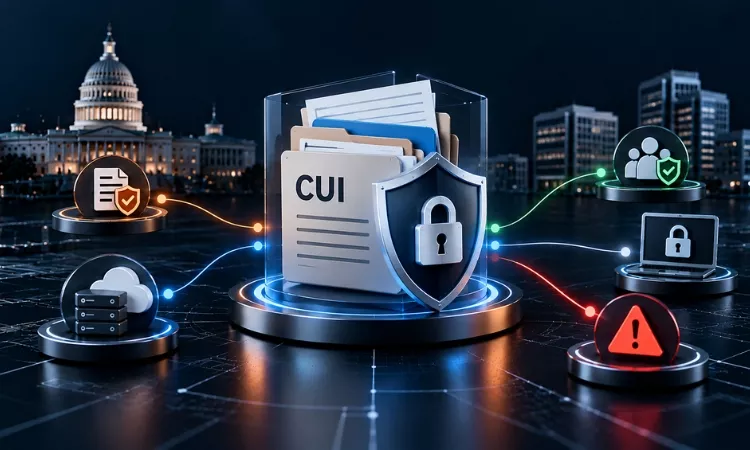
Controlled Unclassified Information is sensitive information owned by the U.S. government that requires safeguarding and dissemination controls but doesn’t meet the classification levels of classified national defense information. CUI isn’t classified as Confidential, Secret, or Top Secret, yet it demands protection because unauthorized disclosure could harm national security, business interests, or government operations.
The National Archives and Records Administration defines CUI categories and subcategories that cover hundreds of information types. Federal agencies designate information as CUI when it contains sensitive content requiring controlled access. This designation doesn’t come from individual classification decisions but from laws, regulations, and agency policies that identify information types requiring protection.
Examples of CUI include acquisition plans, system architecture designs, network diagrams, contractor proprietary information, vulnerability information, security plans, export-controlled technical data, and personally identifiable information of government employees. The scope is broad because the government’s information needs are extensive, and disclosure of any CUI can damage operations, competitive advantages, or national interests.
Organizations handling CUI must treat it differently from standard business-confidential information. The government establishes specific requirements for who can access CUI, how it must be protected, what security controls apply, and how long organizations must maintain records. These aren’t guidelines or best practices. They’re compliance obligations written into federal regulations and contracts.
How Is CUI Different From Classified Information?
The distinction between CUI and classified information matters significantly for organizational compliance strategies. Many people assume that if information isn’t classified, it doesn’t need special protection. This assumption creates compliance failures for federal contractors.
Classified information protects national defense information and receives handling by personnel with security clearances who undergo extensive vetting. Classified information requires need-to-know determinations, special facilities, and secure destruction. The consequences for mishandling classified information include criminal prosecution and imprisonment.
CUI occupies a distinct category. It requires safeguarding and access controls but doesn’t demand security clearances or classified facility requirements. Organizations can handle CUI with trained personnel who follow specific security procedures. The government recognizes that CUI requires protection but understands that overly restrictive classified information procedures would burden operations and limit information sharing needed for government functions.
However, calling CUI “unclassified” shouldn’t mislead anyone into thinking it requires minimal protection. CUI requires robust security controls aligned with NIST SP 800-171 requirements. These standards define access restrictions, encryption requirements, audit logging, monitoring, and incident response procedures. The control requirements rival classified information protection in many aspects, even though the handling procedures differ.
The practical difference: classified information requires security clearances and special access programs; CUI requires role-based access, security training, and technical controls. Both demand organizational commitment and documented compliance.
Why Is CUI Safeguarding Critical For Your Organization?
CUI safeguarding directly impacts organizational viability for any entity receiving federal contracts or working with government agencies. The risks extend beyond regulatory compliance into business sustainability.
Contract Requirements And Business Continuity
Federal agencies include CUI protection clauses in contracts. These clauses transform NIST SP 800-171 requirements into contractual obligations. Failure to meet CUI safeguarding requirements provides grounds for contract termination, whether organizations face a breach or a compliance audit finding. Contract termination doesn’t just end one project. It signals to other agencies that an organization cannot meet federal security requirements, damaging competitive positioning for future opportunities.
Federal contractors recognize that CUI compliance determines bid eligibility. Agencies increasingly require compliance certifications before awarding contracts. Organizations lacking documented CUI safeguarding capabilities lose contract access.
Competitive Intelligence And Business Damage
CUI breaches expose sensitive competitive information to threat actors. Contractor proprietary information, acquisition plans, and technical designs held within CUI breach consequences extend beyond compliance. Business competitors may obtain strategy information. Threat actors may sell CUI to adversaries interested in government operations. The damage compounds organizational losses.
National Security Implications
CUI exists because disclosure harms national security interests. Acquisition plans reveal government spending priorities. Technical specifications expose system vulnerabilities. Security plans demonstrate defensive gaps. When CUI reaches unauthorized parties, it enables targeting of government systems and operations. This transforms CUI protection from a compliance requirement into a patriotic responsibility for organizations working with government.
What Are The Key Requirements For CUI Compliance?
CUI compliance requirements originate from multiple sources: NIST standards, federal regulations, agency policies, and contract clauses. Organizations cannot pick which requirements apply. Compliance means meeting all applicable requirements simultaneously.
NIST SP 800-171 And Control Implementation
NIST SP 800-171, “Protecting Controlled Unclassified Information in Nonfederal Information Systems and Organizations,” establishes the baseline for CUI protection. The standard defines 14 control families covering access controls, awareness and training, audit and accountability, identification and authentication, incident response, maintenance, media protection, personnel security, physical and environmental protection, recovery planning, system and acquisition integrity, and system development.
These control families encompass 110 specific security controls. Organizations must implement controls aligned with their systems and information types. Implementation isn’t prescriptive about technology. The standard allows organizations to choose technologies matching their environments while achieving the security outcomes the controls specify.
Access Control And Need-To-Know
CUI protection mandates role-based access controls. Only personnel with legitimate business need should access CUI. Organizations must document roles, permissions, and access justifications. Access reviews must occur annually at minimum. When personnel change roles or leave organizations, access must terminate immediately.
Technical controls must enforce access decisions. Systems should restrict CUI visibility to authorized accounts. Multi-factor authentication adds verification that the authorized person accesses systems. Privileged access management controls administrator accounts accessing CUI.
Encryption And Data Protection
NIST SP 800-171 requires encryption for CUI in transit and at rest. Organizations must use NIST-approved algorithms. Encryption keys require protection and rotation. Key management systems should prevent unauthorized key access. Organizations must document encryption implementations and maintain evidence of encryption coverage across systems storing or transmitting CUI.
Audit Logging And Monitoring
CUI systems must log access events, configuration changes, and privileged actions. Organizations cannot store logs indefinitely due to storage limitations, but retention periods must extend beyond one year for most access events. Monitoring systems should alert security teams to suspicious activities like failed login attempts, privilege escalation, or unusual data access patterns.
Incident Response Planning
Organizations must establish incident response procedures specific to CUI breaches. Response plans should define detection procedures, notification timelines, and remediation steps. Federal agencies require notification of CUI breaches within 72 hours. Response procedures must address evidence preservation for investigations.
How Should You Implement CUI Protection Practices?
Implementation transforms compliance requirements into operational security. Organizations should approach CUI protection as an integrated program rather than isolated controls.
Assessment And Gap Analysis
Begin with a comprehensive assessment identifying where CUI exists and how systems currently protect it. Gap analysis reveals which NIST controls require strengthening. Many organizations discover that individual security practices exist but lack documented consistency and coverage. Assessment should identify both technical gaps and procedural weaknesses.
Risk-Based Prioritization
Organizations cannot implement all controls simultaneously. Risk-based prioritization focuses efforts on high-impact controls first. Controls protecting the most sensitive CUI categories or covering the largest user populations should receive priority. Controls preventing the most likely threats should be sequenced before those addressing low-probability scenarios.
Documentation And Procedures
CUI safeguarding requires documented security plans covering information flow, system architecture, access procedures, and responsibility assignments. Security plans must identify which CUI categories the organization handles and explain how each control applies to that CUI. Documentation provides evidence of intentional, deliberate compliance rather than accidental adherence.
Personnel Training And Awareness
Employees require training on CUI handling, access controls, and incident reporting. Training should occur annually at minimum and within 30 days of hire. Organizations should emphasize the organization-specific implications of CUI protection, not just abstract compliance requirements. Effective training increases compliance and reduces unintentional disclosure incidents.
Continuous Monitoring And Improvement
CUI compliance requires ongoing monitoring, not one-time implementation. Organizations should conduct quarterly or semi-annual reviews of access controls, monitoring effectiveness, and incident response readiness. Third-party assessments provide independent verification and often reveal gaps internal reviews miss. Assessment frameworks like NIST SP 800-171B establish specific assessment procedures for consistent evaluation.
Common Challenges In CUI Management And How To Address Them
Organizations implementing CUI safeguarding encounter recurring challenges. Understanding these challenges and mitigation approaches accelerates successful compliance.
Determining What Qualifies As CUI
Many organizations struggle with CUI identification. Information sometimes contains CUI mixed with uncontrolled information. Guidelines state that if information contains CUI, the entire document requires CUI treatment. Organizations should establish classification procedures where originators mark CUI content and management reviews classifications periodically. Uncertainty should default to CUI treatment.
Balancing Accessibility With Restriction
CUI protection restricts access, but government operations require information sharing. Organizations must balance restrictive access controls with operational efficiency. Role-based access models should grant minimum necessary permissions while maintaining usability. Technical solutions like data loss prevention tools can allow access while preventing unauthorized disclosure.
Sustaining Compliance During Organizational Growth
As organizations grow, CUI handling becomes more complex. New employees, contractors, and systems introduce compliance risks. Scaling security procedures requires automation and systematic processes rather than manual oversight. Organizations should implement identity and access management systems, automated provisioning, and consistent monitoring to maintain compliance as operations expand.
Managing Legacy Systems
Older systems often lack CUI safeguarding capabilities. Organizations cannot simply turn off legacy systems hosting CUI due to operational dependencies. Remediation options include implementing compensating controls around legacy systems, establishing air-gapped networks for sensitive data, or prioritizing system replacement. Cost-benefit analysis should drive remediation strategies for legacy system challenges.
Strengthen your CUI safeguarding program with expert guidance.
| Contact Ampcus Cyber to schedule your CUI compliance assessment and position your organization for successful federal contracting. |
People Also Ask
What happens if an organization fails CUI compliance audits?
Failed compliance audits trigger corrective action requirements, contract suspension, or termination depending on severity. Agencies may remove the organization from contracting eligibility until remediation demonstrates compliance restoration.
Can external contractors access CUI?
External contractors can access CUI if their contracts include CUI protection clauses and organizations implement consistent access controls and training. Contractor access requires the same safeguarding standards as employee access.
How long must organizations retain CUI?
Retention depends on regulatory requirements and contract language, typically ranging from three to seven years after contract completion. Organizations should maintain audit logs for minimum one year. Destruction procedures must ensure complete CUI removal from all systems.
Is CUI protection required for all federal contracts?
CUI protection applies to contracts involving government information requiring safeguarding. Not every contract involves CUI, but organizations should assume CUI requirements exist unless contracts explicitly state otherwise.
What is the relationship between CUI and DFARS compliance?
DFARS (Defense Federal Acquisition Regulation Supplement) contractors handling CUI must comply with NIST SP 800-171 requirements. DFARS clauses incorporate these requirements into defense contracts, making NIST compliance contractually mandatory for defense contractors.
Enjoyed reading this blog? Stay updated with our latest exclusive content by following us on Twitter and LinkedIn.