








A security team at a growing enterprise had all the right tools in place, SIEM, EDR, cloud monitoring, identity security, and automated response. Yet analysts were still spending hours every day investigating alerts, switching between platforms, gathering context, and deciding what required action. The challenge was no longer visibility. It was the speed and scale of investigation.
As alert volumes continued to grow and threats moved faster, the organization began asking a different question: What if AI could investigate and respond to routine threats without waiting for an analyst at every step?
That question sits at the center of the autonomous SOC. Read this article to understand the basics and beyond of autonomous SOC.
What is Autonomous Soc?
An autonomous SOC is a security operations model where AI agents independently detect, investigate, and respond to threats across an organization’s environment, with human analysts overseeing strategy, tuning, and the decisions that carry the highest business impact. Rather than an analyst manually pulling logs, correlating alerts, and deciding on containment, an AI agent performs that entire investigation on its own, often in seconds, and either takes action within its defined authority or escalates a fully investigated case to a person.
The term covers a range of maturity, from AI that assists a human analyst at every step to AI that runs full investigations with only edge cases reaching a person. Most organizations calling themselves an autonomous SOC today sit somewhere in that range rather than at the far end of it and understanding where a vendor or a program sits on that spectrum matters more than the label itself.
What Does an Autonomous SOC Do?
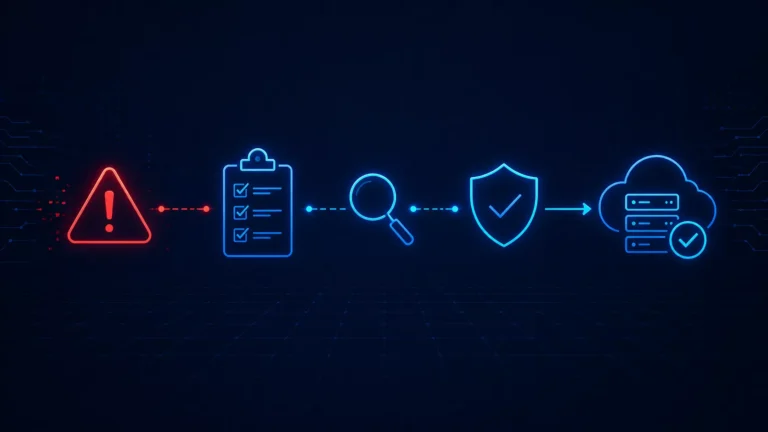
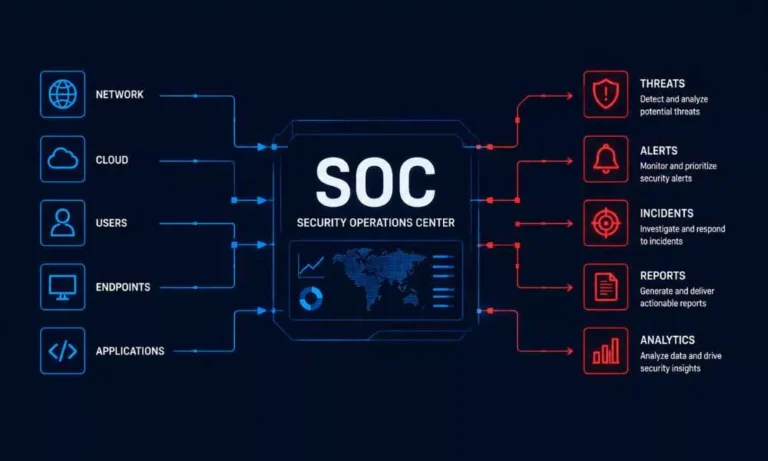
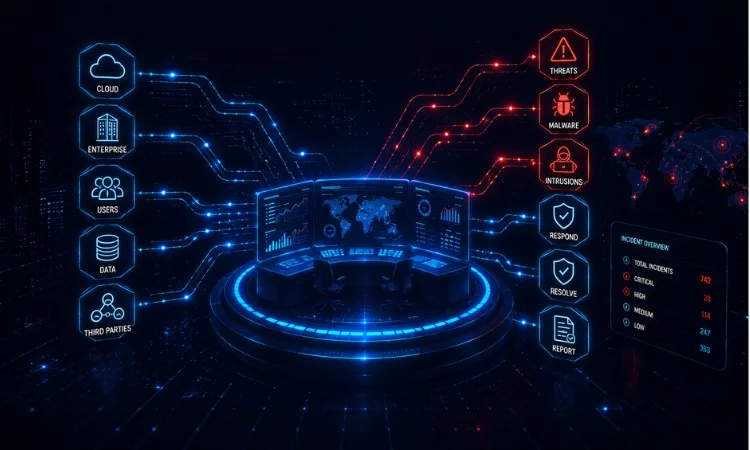
An autonomous SOC performs the same three functions a traditional security operations center performs, detection, investigation, and response, but compresses them into a single automated workflow instead of a chain of manual handoffs.
Detection ingests signals from endpoints, identity systems, cloud infrastructure, and network traffic, the same sources feeding a SIEM. Investigation is where the shift is most visible: instead of following a fixed if-this-then-that playbook the way SOAR automation does, an AI agent reasons through the evidence step by step, pulling additional context, checking related systems, and adjusting its next move based on what it finds, the way a human analyst would. Response either executes a predefined containment action directly or produces a fully documented case for a human to approve, depending on the risk tier assigned to that type of incident.
How Is an Autonomous SOC Different from a Traditional SOC?
A traditional SOC scales with headcount. More alerts require more analysts, and alert volume has grown faster than most security budgets, which is why Tier 1 analysts routinely triage far more alerts than they can properly investigate, closing many with a quick guess rather than a full review.
An autonomous SOC scales with compute instead. The same AI agent that investigates one alert can investigate the next thousand without additional staffing, and it applies the same reasoning process every time rather than the varying judgment calls of different analysts on different shifts. This does not eliminate the value of human expertise. It shifts where that expertise gets applied, away from repetitive first-pass triage and toward the truly ambiguous cases, strategic threat hunting, and oversight of the AI agents themselves.
What Are the Core Components of an Autonomous SOC?
Three components consistently appear across autonomous SOC implementations.
An agentic AI decision layer sits at the center, capable of planning a multi-step investigation, calling other tools and APIs, and adapting its approach as new evidence appears, rather than executing a fixed script. Deep integration across the existing security stack, SIEM, EDR, identity platforms, and cloud logs, gives that layer the raw material it needs; an autonomous SOC that can only see one data source cannot investigate the way a human analyst who checks multiple systems would. A feedback loop feeds incident outcomes and analyst corrections back into the system, so detection logic and investigation quality improve over time instead of staying static.
Human oversight remains a fourth, non-negotiable component. Every credible autonomous SOC implementation preserves a role for analysts to review high-impact decisions, tune the system, and handle the cases that require judgment an AI agent cannot yet apply.
How Mature Is Autonomous SOC Technology Today?
The technology is real, but it is early. Gartner’s 2026 Hype Cycle for Security Operations places AI SOC agents at the Peak of Inflated Expectations, its term for a category attracting significant attention and investment while still reaching only 1% to 5% of the market. That positioning matters for buyers: it signals genuine capability paired with wide variation in how much autonomy different products deliver in practice.
The practical distinction worth checking is between an assistant and an agent. An assistant accelerates a human analyst’s work but still requires that analyst to review and act on every case. An agent investigates and, within defined limits, acts on its own, escalating only what falls outside its authority. Vendors describe both as AI-driven, but the operational difference between them is the entire point of the autonomous SOC model.
Why Does an Autonomous SOC Matter Now?
Attackers have gotten faster than manual response can match. CrowdStrike’s 2026 Global Threat Report found that the average breakout time, the gap between initial access and an attacker’s first lateral movement, fell to 29 minutes in 2025, with the fastest recorded case at 27 seconds and one intrusion moving to data exfiltration within four minutes of initial access.
A traditional SOC workflow, alert generated, queued, picked up by an analyst, investigated, escalated, cannot consistently beat those timelines even with a fully staffed team. IBM has described this gap as the reason SOCs need more than automation; they need what IBM calls digital autonomy, systems that can investigate and act at the speed the threat now moves, with human judgment reserved for the decisions that still need it.
What Are the Risks and Limitations of an Autonomous SOC?
An autonomous SOC introduces a governance problem alongside its speed advantage. An AI agent that can inspect alerts, move between tools, and take containment action is functioning as a privileged actor inside the security stack, which means it needs the same access scoping, credential management, and audit trail that any highly privileged human account would receive. Treating these agents as a feature bolted onto existing tools rather than as identities requiring governance under a program like Agentic IAM is one of the more common gaps security teams discover after deployment.
The other risk is over-trust. An agent that appears autonomous is not automatically accountable; buyers should expect reproducible audit trails, independent evidence of accuracy, and clear boundaries around what the system can act on without approval. An autonomous SOC that cannot show its work is a liability wearing the language of innovation.
How Should CISOs Start Building Toward an Autonomous SOC?
Most organizations do not need to choose between a traditional SOC and a fully autonomous one on day one. A practical path moves through stages.
- Start with low-risk automation: Apply AI to detection and enrichment first, where a wrong call has limited consequence, before extending it to response actions.
- Keep humans on high-impact decisions: Reserve containment actions on critical systems for human approval until the agent has a proven track record.
- Govern agents as identities: Scope credentials, log every action, and review agent permissions on the same cadence as privileged human accounts.
- Build on what exists: SOAR and incident response playbooks already in place give an AI agent a documented process to work from rather than starting from nothing.
- Measure before scaling: Track mean time to detect and respond against a real baseline before extending autonomy to more incident types.
Organizations without the internal capacity to build this stage by stage often start with an MDR provider instead.
Key Takeaway
An autonomous SOC will not eliminate the need for skilled security analysts. It changes what they spend their time on, moving human attention away from repetitive first-pass triage and toward the judgment calls, strategic threat hunting, and oversight that AI agents cannot yet handle alone. The organizations getting real value from this shift are the ones treating autonomy as something to govern and prove, not something to assume.
| Extend your SOC’s capacity with Ampcus Cyber SOC experts while you build toward greater autonomy. |
Enjoyed reading this blog? Stay updated with our latest exclusive content by following us on Twitter and LinkedIn.