







Cyberattacks don’t follow business hours; they evolve overnight, vulnerabilities surface without warning, and breaches can go undetected for months. In this landscape, reactive security is no longer enough. Organizations need a dedicated, always-on function built to detect, investigate, and respond to threats in real time.
That function is the Security Operations Center (SOC)
Whether you’re a CIO evaluating your security posture, an IT manager exploring managed security options, or simply trying to understand how modern cybersecurity works, this guide answers every fundamental question about SOCs, what they are, who runs them, how they operate, and why they matter more than ever in 2025.
What Is SOC?
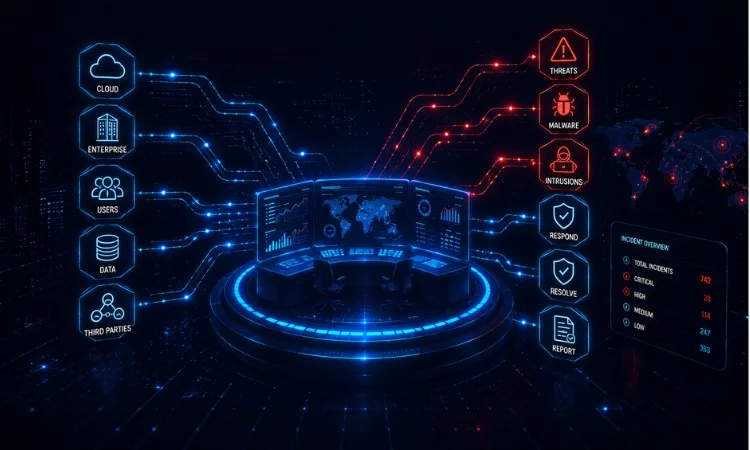
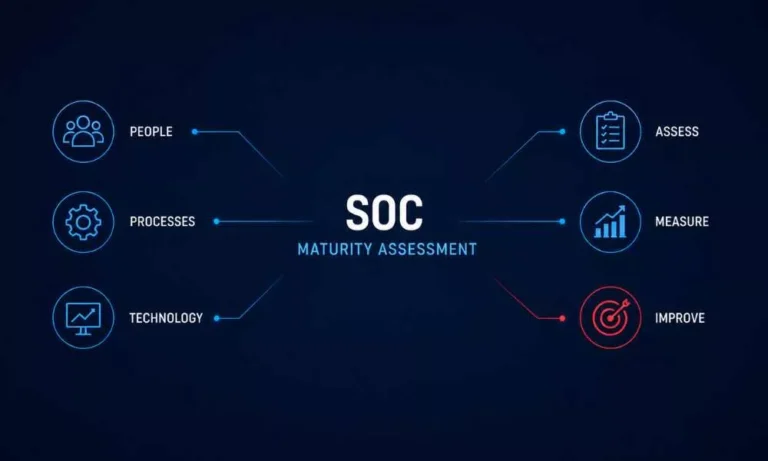
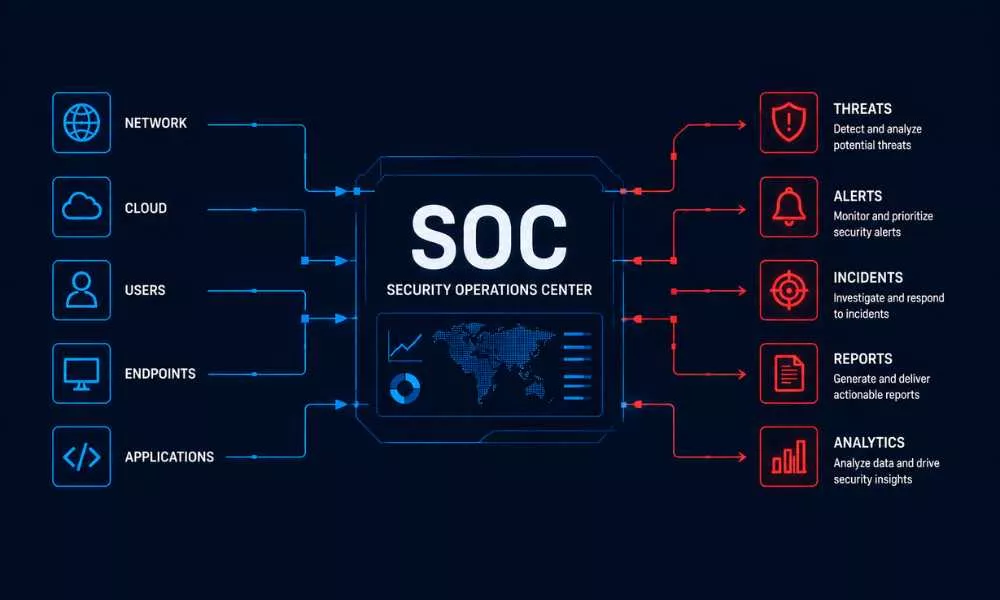
Security Operations Center (SOC) is a centralized unit of people, processes, and technology dedicated to continuously monitoring, detecting, analyzing, and responding to cybersecurity threats across an organization’s entire IT environment.
Think of a SOC as the nerve center of an organization’s cybersecurity. Unlike firewalls and antivirus tools, the SOC is the intelligence hub that watches everything happening inside and outside that perimeter, 24 hours a day, 7 days a week, 365 days a year.
A SOC is a structured operational capability powered by skilled analysts, advanced tools, and defined processes working in concert to protect organizational assets from compromise.
What Does a SOC Do?
The SOC’s core mission is to minimize the impact of cybersecurity incidents through continuous vigilance. Its key functions include the following:
- Continuous Monitoring: The SOC ingests and analyzes log data, network traffic, endpoint activity, and alerts from across the IT environment, cloud, on-premises, and hybrid, around the clock.
- Threat Detection: Using a combination of rule-based alerts, behavioral analytics, and threat intelligence, SOC analysts identify anomalies and indicators of compromise (IoCs) before they escalate into full breaches.
- Incident Investigation: When a threat is detected, the SOC investigates the root cause, scope, and potential impact. This triage process determines whether an alert is a genuine threat or a false positive.
- Incident Response: For confirmed threats, the SOC executes or coordinates, containment, eradication, and recovery actions to minimize damage and restore normal operations.
- Threat Intelligence Integration: SOC teams consume global threat intelligence feeds to stay ahead of emerging attack techniques, threat actor profiles, and newly discovered vulnerabilities.
- Vulnerability Management: SOC teams track known vulnerabilities in the organization’s environment and work with IT teams to prioritize patching and remediation.
- Compliance Reporting: SOCs generate audit logs, incident reports, and compliance documentation required under regulations such as DPDPA, GDPR, ISO 27001, SOC 2, PCI DSS, and HIPAA.
- Forensics and Post-Incident Analysis: After an incident is resolved, the SOC conducts a detailed post-mortem to understand what happened, how it happened, and how to prevent recurrence.
Where Does a SOC Operate?
SOCs can operate in several different models depending on an organization’s size, budget, risk profile, and operational requirements.
- In-House (Dedicated) SOC: Built and operated entirely within the organization. Offers maximum control and customization but requires significant investment in people, tools, and infrastructure. Best suited for large enterprises with complex security requirements.
- Managed SOC (SOC-as-a-Service): Security operations are fully outsourced to a specialist provider. The organization benefits from 24/7 coverage, expert analysts, and enterprise-grade tools without the overhead of building an internal team. Ideal for mid-market organizations and those with limited internal security resources.
- Hybrid SOC: A combination of internal security personnel and managed security service providers (MSSP). The organization retains control of strategic decisions while outsourcing monitoring, detection, or specific response functions.
- Virtual SOC: A distributed model where analysts work remotely, enabled by cloud-based SIEM and collaboration tools. Increasingly common in post-pandemic security operations.
- Co-Managed SOC: The organization has an internal security team that co-manages security operations in partnership with an external provider, sharing tools, data, and responsibilities.
When Does an Organization Need a SOC?
The honest answer is sooner than most organizations think. Common triggers that signal it’s time to establish or engage a SOC include:
- Your organization has experienced a security incident or near-miss that exposed detection and response gaps.
- You operate in a regulated industry (finance, healthcare, recruitment, government) where data protection compliance is mandatory.
- Your IT environment has grown complex; cloud workloads, remote users, third-party integrations, and security visibility is fragmented.
- You lack internal expertise or headcount to monitor threats around the clock.
- You are facing increasing threat volumes, and your current tools are generating more noise than signal.
- Your cyber insurance provider or a compliance framework (ISO 27001, SOC 2, DPDPA) requires documented security monitoring capabilities.
If any of these resonate, the case for a SOC is already made.
What are the key benefits of implementing SOC?
A well-functioning SOC doesn’t just reduce cyber risk; it delivers tangible business value.
- Faster Threat Detection and Response: The industry average dwell time, how long a threat actor operates undetected inside a network, is measured in weeks. A SOC dramatically compresses this window, limiting the blast radius of any breach.
- Reduced Cost of Breaches: IBM’s Cost of a Data Breach Report consistently shows that organizations with strong detection and response capabilities experience significantly lower breach costs than those without. A SOC is an investment that pays for itself.
Regulatory Compliance Regulators under DPDPA, GDPR, PCI DSS, and HIPAA expect organizations to demonstrate continuous monitoring and incident response capabilities. A SOC provides the audit trail and documentation to prove it.
Business Continuity By containing threats before they escalate, a SOC protects critical systems from downtime, ransomware lockouts, and data destruction safeguarding revenue and reputation.
Centralized Visibility A SOC consolidates security data from every corner of the IT environment into a single operational picture, eliminating the blind spots that attackers exploit.
How Does a SOC Work?
Understanding the SOC workflow demystifies how continuous security monitoring operates in practice.
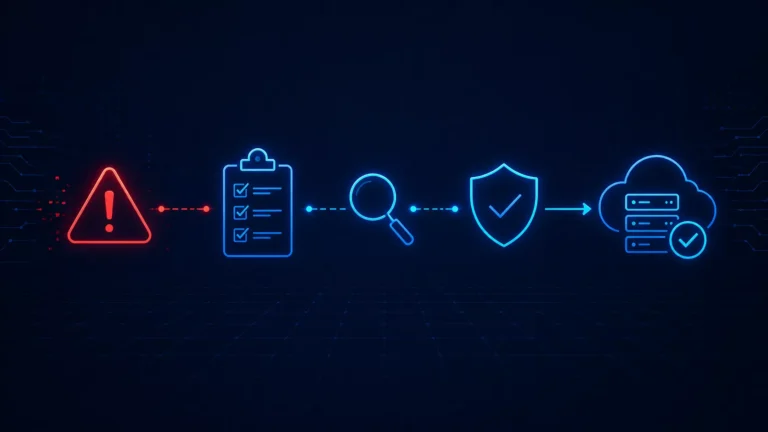
Step 1: Data Ingestion: The SOC collects logs, events, and telemetry from every asset in the environment: endpoints, servers, firewalls, cloud platforms, email gateways, identity systems, and applications. This data flows into a central platform, typically a SIEM (Security Information and Event Management) system.
Step 2: Correlation and Detection: The SIEM applies detection rules, behavioral baselines, and threat intelligence to correlate raw events into meaningful alerts. Advanced SOCs augment SIEM with SOAR (Security Orchestration, Automation, and Response) platforms and EDR/XDR solutions for richer context and automated response.
Step 3: Alert Triage: Tier 1 analysts review incoming alerts, classify their severity, and perform initial investigation to separate real threats from false positives.
Step 4: Investigation and Escalation: Confirmed or ambiguous threats are escalated to Tier 2 for deeper investigation. Analysts reconstruct the attack chain, identify affected assets, and assess impact.
Step 5: Response and Containment: The SOC executes a response playbook isolating affected systems, blocking malicious IPs, disabling compromised accounts, or triggering automated responses via SOAR.
Step 6: Recovery and Reporting: Once contained, affected systems are restored. The SOC documents the incident, produces a report, and feeds learnings back into detection rules and response playbooks.
What Tools Does a SOC Use?
A modern SOC relies on an integrated technology stack to deliver effective operations:
- SIEM: log aggregation, correlation, and alerting
- EDR/XDR: endpoint detection and response
- SOAR: automated playbooks and orchestration across security tools
- Threat Intelligence Platforms (TIP): curated feeds on threat actors, IoCs, and TTPs
- Vulnerability Management: continuous asset and vulnerability visibility
- UEBA: user and entity behavior analytics for insider threat detection
- NDR: network detection and response for east-west traffic visibility
SOC vs. NOC: What’s the Difference?
As a common point of confusion, the SOC and the Network Operations Center (NOC) are distinct functions with different mandates.
| SOC | NOC | |
| Focus | Security threats and incidents | Network performance and availability |
| Goal | Detect, contain, and respond to attacks | Maintain uptime and network health |
| Monitors | Security events, logs, threat indicators | Bandwidth, latency, outages, hardware |
| Responds to | Breaches, malware, unauthorized access | Downtime, connectivity issues, failures |
In mature organizations, the SOC and NOC work closely together, network anomalies detected by the NOC can be security incidents investigated by the SOC.
Strengthen Your Security Posture with Ampcus Cyber’s Managed SOC
Building a SOC in-house takes years, a significant budget, and specialized talent that is increasingly scarce. Ampcus Cyber’s Managed SOC Services give your organization 24/7 threat monitoring, expert analysis, and rapid incident response, without the overhead.
Whether you need a fully managed security operations capability or a co-managed model that extends your existing team, Ampcus Cyber delivers the intelligence, the expertise, and the technology to keep your organization secure.
| Ready to take control of your security operations? Schedule a consultation with Ampcus Cyber’s SOC experts today. |
Enjoyed reading this blog? Stay updated with our latest exclusive content by following us on Twitter and LinkedIn.