








When ransomware strikes, most organizations discover whether their incident response plan works for the first time. Picture this: It’s 2:00 AM on a Sunday. Your core servers are encrypted, an extortion note is demanding millions in Bitcoin, and your corporate email network is completely dark. In that moment of intense friction, opening a dusty, 50-page incident response plan PDF for the first time isn’t a strategy, it’s a liability.
Chaos becomes the default setting. Panic sets in, communication channels break down, and leadership suffers from costly analysis paralysis. However, a distinct subset of enterprises handles these crises with systematic, calm precision.
The difference isn’t the software they buy or the size of their security budget. It is cyber resilience built through deliberate, repeated practice.
The Preparedness Dividend: What the Data Shows
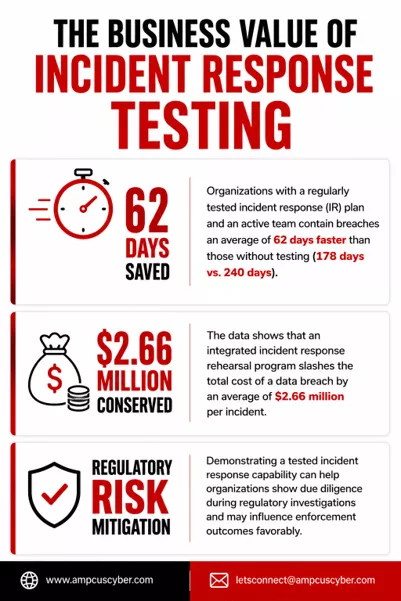
We no longer guess whether running a cyber crisis simulation works; the empirical data is overwhelming. According to global benchmarks, including the landmark IBM Cost of a Data Breach Report, the financial and operational divergence between prepared and unprepared organizations is staggering.
Why Most Organizations Don’t Discover Their Incident Response Gaps?
If the data is so conclusive, why do so many enterprises remain unprepared? The truth is that standard corporate security programs often harbor hidden vulnerabilities in how they approach readiness. Thought leaders recognize that organizations fail to rehearse effectively due to several core structural blind spots:
- Plans are written for audits, not crises: Too many incident response documents exist solely to check a compliance box for insurance renewals or regulatory auditors. A plan optimized for a checklist is rarely optimized for the chaotic reality of a live attack.
- Legal and executive teams are excluded: Cybersecurity is frequently miscategorized as a purely technical IT issue. If your general counsel, HR lead, and PR head are not actively involved in your tabletop exercise, your organization will freeze when high-stakes decisions must be made.
- Communication channels are never tested: When a primary network goes down, standard Slack, Microsoft Teams, and email networks go with it. Organizations that haven’t practiced pivoting to secure, out-of-band communication pathways find themselves completely paralyzed.
- Backup restoration assumptions go unverified: Having backups is not the same as being able to restore them at scale under pressure. Without routine testing, teams often discover too late that their restoration timeline will take weeks, not hours.
The Real Purpose of an Incident Response Rehearsal
Many organizations believe a rehearsal exists to validate the incident response plan. The most valuable outcome is exposing assumptions hidden inside the plan.
Every exercise reveals unverified assumptions about communication channels, decision-making authority, third-party vendor availability, backup recovery timelines, and legal escalation paths. The sooner those assumptions are challenged in a safe environment, the less likely they are to become catastrophic operational failures during a real incident.
Why Boards Are Increasingly Asking for Cyber Crisis Simulations
Cybersecurity incidents are no longer purely technical events. They directly affect revenue, customer trust, regulatory compliance, legal liability, and shareholder confidence.
As a result, corporate boards are shifting their focus. They are no longer satisfied with passive dashboards indicating that firewalls are operational as part of baseline cyber risk management. Today, boards increasingly demand empirical evidence that leadership teams can make critical, high-pressure decisions during a worst-case scenario.
A comprehensive cyber crisis simulation provides the board with validated proof of operational readiness, turning theoretical resilience into a verifiable business capability.
The Compliance Challenge
Breach recovery is more than a technical hurdle; it is a localized legal race against the clock. Regulatory deadlines don’t pause during a crisis.
Many regulations, including GDPR and sector-specific requirements, impose strict breach notification timelines that can begin shortly after an organization becomes aware of a reportable incident.
Without routine, cross-departmental rehearsals, it is virtually impossible to safely isolate a system, leverage digital forensics to determine the exact scope of compromised data, and draft a legally compliant regulatory notice within those tight constraints. A realistic simulation guarantees your legal team knows their exact play the moment an indicator of compromise appears, protecting the organization from severe compliance penalties and post-breach litigation.
The Incident Response Rehearsal Maturity Model
To achieve an authoritative, enterprise-grade posture, organizations must evolve beyond baseline checkbox compliance. Leading organizations assess incident response readiness using a progressive maturity model that moves from documented plans to threat-informed resilience. Where does your organization sit?
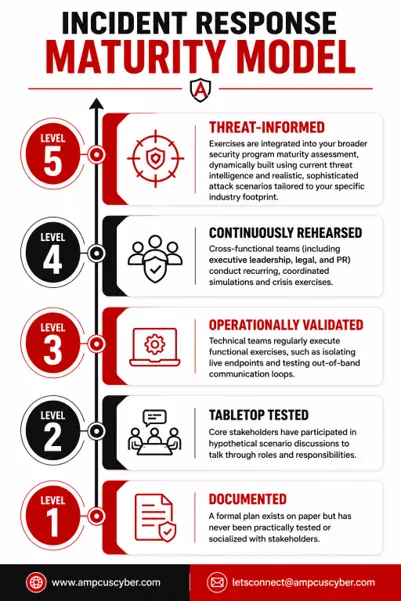
Ultimately, the data proves a singular reality: you can choose to test your incident response plan during a calm, controlled simulation, or you can let a threat actor test it for you.
Are you confident enough that your organization could coordinate a response within the first critical hour of a breach?
A plan that has never been tested under realistic operational pressure is simply an optimistic hypothesis. Our Cyber Crisis Simulation and Tabletop Exercise programs help organizations identify operational blind spots before attackers do. Discover where your incident response capability stands today.
| Call our Experts to Schedule a Cyber Crisis Readiness Assessment |
Enjoyed reading this blog? Stay updated with our latest exclusive content by following us on Twitter and LinkedIn.