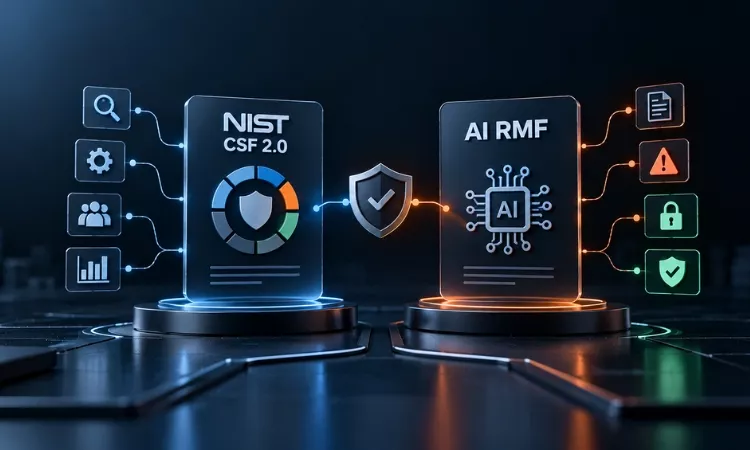










Artificial Intelligence (AI) is no longer a fringe capability; it is becoming an integral part of organizational decision-making, operational workflows, and even cybersecurity. With this shift, simply securing data and systems is no longer enough; organizations must govern how AI systems make decisions, operate, and evolve. That’s where ISO 42001 made its mark: the world’s first international management-system standard for the responsible development, deployment, and use of AI.
In many organizations, the journey begins with ISO/IEC 27001, the established standard for Information Security Management Systems (ISMS). Together, these two standards define a roadmap from securing information to governing intelligence.
The Foundation: ISO 27001 and Information Security Governance
For years, ISO 27001 has been the cornerstone for managing information-security risk. It helps organizations protect the confidentiality, integrity and availability of information assets through a structured risk-based approach: establish policies, assess risks, apply controls, monitor and improve.
However, AI introduces new vectors: the model making decisions, the data used to train it, hidden biases, drift over time, opaque logic, and adversarial attacks against AI. Securing the data is necessary, but no longer sufficient.
The Leap: ISO 42001 and AI Governance
Published in December 2023, ISO/IEC 42001 establishes requirements for an AI Management System (AIMS), a framework to govern the development, use, monitoring, and improvement of AI.
Key features include:
- Risk assessment specific to AI systems (bias, drift, misuse)
- Data governance and traceability (training-data provenance, model lineage)
- Transparency and explainability of AI decision-making
- Human oversight and governance of model deployment
How ISO 27001 and ISO 42001 Work Together
These two standards are complementary. Organizations that already hold ISO 27001 certification can often leverage much of the groundwork (risk frameworks, audit processes, documentation) when moving toward ISO 42001. According to industry research, ISO 27001-certified organizations can achieve ISO 42001 compliance 30-40 % faster than those starting from scratch.
Here’s a quick comparison:
| Standard | Focus | Typical Controls |
| ISO 27001 | Information security (data, access, risks) | Access controls, encryption, and incident response |
| ISO 42001 | AI governance (ethics, model, transparency) | Model validation, bias tests, and explainability |
Implementation: Practical Steps for Organizations
To navigate from ISO 27001 to ISO 42001 and modern AI governance, organizations should consider:
- Gap analysis: Map existing ISMS controls (ISO 27001) against AI-specific requirements of ISO 42001 (e.g., Clauses on data governance and model monitoring).
- Define scope & policy: Extend governance policies to include AI lifecycle: design, training, deployment, monitoring, retirement.
- Risk & impact assessment: Conduct assessments specific to AI: bias drift, adversarial manipulation, decision-transparency gaps.
- Human-in-the-loop and oversight: Ensure that critical AI decisions have accountable human oversight, clear documentation, and audit logs.
- Continuous monitoring & improvement: Use PDCA (Plan-Do-Check-Act) approach across AI lifecycle: monitor performance, retrain models, document outcomes.
- Integrate with existing ISMS: Use your ISO 27001 infrastructure (audit, controls, incident management) to support the AI-governance system.
Business Benefits & Competitive Advantage
| Focus Area | What it means | Impact |
| Build Trust | Demonstrate responsible AI governance to investors, customers, and regulators. | Strengthens credibility and stakeholder confidence. |
| Streamline Partnership | Offer certification and structured governance proof. | Speeds up partner onboarding and vendor approvals. |
| Drive Responsible Innovation | Integrate governance into AI design and deployment. | Maintains compliance without slowing innovation. |
Challenges and Considerations
| Challenge | What’s Involved | Why it Matters? |
| Evidence Gathering | Maintain consistent audit trails, model logs, and decision lineage. | Builds traceability and accountability across the AI lifecycle. |
| Cross-Functional Alignment | Connect data science, risk, legal, and operations teams. | Breaks silos and ensures unified governance. |
| Adapting to Change | Keep up with fast-evolving AI models and technologies. | Ensures governance remains relevant and effective. |
| Navigating Regulations | Align voluntary ISO 42001 with mandatory frameworks (like the EU AI Act). | Future-proofs compliance across global markets. |
Final Thoughts
Moving from ISO 27001 to ISO 42001 is a strategic transformation from securing information to governing intelligence. As AI becomes woven into the fabric of business and technology, organizations must ensure that AI systems are trusted, transparent, accountable, and secure.
For executives, this shift means thinking beyond “Are we safe?” to “Are we responsible and resilient in how we use AI?” ISO 42001 provides the blueprint, and for organizations already grounded in ISO 27001, the transition is within reach.
Adopting this dual-standard mindset sets the stage not just for risk mitigation but for innovation and trust in the AI era.
Enjoyed reading this blog? Stay updated with our latest exclusive content by following us on Twitter and LinkedIn.