









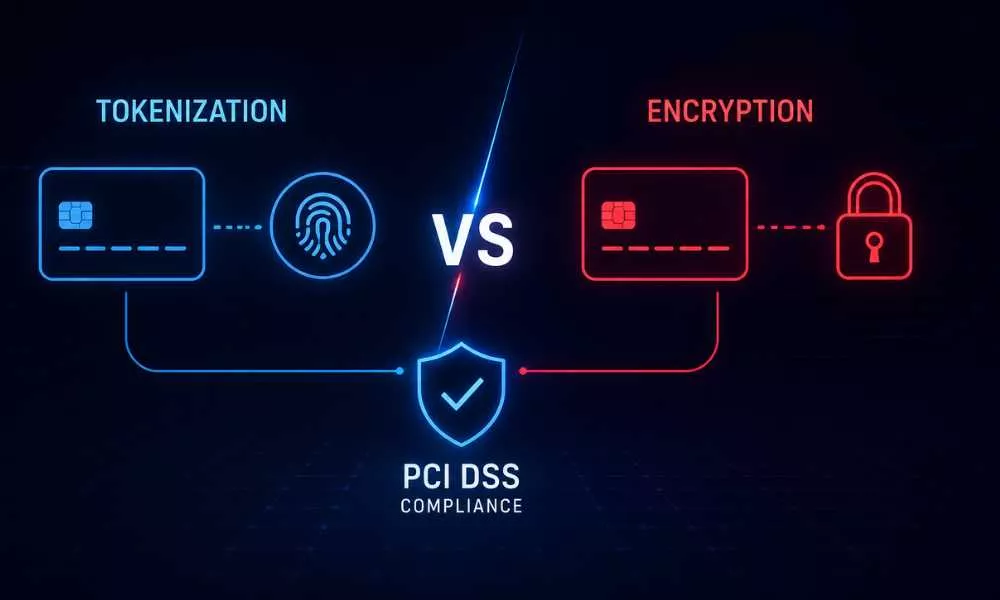
When it comes to protecting payment card data, two terms surface repeatedly in every compliance conversation: tokenization and encryption for PCI DSS. Both are powerful data security controls endorsed within the PCI DSS framework. Yet they work differently, carry different operational implications, and serve distinct business scenarios.
Choosing the wrong approach or applying it incorrectly can mean the difference between a streamlined audit and a costly remediation effort. With PCI DSS 4.0 raising the bar on cardholder data protection, this decision matters more than ever.
This article breaks down how each method works, where each fit best, and how to make a smart, risk-informed decision for your organization.
What Is Tokenization in PCI DSS?
PCI tokenization is the process of replacing a sensitive data element, most commonly a Primary Account Number (PAN) with a randomly generated, non-sensitive placeholder called a token. This token has no mathematical relationship to the original card number, making it functionally useless if intercepted.
The original PAN is stored securely in a token vault, typically managed by a third-party tokenization provider or an in-house system.
How it works in practice:
- A customer enters their card number at checkout.
- The payment processor replaces the PAN with a unique token (e.g., 8923-XXXX-XXXX-1147).
- The token is stored in your systems for recurring transactions, chargebacks, or reporting.
- The actual PAN never lives in your application, database, or logs.
Systems that only store, process, or transmit tokens, not actual PANs, may fall outside your defined CDE boundary, potentially reducing the number of systems subject to PCI DSS requirements. However, scope boundaries must always be validated by a Qualified Security Assessor.
What Is Encryption for Payment Data?
Encryption for payment data transforms the PAN into an unreadable ciphertext using a cryptographic algorithm. Unlike tokenization, the encrypted value maintains a deterministic relationship with the original data, meaning the right decryption key will always recover the original PAN.
There are two primary encryption approaches relevant to PCI DSS:
- At-rest encryption: Protects stored cardholder data in databases, file systems, and backups.
- In-transit encryption: Protects data moving across networks (e.g., TLS 1.2/1.3 for web transactions).
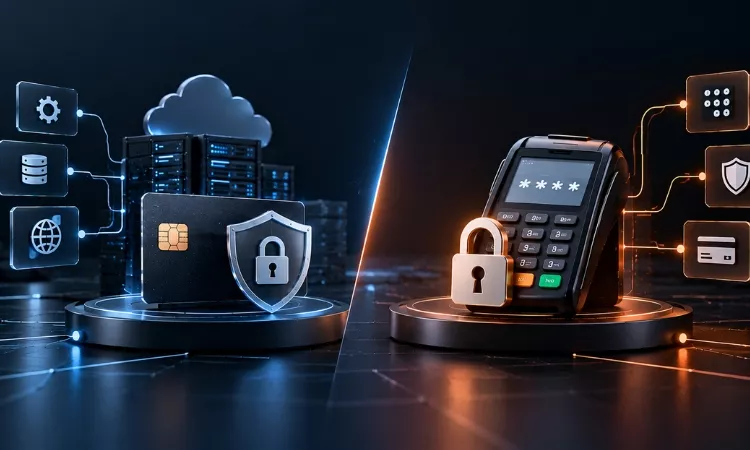
Point-to-Point Encryption (P2PE) is a specific PCI-validated method where card data is encrypted immediately at the point of interaction (e.g., a payment terminal) and only decrypted at a secure, PCI-validated decryption endpoint. A validated P2PE solution can dramatically reduce PCI DSS scope for merchants.
Encryption protects data in environments where you must retain the original PAN for business or regulatory reasons such as dispute resolution, fraud analytics, or cross-border financial reconciliation. It’s also mandated by PCI DSS 4.0 Requirement 3 for any stored cardholder data.
Tokenization vs Encryption for PCI DSS: A Side-by-Side Comparison
| Feature | Tokenization | Encryption |
| Data format preserved? | No (token string is meaningless) | No (Encryption string is meaningless) |
| Reversible? | Yes (via token vault lookup) | Yes (via decryption key) |
| CDE scope reduction | Yes (less effort required) | Moderate (data still technically present) |
| Key management required? | Minimal (vault-based) | Yes (complex key lifecycle) |
| Performance overhead | Low | Moderate (especially for large datasets) |
| PCI DSS 4.0 alignment | Req. 3, Appendix C guidance | Req. 3.4, 3.5, 4.2 (mandatory for transit/storage) |
| Best for | eCommerce, SaaS, recurring billing | Enterprises retaining PANs, financial institutions |
PCI DSS 4.0: What’s Changed and Why It Matters
Released in March 2022 and fully mandatory since March 2025, PCI DSS 4.0 introduces more rigorous requirements around both encryption and tokenization:
- Requirement 3.3.3 now explicitly requires that PANs stored electronically are unreadable anywhere they are stored, accelerating the adoption of strong encryption or tokenization.
- Requirement 3.5 tightens key management practices, requiring documented procedures, split knowledge, and dual control for cryptographic keys.
- Customized Approach provisions give organizations more flexibility to demonstrate compensating controls, which can work in favor of innovative tokenization architectures.
- Requirement 12.3.2 introduces a targeted risk analysis for each PCI DSS requirement, meaning organizations must now formally justify their chosen data protection approach.
According to the Verizon 2024 Payment Security Report, only 43% of organizations maintained full PCI DSS compliance at the time of their interim assessments, a figure that underscores the challenge of keeping pace with evolving standards.
Which Approach Is Right for Your Business?
The honest answer: most mature payment security programs use both. Tokenization and encryption are complementary rather than competing strategies. That said, your architecture, business model, and risk profile will determine where each plays a primary role.
Choose Tokenization If You:
- Are an eCommerce business or SaaS platform that stores card-on-file data for subscriptions or repeat purchases.
- Want to minimize PCI DSS audit scope and reduce the cost and complexity of assessments.
- Process payments through a third-party payment gateway (e.g., Stripe, Braintree, Adyen) that offers native tokenization.
- Handle high transaction volumes where key management overhead would be operationally burdensome.
- Operate in multi-cloud or hybrid environments where centralizing key storage is difficult.
Choose Encryption If You:
- Are a financial institution, bank, or payment processor that must retain the actual PAN for reconciliation, fraud analysis, or regulatory reporting.
- Operate physical retail environments and use PCI-validated P2PE terminal solutions.
- Need to perform analytics or pattern matching on payment data without losing fidelity.
- Have robust key management infrastructure (HSMs, key rotation policies, access controls) already in place.
- Work in healthcare or government contexts where HIPAA or federal mandates require encrypted data at rest.
For Most Mid-Market and Enterprise Businesses:
A hybrid model works best when tokenize at the application layer to reduce scope and minimize exposure, while maintaining encryption in transit and at rest for any residual cardholder data that must be retained. This layered approach reflects what security professionals refer to as defense in depth.
Common Implementation Mistakes to Avoid
Even well-intentioned security teams make costly missteps. Here are the most frequent pitfalls:
- Assuming tokenization eliminates all PCI scope. Tokens still require secure storage and access controls. If your token vault is breached, re-tokenization is complex and expensive.
- Using homegrown encryption without HSM support. PCI DSS 4.0 Requirement 3.7 mandates that cryptographic keys are protected using industry-accepted key management practices. DIY solutions rarely pass QSA scrutiny.
- Neglecting key rotation schedules. Stale cryptographic keys are a persistent vulnerability. Requirement 3.7.4 mandates documented cryptographic key retirement and replacement processes.
- Over-relying on third-party tokenization without validating scope reduction. Not all token formats qualify for scope reduction. Always work with a Qualified Security Assessor (QSA) to confirm your CDE boundaries.
- Ignoring log and monitoring requirements. PCI DSS 4.0 Requirement 10 still applies to tokenization and encryption systems; audit logs must be retained and reviewed.
A Cybersecurity Risk Assessment is an essential first step to identify exactly where your cardholder data flows, where it rests, and which controls best address your specific risk exposure.
Conclusion
The tokenization vs encryption debate doesn’t have a single right answer, it is a choice dependent on your business. The key is understanding what data you hold, why you hold it, who can access it, and what your regulatory obligations require.
Doing nothing, or relying on outdated, unvalidated controls, is no longer an option. PCI DSS has raised the standard, regulators are paying closer attention, and attackers are more sophisticated than ever. The average cost of a payment data breach now exceeds $4.4 million, according to IBM’s Cost of a Data Breach Report 2025.
Ampcus Cyber helps organizations navigate exactly these decisions. Whether you need a gap assessment against PCI DSS, guidance on implementing a tokenization architecture, or end-to-end PCI compliance services, our certified security experts bring the technical depth and regulatory knowledge to move you forward with confidence.
| Get a payment security strategy that’s both compliant and operationally sound! Connect with our PCI DSS specialists today. |
Enjoyed reading this blog? Stay updated with our latest exclusive content by following us on Twitter and LinkedIn.