










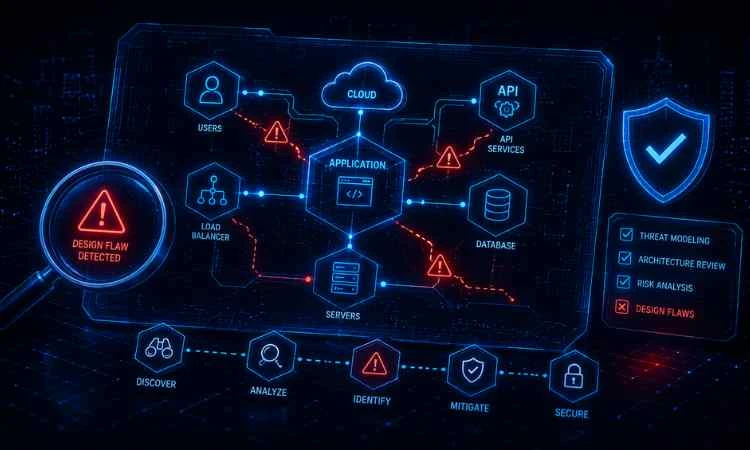
Most breaches do not start with a zero-day exploit, and they rarely begin with a stroke of criminal genius either, because attackers usually find the path that your own architecture left open for them. A critical design flaw is a structural weakness in how a system is built, and it hides in trust boundaries, authentication logic, and data flows rather than in a single line of vulnerable code. Finding these flaws before deployment is the job of a security architecture review, and this walkthrough explains how experienced security architects do it, so you can bring the same discipline into your own development lifecycle.
Why Design Flaws Are More Dangerous Than Code Bugs
A code-level bug, such as a missing input validation check, is usually fixed with a patch, and the fix is contained to one function or module. A design flaw is different because it is woven into the architecture itself, so fixing it later often means re-architecting entire components, and that is expensive, disruptive, and sometimes commercially impossible once a product has shipped.
For example, an application that trusts client-side data for authorization decisions has a design flaw, and no amount of code cleanup fixes that problem unless the trust model itself is redesigned. This is why organizations that rely only on penetration testing after launch tend to discover the most expensive issues, because pen testing finds symptoms while architecture review finds root causes.
The Open Web Application Security Project has documented this pattern for years, and its guidance consistently shows that insecure design now ranks among the top categories of real-world application risk, distinct from implementation bugs (OWASP Top 10). That distinction matters because it tells security teams where to spend their earliest and most valuable hours.
Step 1: Map Every Trust Boundary Before You Map Anything Else
A trust boundary is any point where data or control moves from one privilege level, network zone, or user role to another, and every serious flaw traces back to a boundary that was assumed rather than verified. Start by drawing the system at a high level and mark every place where a request crosses from public to internal, from user to admin, or from one microservice to another. Skilled reviewers treat this diagram as a living document rather than a one-time exercise, and they update it whenever a new service, API, or third-party integration is added, because an unmapped boundary is an unmonitored boundary.
Step 2: Threat Model the Architecture, Not Just the Features
Once the boundaries are mapped, the next step is structured threat modeling, and frameworks such as STRIDE (Spoofing, Tampering, Repudiation, Information Disclosure, Denial of Service, Elevation of Privilege) give reviewers a repeatable way to ask the right question at every boundary. The goal is not to imagine every possible attacker, but to systematically test each trust boundary against each threat category, so nothing gets skipped simply because it seemed unlikely.
The National Institute of Standards and Technology recommends that organizations integrate threat modeling early in the system development lifecycle precisely because late-stage discovery is costlier and less complete (NIST SP 800-160). Reviewers who follow this guidance consistently catch privilege escalation paths and data exposure risks that functional testing alone would miss.
Step 3: Trace Data Flows From Input to Storage to Output
Every critical flaw eventually touches data, so the next step is to trace how sensitive information actually moves through the system, from the moment it is entered by a user, through processing and storage, to the moment it is displayed, exported, or shared with another system. Reviewers should ask where encryption is applied, where it is missing, and whether sensitive data ever passes through a component that does not need to see it, because unnecessary exposure is itself a design weakness even if no bug ever triggers it.
This step often reveals that logging systems, analytics pipelines, or third-party integrations are quietly collecting more sensitive data than the business ever intended, and that discovery alone can justify the entire review.
Step 4: Validate Authentication and Authorization as Separate Concerns
Authentication answers who a user is, while authorization answers what that user is allowed to do, and conflating the two is one of the most common and most dangerous design flaws in modern applications. A secure architecture verifies authorization independently at every layer, rather than if a successful login at the front door means every downstream service can be trusted to make good decisions. Reviewers specifically look for services that skip their own authorization checks because they assume an upstream gateway already handled it, since that assumption is exactly what attackers exploit once they find a way to call the service directly.
Step 5: Stress-Test Failure Modes, Not Just Success Paths
Most design reviews focus heavily on what happens when everything works correctly, but attackers focus on what happens when something breaks, times out, or returns an unexpected error. A resilient architecture fails closed, meaning it denies access by default when something goes wrong, yet many systems fail open instead, silently granting access or bypassing a check because a dependency was slow or unavailable. Reviewers deliberately simulate outages, timeouts, and malformed responses at every trust boundary, and they treat any failure that grants access, rather than restricting it, as a critical finding regardless of how unlikely that failure scenario seems.
Turning This Walkthrough Into a Repeatable Practice
A single architecture review is valuable, but the real security gain comes from making this walkthrough a standard gate in your development lifecycle, so every new service or major feature is reviewed before it reaches production rather than after an incident force the question.
Organizations that build this into their process, supported by a structured security architecture review service, consistently reduce the cost and frequency of late-stage redesigns, because flaws are caught while they are still cheap to fix. Pairing architecture review with ongoing vulnerability assessment and penetration testing closes the loop, since architecture review addresses structural risk while testing validates that the implementation matches the design intent.
Identifying critical design flaws before an attacker does is not about finding every possible bug, but about asking the right structural questions at the right stage and doing so consistently rather than only after something breaks.
The most expensive vulnerabilities are often built into the architecture, not the code
| Connect with Ampcus Cyber’s Security Architecture Review experts to identify design flaws early and build secure-by-design systems before they reach production. |
Enjoyed reading this blog? Stay updated with our latest exclusive content by following us on Twitter and LinkedIn.