









Meet PCI DSS Requirement 10 with a compliant logging and monitoring strategy that strengthens audit readiness and security visibility. This blog covers the key PCI DSS v4.0 logging requirements, including audit trail creation, log retention, integrity protection, automated alerting, SIEM implementation, and common compliance gaps organizations must avoid while passing QSA assessments.
If your organization handles cardholder data, building a robust audit trail isn’t optional; it’s a compliance mandate. PCI DSS (Payment Card Industry Data Security Standard) Requirement 10 specifically governs logging and monitoring, and it’s one of the most scrutinized areas during a QSA audit. Fail here, and you fail the PCI DSS assessment. This guide covers exactly what compliant logging looks like and how to build an audit trail that holds up under real-world QSA scrutiny.
What Is PCI DSS Requirement 10?
PCI DSS Requirement 10 mandates that organizations track and monitor all access to network resources and cardholder data. The goal is straightforward: if a breach or suspicious activity occurs, your logs must tell the story, who did what, when, from where, and what changed.
Under PCI DSS v4.0, Requirement 10 was updated with more prescriptive controls in three key areas compared to v3.2.1:
- Automated log alerting is now explicitly required (not just encouraged) for critical events in the cardholder data environment (CDE).
- Automated mechanisms must protect audit logs from destruction and unauthorized modifications.
- Failure of critical security controls, including logging systems themselves, must trigger immediate alerts.
Whether you’re chasing SAQ compliance or a full ROC assessment, understanding these requirements is foundational to passing.
PCI DSS Requirement 10 Breakdown
Requirement 10.1: Establish a Logging and Monitoring Policy
Before configuring a single log source, PCI DSS v4.0 requires that organizations establish and implement policies and procedures for logging and monitoring. This means documenting: which systems are in scope, who is responsible for log management, how logs will be protected, and how reviews will be conducted and evidenced.
This is the governance layer that makes everything downstream auditable. Auditors will ask for your logging policy early in the assessment, if it doesn’t exist, or if your actual practices don’t match what’s written, it creates findings across the entire Requirement 10 section. Think of 10.1 as the blueprint that all other sub-requirements must conform to.
Requirement 10.2: Which Events Must Be Logged
PCI DSS requires that audit logs capture all the following event types:
- All individual users have access to cardholder data.
- All actions taken by root or administrative users.
- Access to all audit trails.
- Invalid logical access attempts.
- Use of changes to identification and authentication mechanisms.
- Initialization, stopping, or pausing audit logs.
- Creation and deletion of system-level objects.
This is not a “log what you think is important” situation. Every event category above must be captured without exception.
Requirement 10.3: What Each Log Entry Must Contain
Each log entry must include enough context to reconstruct the event. PCI DSS specifies that every log record must contain:
- User identification
- Type of event
- Date and time
- Success or failure indication
- Origination of event (e.g., IP address)
- Identity or name of affected data, component, or resource
Missing any one of these fields can result in a finding during your audit. Structured logging formats such as JSON or CEF (Common Event Format) make it significantly easier to meet these requirements consistently.
Requirement 10.4: Log Review and Analysis
Generating logs is only half of the battle. PCI DSS also requires that logs are reviewed regularly:
- Daily review of logs for all system components in the cardholder data environment (CDE).
- Review of security event logs for all other in-scope systems.
- Automated log analysis tools are required at any meaningful scale.
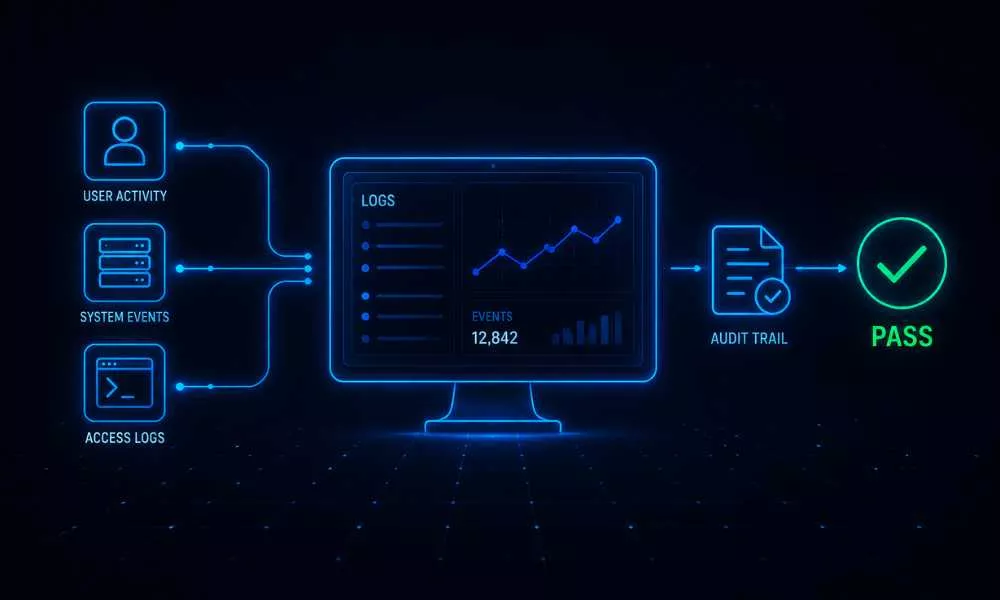
Manual log review is technically permissible but impractical at scale. Most organizations use a SIEM (Security Information and Event Management) system to automate ingestion, parsing, correlation, and alerting.
Requirement 10.5: Retain Logs for at Least 12 Months
PCI DSS requires that audit logs are retained for a minimum of 12 months, with at least 3 months immediately available for analysis. “Immediately available” means online or near-online storage not archived for tape or cold storage that can’t be queried quickly.
This is a common gap in many compliance programs. Organizations store logs but don’t verify retrieval of SLAs, or they archive everything to cold storage that can’t be queried in time for an audit.
Requirement 10.6: Protect Log Integrity
Your logs are only as trustworthy as their protection. PCI DSS requires that:
- Logs cannot be modified or deleted by the individuals who generate them.
- Log files are protected against unauthorized access.
- Hashing or other integrity mechanisms are used to detect tampering.
This means developers and system admins should never have the ability to alter production logs. Role separation is critical. Sending logs to a centralized, write-once logging platform, separate from the systems generating the events, is the architectural best practice here.
Requirement 10.7: Clock Synchronization (NTP)
All in-scope systems must use a consistent, documented time source. Inconsistent timestamps across systems make log correlation during incident investigations unreliable and will surface as a finding. Configure NTP across every in-scope system using a documented time source hierarchy and ensure your internal sources sync to a reliable external reference such as pool.ntp.org or a cloud provider’s time service. During your audit, expect to provide evidence of NTP configuration on in-scope systems and a documented policy identifying your authoritative time source, not just verbal confirmation that NTP is running.
How to Build a PCI DSS-Compliant Audit Trail
Step 1: Map Your Cardholder Data Environment (CDE)
Before you configure a single log source, you need a clear, current diagram of your CDE. Every system that stores, processes, or transmits cardholder data, and every system connected to it is in scope. Your logging strategy must cover all of it.
Step 2: Enable Logging at Every Layer
Compliant logging requires coverage across:
- Operating systems (Windows Event Logs, Linux syslog/audited)
- Databases (Oracle Audit Vault, MySQL General Query Log, etc.)
- Applications (custom app logging tied to user sessions and data access)
- Network devices (firewall logs, router/switch logs, VPN logs)
- Security tools (IDS/IPS, anti-malware, endpoint detection)
Gaps at any layer create audit findings. A common mistake is logging application events but ignoring database-level access logs, especially risky when DBAs have direct query access to cardholder tables.
Step 3: Centralize with a SIEM
Route all log sources to a centralized SIEM. This provides:
- Unified visibility across your entire CDE
- Real-time correlation and alerting
- Audit-ready dashboards and reports
- Long-term storage with retrieval capabilities
Ensure your SIEM has tamper-evident logging enabled, and that access to the SIEM itself is tightly controlled and logged.
Step 4: Automate Alerts for Critical Events
PCI DSS v4.0 requires automated detection, not just logging. Configure real-time alerts for:
- Failed authentication attempts (brute force indicators)
- Privilege escalation events
- Access outside business hours
- Large data exports or bulk queries on cardholder tables
- Changes to audit log configurations
- Failures of the logging system itself (new in v4.0)
Document every alert rule, its threshold, and the escalation path. Auditors will ask.
Step 5: Establish a Formal Log Review Process
Even with a SIEM, your program needs a documented log review process:
- Assign ownership: Who reviews logs daily? Who reviews security alerts?
- Document the process: Write a runbook for log review procedures
- Track exceptions: Maintain records of investigated events and outcomes
- Test periodically: Conduct internal log review tests to verify the process works
Auditors will ask to see evidence of log reviews, not just the capability, but proof it’s being done consistently.
Common PCI DSS Logging Failures to Avoid
- Incomplete log coverage from all in-scope system components.
- Incomplete event capture: Missing admin actions or authentication failures
- No log integrity controls: Logs that can be deleted or modified by admins
- Insufficient retention: Logs purged before 12 months, or archived to storage that can’t be queried in under 3 months
- No review process: Logs collected but never analyzed, a very common finding
- Clock synchronization issues: Inconsistent timestamps across systems (Requirement 10.7 mandates NTP)
- Logging system failures go undetected: New in v4.0, you must alert on logging failures, not just log events
Final Thoughts
PCI DSS logging and monitoring requirements exist because the evidence trail is often the only thing standing between a contained incident and a full-scale breach of investigation. Building an audit trail that passes isn’t just about checking boxes; it’s about creating a system that genuinely works when you need it most.
Start with your CDE scope, layer in comprehensive log coverage, centralize with a SIEM, automate alerting, and document everything. That combination will put you in a strong position for your next QSA audit and more importantly, for the security incidents you’ll eventually face. If you’re not sure where your current program stands against these requirements, a gap assessment is the most efficient place to start, it surfaces findings before your QSA does, when you still have time to remediate without a formal non-compliance mark on your ROC. Build a Stronger Logging Foundation. From architecture review to visibility optimization, our team helps you improve logging maturity and response readiness.
| Need Consultation? Connect with our PCI Experts to learn more about PCI Requirements |
Enjoyed reading this blog? Stay updated with our latest exclusive content by following us on Twitter and LinkedIn.