









Earning HITRUST r2 certification is one of the most credible security achievements an organization can demonstrate to clients, regulators, and business partners. It opens doors for healthcare contracts, federal vendor agreements, and enterprise SaaS deals, that require documented, third-party validated security assurance.
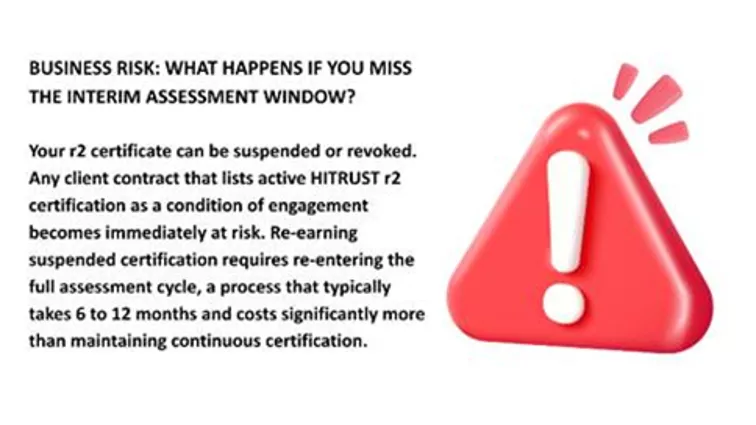
But here is what many r2 certificate holders discover too late: certification has a mandatory Year One checkpoint. Miss it, and you do not simply pause your certification status. You risk having it suspended and, in some cases, revoked entirely. For organizations where r2 is a contractual requirement with clients or partners, that is not just a compliance problem. It is a revenue problem.
This guide explains what the HITRUST r2 interim assessment covers, what your organization is at risk of losing if the process is mishandled, and how to prepare so that Year One becomes a routine checkpoint, not a crisis.
What Is the HITRUST r2 Interim Assessment?
The HITRUST r2 Interim Assessment is a mandatory mid-cycle compliance validation that occurs approximately 12 months after your initial r2 certification date. It is conducted by a HITRUST-approved External Assessor and submitted through the HITRUST MyCSF portal for review by the HITRUST Alliance, the same body that issued your certificate.
Unlike the full r2 assessment, which tests all in-scope control requirements across your environment, the interim assessment evaluates a defined subset of controls, specifically, one fixed control requirement drawn from each of the 19 HITRUST CSF domains, plus every open CAP from your initial assessment. That structure matters: it means all 19 domains are in play, not just the ones your team considers high-risk. Its core purpose is to confirm that the security posture documented at initial certification has been held and that every Corrective Action Plan (CAP) identified during the initial assessment has been formally closed.
According to the HITRUST Alliance, interim assessments are a non-negotiable component of maintaining active r2 certification status.
What Does the Interim Assessment Actually Evaluate?
Assessors work from a defined control subset, but the review is substantive. The four areas that drive most interim findings are:
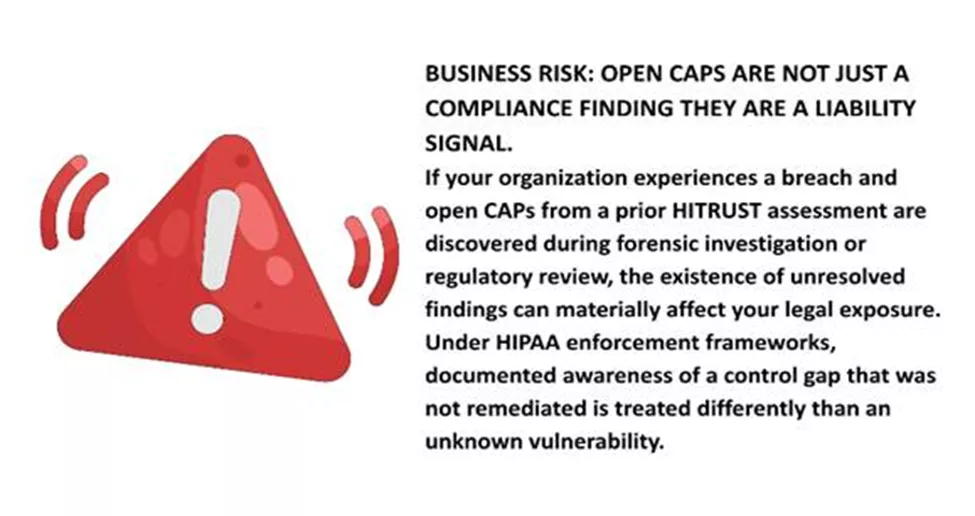
- CAP closure: Every Corrective Action Plan raised during your initial assessment must be formally closed with documented evidence. This is the single most common failure point. Organizations that logged CAPs at Year Zero and did not assign ownership, deadlines, or evidence requirements routinely arrive at the interim assessment with open items they assumed were handled.
- Policy and procedure currency: Documentation must reflect current operational reality. Personnel changes, new cloud environments, updated vendor relationships, if your policies have not kept pace, the gap will surface.
- Incident response and vulnerability management controls: These receive consistent assessor scrutiny because they are the most operationally visible controls. Evidence of regular patching cycles, documented incident response tests, and updated contact trees is typically required.
- HITRUST CSF version alignment: In 2026, most organizations are operating under HITRUST CSF v11.x, which introduced a restructured control hierarchy and new “traversable” requirement categories. If your initial certification was issued under an earlier CSF version, your Year One interim assessment is the point at which your assessor will expect evidence that you have mapped your control environment to the v11 traversable requirements, not deferred that work to re-certification. Organizations that arrive at the interim assessment without having completed this mapping consistently generate additional findings and remediation cycles. Address it early.
How to Prepare: A Five-Step Framework for Year One
Step 1: Close and document every CAP (90+ days out)
Pull your full CAP register from the initial assessment. For every item, confirm that remediation is complete and that evidence is documented, dated, and accessible. Verbal fixes and informal email threads are not evidence. You need configuration exports, policy version histories, signed approvals, and dated screenshots.
Step 2: Review all in-scope policies for currency
Walk through your policies, procedures, and system security plans. Identify anything that has changed since certification, new cloud services, personnel in key roles, and updated vendor agreements and ensure documentation reflects current operations. Pay particular attention to access management, encryption standards, and third-party risk controls.
Step 3: Run an internal readiness review
Conduct a structured dry run 60 to 90 days before your assessment window. Assign your internal team or engage a qualified HITRUST compliance consultant, to walk sampled controls as an assessor would. Document every gap, assign an owner, and set a remediation deadline. Any gap found internally is a gap you can close. Any gap found by your External Assessor is a finding that becomes part of your submission record.
Step 4: Engage your External Assessor at least 90 days early
HITRUST-approved External Assessors have constrained scheduling windows. Waiting until 60 days before your interim window typically means the earliest available slot falls outside your certification window. Engage early, align on evidence format, and clarify scope of expectations before documentation preparation begins.
Step 5: Build a structured evidence package
Organize evidence in clearly labeled folders aligned to the HITRUST MyCSF control categories your assessor will be working with. A well-structured evidence package reduces assessment duration, signals organizational maturity, and gives your assessor confidence in your program, all of which influences how findings are characterized in the final report.
Three Mistakes That Turn a Routine Checkpoint into a Business Risk
- Treating the interim scope is narrower than it is. Organizations that assume the interim assessment will only touch a handful of low-risk controls are regularly surprised. Assessors are trained to provide evidence of security drifts, not just tick boxes.
- Failing to track CAP closure as an ongoing process. CAP management should not be a Year One activity; it should be a standing agenda item in your security governance calendar from the day your initial certificate is issued.
- Undocumented infrastructure changes. New cloud environments, network re-architecture, significant vendor change, each of these can carry compliance implications. If your control documentation does not reflect the current state environment, your assessment will.
How Ampcus Cyber Supports r2 Certificate Holders Through the Interim Cycle
Ampcus Cyber provides end-to-end HITRUST assessment services built for organizations at every stage of the certification lifecycle, not only at initial certification. Our certified assessors have guided organizations across healthcare technology, financial services, and enterprise SaaS through both initial r2 certification and Year One interim assessments.
Our interim assessment support includes a structured HITRUST gap analysis against your existing CAP register, control documentation review, evidence preparation, and direct coordination with your External Assessor. For organizations that want to eliminate the cost and disruption of re-certification at Year Two, we also offer a continuous compliance monitoring program under our broader HITRUST compliance services offering.
The Bottom Line
The HITRUST r2 interim assessment is not a formality. It is a substantive obligation with real business consequences if mishandled. Organizations that approach it as part of a continuous security program, rather than a one-time compliance event, consistently experience lower remediation costs, faster assessment cycles, and stronger re-certification outcomes at Year Two.
| Don’t let a “routine” Year One become a “revoked” Year Two. Schedule your readiness review today and give your team the runway they need to close every gap before the window opens. |
Enjoyed reading this blog? Stay updated with our latest exclusive content by following us on Twitter and LinkedIn.