









AI agents now approve payments, update records, and push code into production without human review at each step. When an agent misbehaves, security teams often detect the problem quickly but struggle to stop it, because shared service accounts and embedded API tokens make containment slow and uncertain. The AI kill switch closes that gap. This guide explains what it is, how it works, what regulators expect, and whether your enterprise needs one.
What Is An AI Kill Switch In Enterprise Security?
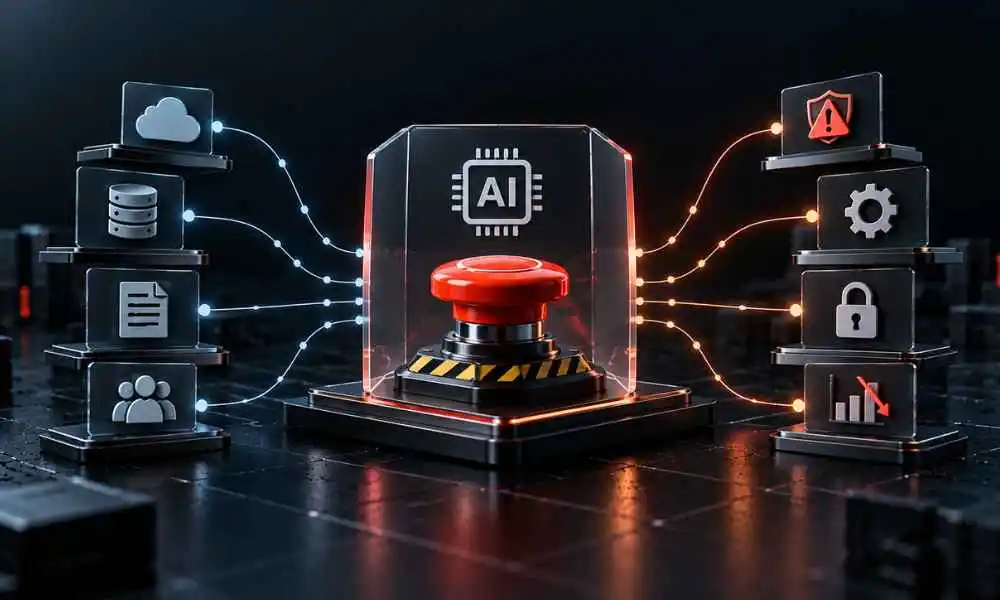
An AI kill switch is a predefined control that lets authorized people stop, pause, or isolate an AI system and bring it to a safe state when it behaves in unsafe or unexpected ways. In enterprise security, the term rarely describes a single physical button. It describes a set of technical and governance mechanisms, such as credential revocation, permission scoping, workflow suspension, and traffic blocking, that operate outside the AI system’s own reasoning. That independence matters because an agent that has lost context, been manipulated, or drifted from its objective cannot be trusted to obey a request to stop. A mature kill switch also defines who can activate it, what happens to in-flight tasks, and how the system resumes after review.
How Does An AI Kill Switch Work For Agentic AI Systems?
An AI kill switch works by cutting the agent off from the identities, tools, and data it depends on, rather than asking the model to stop itself. Most enterprise designs combine four layers of control:
- Identity revocation: Security teams disable or rotate the agent’s credentials, API keys, and OAuth tokens so it can no longer authenticate to connected systems. This layer depends on every agent having its own identity, which is why Agentic IAM is becoming the control plane for AI agents.
- Scoped capability removal: The team withdraws a single high-risk permission, such as payment approval or record deletion, while leaving low-risk read access in place so business operations continue.
- Workflow pause: The orchestration layer holds queued actions for human review instead of discarding them, which preserves state and prevents half-completed transactions.
- Automated circuit breakers: Predefined thresholds on transaction volume, spend, error rates, or anomaly scores trip the switch automatically when the agent behaves outside its normal pattern.
Many organizations pair these layers with a Governor Agent that evaluates intent in real time and flags high-risk actions before they execute.
Why Do Enterprises Need An AI Kill Switch Now?
Enterprises need an AI kill switch now because AI agents have moved from drafting content to executing actions inside production systems. An agent with write access can send emails, modify records, approve transactions, and push code without waiting for a person to review each step. Governance maturity has not kept pace with adoption. According to Deloitte’s 2026 State of AI in the Enterprise report, as cited by industry analysts, only 21% of organizations report a mature governance model for AI agents, while 74% expect to run agentic AI within two years.
Every added tool connection widens the AI agent blast radius, and attackers can redirect agents through techniques such as prompt injection. Vendor dependency adds another layer of exposure. Gartner has warned that enterprises hard-coding their agentic workflows to a single provider’s API lose control and uptime if that vendor is forced to alter capabilities, remove tools, or impose heavy rate limits. A kill switch paired with a tested fallback plan keeps business processes recoverable.
Is An AI Kill Switch Required By Law Or Regulation?
Some regulations already require the capability behind an AI kill switch, and others are moving in that direction. Under the EU AI Act, human oversight of high-risk AI systems must include the ability to intervene in or interrupt the system through a stop button or comparable procedure that halts it in a safe state, as set out in Article 14.
In the United States, Representatives Ted Lieu and Nathaniel Moran introduced the AI Kill Switch Act on July 23, 2026, which would require developers of the most powerful AI systems to retain the technical ability to throttle, suspend, or shut them down, and would let the Homeland Security Secretary order a slowdown or shutdown of systems capable of catastrophic harm. The bill targets frontier developers rather than enterprise users, yet its effects will reach any company that builds workflows on those models.
The NIST AI Risk Management Framework sets a similar expectation through its Manage function, which calls for mechanisms to supersede, disengage, or deactivate AI systems that perform inconsistently with their intended use. For governance leaders, the direction is consistent: auditors and regulators will increasingly ask for evidence of a working stop capability.
Does Every Enterprise Need An AI Kill Switch?
Every enterprise that allows AI to take autonomous actions needs an AI kill switch, though the depth of the control should match the risk. A marketing team using an AI assistant to draft internal copy needs little more than the ability to disable access quickly. An agent that approves refunds, changes firewall rules, or processes patient data needs layered controls, automated triggers, and a named owner on call. The EU AI Act follows the same logic, since it scales oversight measures to the risks, level of autonomy, and context of use of each system.
A practical test works well for most organizations. If an action would require manager approval when a human employee performed it, the agent performing that action should sit behind a kill switch. Enterprises that cannot list every agent in their environment should start with discovery, because shadow AI deployments often carry the broadest permissions and the weakest oversight.
How Can CISOs Build And Test An Effective AI Kill Switch?
CISOs build an effective AI kill switch by treating it as an incident response capability that is designed, owned, documented, and rehearsed before deployment. In our work with security and compliance teams, the organizations that recover fastest follow a consistent sequence:
- Inventory every AI agent, its business owner, its identity, and the systems it can reach.
- Assign each agent a unique, non-shared identity with least-privilege access.
- Define activation triggers, such as policy violations, anomaly spikes, cost overruns, or confirmed compromise.
- Name the people authorized to activate the switch and document the escalation path.
- Specify how in-flight tasks are held, rolled back, or completed safely.
- Require deliberate human-in-the-loop approval before any agent restarts.
- Test the switch through tabletop exercises and live drills at least once a quarter.
Testing exposes the problems that documentation hides, including hardcoded tokens, shared service accounts, and undocumented dependencies. Every activation should produce a log that auditors can review and that engineers can use to improve the agent.
What Should Enterprise Leaders Do Next?
The logistics company in our opening scenario had capable engineers and mature security tools, yet it had no tested plan for stopping an autonomous system operating at full speed. An AI kill switch closes that gap and gives boards, auditors, and regulators evidence that the organization remains in control of its AI. Enterprises that build this control early will scale agentic AI with more confidence, while those that wait will discover their gaps during an incident.
Turning Vendor Risk Into Decisions Your Board Can Trust
Vendor risk quantification gives CISOs and governance leaders a defensible answer to the question boards ask most often about suppliers, which is where the next breach is likely to come from. Wizard supports that answer with tiering, evidence-backed questionnaires, exposure intelligence, and continuous monitoring in one place. Teams move from counting completed questionnaires to reducing measurable risk. For organizations facing DPDP, PCI DSS, or DORA vendor oversight expectations, that shift also produces cleaner audit evidence.
| Talk to Ampcus Cyber’s AI governance experts to design, implement, and test an AI kill switch that keeps every autonomous agent in your enterprise accountable, auditable, and under your control. |
People Also Ask
What is an AI kill switch in simple terms?
Is an AI kill switch the same as a circuit breaker?
Does the EU AI Act require an AI kill switch?
Who should have authority to activate an AI kill switch?
How often should an AI kill switch be tested?
Enjoyed reading this blog? Stay updated with our latest exclusive content by following us on Twitter and LinkedIn.