








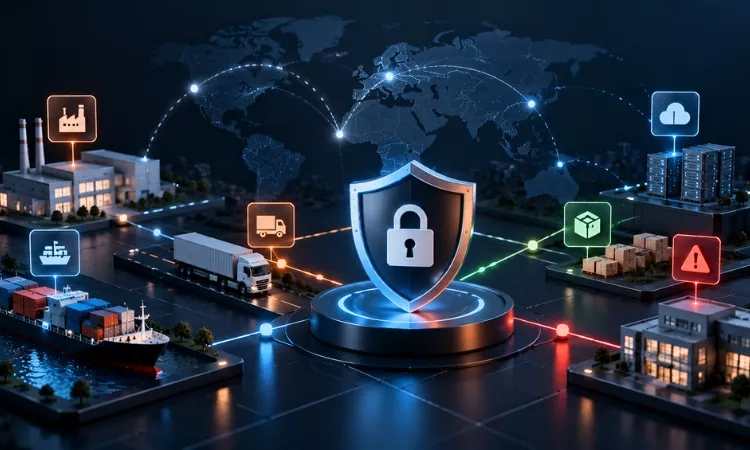
Organizations no longer operate alone. They rely on cloud providers, software vendors, payroll processors, managed service providers and the subcontractors behind each of them. Vendors connect through APIs, service accounts and privileged access, so a weakness at one supplier can open a path into the buyer’s systems and data. A flaw in one shared product can reach thousands of organizations at once.
Security teams without a mapped vendor inventory or visibility into sub-processors cannot say quickly which suppliers are affected. Supply chain risk management closes that gap by identifying, assessing and reducing risk across every supplier, product and service an organization relies on. This guide explains what it is, which risks it covers, which frameworks guide it and how to build a program that works under pressure.
What Is Supply Chain Risk Management?
Supply chain risk management is the process of identifying, assessing and reducing the risks that arise from the suppliers, vendors, software and services an organization depends on. The practice covers the full chain, from direct vendors to the subcontractors behind them. NIST describes cybersecurity supply chain risk management as a systematic process for managing exposure to cybersecurity risk throughout supply chains and developing response strategies. For a CISO, the working question is simple: if a supplier fails or is compromised, how far does the damage reach? The chain includes software libraries, cloud platforms, managed service providers, hardware, logistics partners and outsourced staff. A weakness in any link can reach your systems through trusted connections such as APIs, federated logins and data synchronization jobs, which is why attackers follow trust paths instead of network diagrams.
Why Is Supply Chain Risk Management Important Today?
Supply chain risk matters because one compromise reaches many targets, and attackers know it. Verizon’s 2026 Data Breach Investigations Report found third-party involvement in 48% of breaches, up from 30% a year earlier and 15% the year before that. The same report found that exploiting software flaws, at 31% of breaches, overtook stolen credentials as the top entry point for the first time, which makes a supplier’s patching speed a direct factor in your own exposure. Risk ownership does not transfer with access, so regulators and customers still hold the organization accountable when a supplier fails. The 2023 MOVEit incident showed the effect at scale. Attackers exploited a flaw in MOVEit Transfer to breach Zellis, a UK payroll provider, and the breach exposed employee data at its customers British Airways, the BBC and Boots.
What Types Of Supply Chain Risks Do Organizations Face?
Organizations face five main categories of supply chain risk:
- Cyber and software risk: compromised updates, vulnerable components and malicious code in vendor products.
- Access risk: over-privileged API tokens, shared service accounts and vendor-managed administrative access.
- Data risk: personal or regulated data copied into vendor systems, backups and logs that the organization does not monitor.
- Operational and concentration risk: many vendors depending on the same cloud or platform provider, so one outage spreads widely.
- Compliance risk: gaps in evidence, contracts or sub-processor transparency that surface during an audit.
Who Is Responsible For Supply Chain Risk Management?
Responsibility is shared, and executive ownership matters most. The CISO owns the cyber risk view, procurement owns onboarding and contracts, legal owns liability terms and the risk function owns the enterprise view. The board expects evidence that oversight exists and works. Many programs stall because each team holds one piece and nobody owns the whole picture, so assign a single accountable owner and a clear escalation path. Smaller teams can start with a shared register and a monthly review of critical suppliers, then grow into dedicated tooling.
What Are The Key Components Of A Supply Chain Risk Management Program?
A working program rests on six components:
- Vendor inventory and tiering: a central registry that classifies suppliers by data sensitivity, business criticality and access level.
- Tier-based due diligence: assessment depth that matches the tier, for example questionnaires, certifications and evidence review.
- Contractual safeguards: breach notification windows, security requirements, data retention limits and sub-processor disclosure.
- Continuous monitoring: live signals on vendor security posture and vulnerabilities instead of annual snapshots.
- Incident response and exit plans: joint playbooks, outage procedures and the ability to leave a vendor safely.
- Fourth-party and concentration oversight: visibility into the subcontractors and shared infrastructure behind critical suppliers.
Which Frameworks And Standards Guide Supply Chain Risk Management?
Several frameworks give structure to the practice. NIST SP 800-161 Rev. 1 provides detailed guidance for cybersecurity supply chain risk management across enterprise, mission and system levels. NIST CSF 2.0 places supply chain risk in the Govern function through the GV.SC category, and NIST publishes a quick-start guide for C-SCRM that explains it. ISO 28000 and ISO/IEC 27036 address supply chain security and supplier relationships. DORA expects financial entities to understand dependency chains, and CMMC flows security requirements down to defense subcontractors. Teams already aligned to the NIST CSF can extend that work into supplier governance.
What Is The Difference Between Supply Chain Risk Management And Third-Party Risk Management?
Supply chain risk management is the broader discipline, and third-party risk management is its vendor-focused core. Supply chain risk management covers suppliers, products, software components, logistics and the dependencies behind them. Third-party risk management concentrates on the external parties that touch your data, systems or operations. The two overlap heavily in cybersecurity, and many teams run them as one program. Ampcus Cyber’s guide to what is TPRM is covers the vendor side in detail.
When Should Organizations Reassess Supply Chain Risk?
Reassess continuously and treat specific events as hard triggers. A new critical vendor, a major zero-day in a shared technology, a vendor incident, a merger or a change in vendor access should each prompt a fresh review. Quarterly reviews leave risk windows measured in months. Continuous intelligence shortens detection to days or hours, which directly affects containment cost and regulatory reporting timelines.
Where Do Most Supply Chain Risk Programs Fall Short?
Most programs fall short on visibility beyond the first contractual boundary. Teams hold vendor lists but lack dependency intelligence, so they cannot say which suppliers rely on the same vulnerable platform. Static scoring adds to the problem, because a rating set at onboarding ignores new exploit activity. Useful metrics include the mean time to identify affected vendors, the share of critical vendors under continuous monitoring and the visibility into Nth-party dependencies.
How Do You Build A Supply Chain Risk Management Program?
Build the program in five steps:
- Centralize your vendor inventory and apply risk tiers.
- Define control requirements for each tier and embed them in procurement.
- Automate onboarding, assessments and remediation tracking.
- Add continuous monitoring with clear escalation thresholds.
- Extend oversight to fourth parties and concentration risk.
Start with the suppliers that touch regulated data or support revenue and expand outward, because tiering the full vendor base first delays the controls that matter most. Then run a tabletop exercise on a critical vendor outage so that the exit plan and the escalation path get tested before a real incident.
| Talk to Ampcus Cyber’s third-party risk experts to map your supplier dependencies, quantify vendor exposure and build a program that holds up under pressure. |
People Also Ask
What is cybersecurity supply chain risk management (C-SCRM)?
NIST defines it as a systematic process for managing exposure to cybersecurity risk throughout supply chains and developing response strategies.
What are the four main supply chain risks?
Common groupings include cyber and software risk, access and data risk, operational and concentration risk, and compliance risk.
What is the difference between SCRM and TPRM?
SCRM is the broader discipline that includes products, software and logistics, and TPRM focuses on the external parties that touch your data and systems.
Which framework should I use for supply chain risk management?
NIST SP 800-161 Rev. 1 and the GV.SC category of NIST CSF 2.0 are the most common starting points, with ISO 28000 and ISO/IEC 27036 as complements.
How common are third-party breaches?
Verizon’s 2026 DBIR reported third-party involvement in 48% of breaches, up from 30% the year before.
Enjoyed reading this blog? Stay updated with our latest exclusive content by following us on Twitter and LinkedIn.