








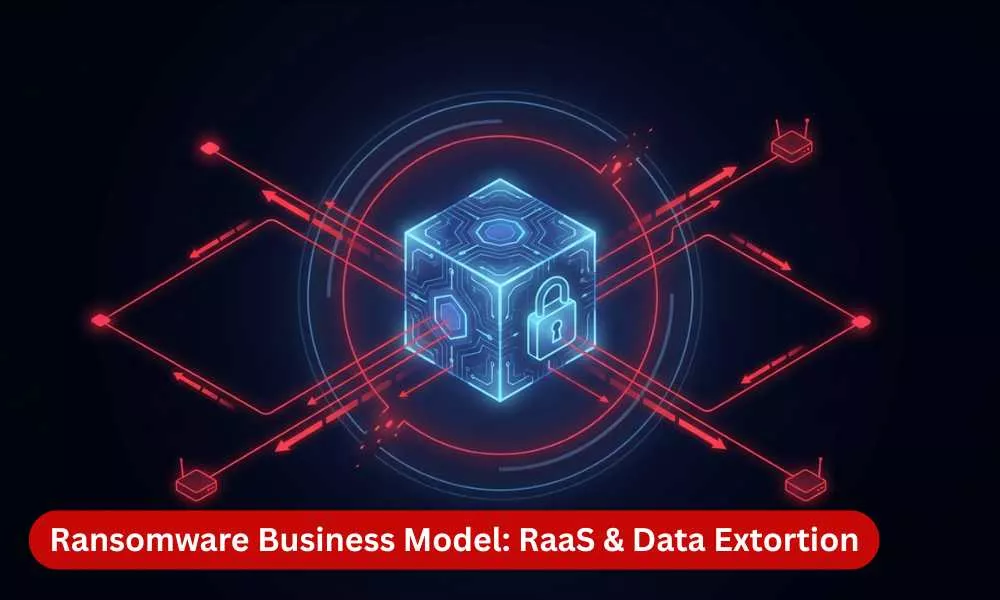
The ransomware business model has evolved from simple encryption attacks into a structured, multi-revenue cybercrime economy. Today, it combines data extortion, ransomware-as-a-service (RaaS), and secondary monetization through data resale and auctions.
Organizations are no longer facing isolated attacks, they are operating within an adversarial system designed to identify, extract, and monetize high-value data assets. This is the fundamental shift: ransomware is no longer just a security incident. It is a business model targeting enterprise value.
Ransomware Statistics That Define the Threat Landscape
The current ransomware landscape is best understood through a set of defining metrics, but the insight lies in what they signal:
- 78% of organizations experienced ransomware attacks within a year.
- Ransomware is no longer an exception; it is an expected operational risk.
- 83% of victims faced repeat attacks, and 93% still had data stolen even after payment. Paying a ransom does not eliminate exposure; it often extends it.
- Average breakout time is ~29 minutes (with extreme cases as low as 27 seconds) The operational benchmark is the average, not the outlier. Most organizations cannot respond within this window.
- More than 50% of attacks execute within 24 hours of initial access. Delayed detection effectively guarantees attack progression.
- $1.1 billion in ransomware payments recorded in 2023. This reflects only reported ransom flows. The total economic impact, including downtime, settlements, and data resale, is significantly higher.
- Only 23% of organizations now pay ransom demands. Attackers are adapting by shifting toward alternative monetization models.
- 76% of organizations report struggling to keep pace with AI-driven threats. The gap is not awareness, it is speed and execution.
Taken together, these signals point to a clear reality: ransomware is scaling as a system, not just as a threat.
Ransomware Evolution: From Encryption to Data Extortion
Ransomware has evolved in response to defensive maturity. Encryption-based attacks were effective when recovery options were limited. As organizations improved backups, attackers introduced data exfiltration, ensuring that recovery did not eliminate risk. This marked the rise of data extortion, where exposure became the primary pressure point.
Today, the model has evolved further. Data is no longer just leverage; it is the core product. Attackers are monetizing it directly through resale and auction ecosystems, reducing reliance on ransom payments entirely.
Ransomware-as-a-Service (RaaS): How Cybercrime Scales
Ransomware-as-a-service (RaaS) has transformed ransomware into a scalable, modular ecosystem. Attack development, execution, and monetization are now distributed across specialized actors. This mirrors legitimate SaaS models and enables rapid scaling, consistent execution, and continuous innovation.
The result is not just more attacks, but attacks that are more efficient. Ransomware is no longer a single actor problem. It has become an industry.
Ransomware Attack Speed: Why 29 Minutes Changes Everything
The defining constraint in modern ransomware defense is time. The average breakout time of approximately 29 minutes means attackers can move laterally and escalate privileges before most detection workflows activate. The key enabler is identity.
Modern attacks increasingly begin with compromised credentials, identity misuse, or access token abuse, allowing attackers to operate inside trusted environments. This means traditional perimeter and signature-based controls are bypassed by design. This is not a tooling gap but a timing and visibility gap.
Data Extortion and Data Auctions: The New Monetization Model
Ransomware is shifting from a negotiation-based model to a market-driven one. With fewer organizations paying ransoms, attackers are increasingly monetizing data through auctions and resale markets.
Once exfiltrated, data becomes a reusable asset. It can be sold multiple times, used in fraud, or leveraged in future attacks. This transforms a breach into a persistent risk event, where impact continues long after the initial compromise.
AI and the Ransomware Kill Chain: Where Defenses Lag
AI is accelerating ransomware execution, but unevenly. The pressure is concentrated in specific areas: credential compromise bypasses endpoint-focused detection, identity-driven lateral movement evades weak behavioral analytics, and detection timelines lag compressed attack cycles
This is why organizations struggle, not because controls don’t exist, but because they are misaligned with attacker behavior. Cybercrime is operating at machine speed. But most defenses are not.
The Strategy for Identity, Detection, and Assumed Exfiltration
Detection engineering must prioritize identity telemetry, authentication anomalies, privilege escalation, and session behavior. The attack surface now includes federated identity, OAuth tokens, and third-party integrations, where trust relationships can be exploited silently.
Mean time to detect must align with sub-30-minute breakout timelines. Anything slower creates structural exposure. At the same time, third-party risk must be reframed as identity risk. Compromised vendors and federated access create indirect entry points into core systems.
But the most critical shift should be the response strategies that must assume that data exfiltration has already occurred. This is no longer a worst-case scenario; it is the most probable one. This shift also impacts cyber insurance. Carriers increasingly require identity visibility, MFA enforcement, privileged access controls, and rapid detection capabilities. Organizations that cannot demonstrate these controls are seeing higher premiums, reduced coverage, or exclusions.
At the same time, leading organizations are investing in data devaluation strategies, encryption, tokenization, and segmentation to ensure that even if data is stolen, its value is limited. This reframes the problem: not just preventing theft but reducing the economic value of stolen data.
What Matters the Most: Ransomware Strategy
Ransomware is now a business risk requiring executive ownership. There are three major questions that need real answers:
- If critical data were exposed, what would be monetized and what would the business impact look like over the next 12–24 months?
- Are detection and response capabilities aligned with modern attack timelines?
- Is there a strategy for operating in a scenario where data is exposed regardless of ransom payment?
These are not awareness questions but decision frameworks.
Ransomware Defense Architecture: Automation, SOAR, and Zero Trust Data
The velocity gap between attackers and defenders is now structural. When breakout times are measured in minutes, manual SOC workflows cannot respond fast enough. This makes automation and SOAR (Security Orchestration, Automation, and Response) critical to closing the gap.
At the same time, data auctions demand a shift toward data-centric security architecture. Organizations must move toward data classification and tagging, encryption across all states (at rest, in transit, and in use), and segmentation aligned to data sensitivity. This enables a Zero Trust Data model, where data remains protected regardless of location or access path.
Because in a data auction economy, the objective is not just to prevent access, it is to ensure stolen data has minimal value.
Conclusion: The Future of the Ransomware Business Model
Ransomware is no longer defined by encryption or extortion; it is defined by economics. Data is currency, access is inventory, and attacks are transactions. Organizations are not being attacked in the traditional sense, they are being audited by a hostile entity looking for liquid assets.
The transition from double extortion to data auctions signals a more resilient and scalable cybercrime ecosystem, one that no longer depends on victim behavior to succeed. Because in the current scenario, a breach is not the end of the story but the beginning of a market lifecycle.
What is the “Ampcus Cyber” Approach for This
Defending against modern ransomware requires alignment across risk, validation, and detection, not isolated tools. At the foundation, organizations need continuous visibility into risk posture and control effectiveness. GRACE, our continuous compliance tool, enables this by providing centralized governance, compliance alignment, and evidence-backed insight into where exposure exists and how it maps to business impact.
This visibility must be continuously validated. Wizard, our continuous vendor risk assessment tool helps assess whether controls are functioning as intended, identifying gaps across identity, infrastructure, and security configurations before they are exploited.
Finally, real-time detection and observability are critical. Mirror, our AI penetration testing tool, provides visibility into identity-driven attacks, lateral movement, and anomalous behavior within compressed attack timelines.
Together, this approach reflects a more realistic defense model by helping you understand risk, validate controls, and detect and respond. This is not a tooling strategy; it is an operating model aligned to how ransomware works.
| Want to understand your real exposure? Our experts will help you map it. Contact us now. |
Enjoyed reading this blog? Stay updated with our latest exclusive content by following us on Twitter and LinkedIn.