






A growing fintech company runs its customer-facing application on AWS, stores analytics data in Google Cloud, and uses Microsoft Azure for identity and access management (IAM) and internal tools. Each cloud provider has its own security controls, configurations, and access policies.
One misconfigured storage bucket in one environment exposes sensitive customer data, and due to a lack of unified visibility, the issue goes unnoticed. Meanwhile, inconsistent access controls allow an attacker to move between cloud environments, increasing the impact of the breach.
This is a typical example of a multi-cloud environment and the security challenges that come with it.
What Is Multi-Cloud Security?
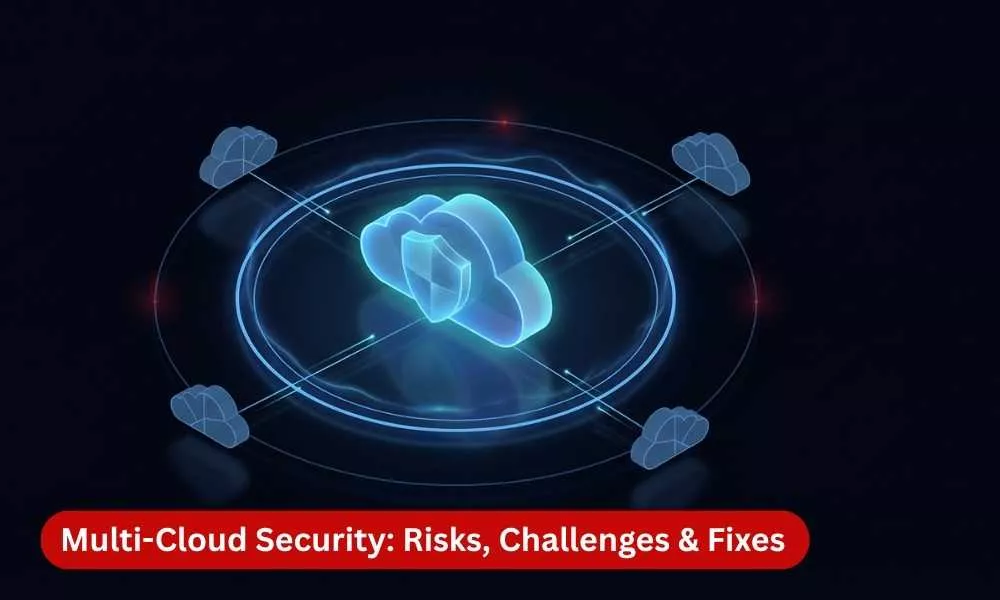
Multi-cloud security is the practice of protecting data, applications, APIs, and infrastructure deployed and managed across two or more cloud platforms from multiple cloud service providers, such as AWS, Microsoft Azure, and Google Cloud Platform, under a unified, consistent security framework.
Unlike traditional perimeter-based security designed for on-premises environments, multi-cloud security addresses a decentralized architecture where workloads, users, and data move across cloud boundaries. The goal is to provide comprehensive risk management regardless of where applications or data are hosted.
Key Definition:
Multi-cloud security is equivalent to consistent visibility with unified policy enforcement and centralized governance across all cloud platforms simultaneously.
Multi-Cloud vs. Hybrid Cloud Security
| Multi-Cloud | Hybrid Cloud |
| Secures workloads across two or more public cloud providers, focusing on consistency across diverse architectures. | Secures apps across public clouds and private/on-prem environments, focusing on boundary protection. |
A multi-cloud security strategy can also be applied to hybrid environments, making it flexible and scalable.
Why is Multi-Cloud Adoption Growing?
Organizations adopt multi-cloud strategies for the following reasons:
- Flexibility to choose best-of-breed services.
- Scalability and cost optimization.
- Avoidance of vendor lock-in.
- Geographic distribution for low-latency delivery.
- Business continuity and disaster recovery.
- Mergers, acquisitions, and developer-driven adoption.
What is Multi-Cloud Security Architecture?
A robust multi-cloud security architecture establishes layered defenses across environments:
- Centralized Management: Unified dashboards, reporting, and logging for visibility and governance.
- Identity and Access Management (IAM): Consistent access control across providers to prevent unauthorized access.
- Data Protection: Encryption, backup, and disaster recovery to ensure integrity and availability.
- Network Security: Secure connections, segmentation, and Zero Trust Network Access (ZTNA).
- API Security: API discovery, authentication, rate limiting, and threat monitoring.
- Advanced Services: WAF, CDN, DDoS protection, and cloud-native firewalls.
- Compliance and Governance: Mapping policies to frameworks and standards such as GDPR, HIPAA, SOC 2, and PCI-DSS with automated scanning.
- Threat Detection and Response: SIEM, SOAR, and threat intelligence for real-time detection and remediation.
What are the Challenges of Multi-Cloud Security?
1. Complexity and Fragmentation
Different providers use different tools and configurations, creating inconsistency and configuration drift.
2. Limited Visibility and Control
Lack of centralized monitoring in many organizations reduces visibility into threats and misconfigurations.
3. IAM Complexity
Inconsistent access controls and privilege management increase breach risks.
4. Data Security and Privacy
Data across regions introduces compliance and privacy challenges.
5. Compliance Across Jurisdictions
Regulatory requirements vary across providers and geographies.
6. Vendor Dependencies and Interoperability
Interdependencies and incompatible APIs complicate security integration.
7. Skills Gap and Operational Costs
Specialized expertise and tooling increase operational burden.
Critical Stat
Organizations operating in multi-cloud environments face up to 3x more misconfigurations than single-cloud deployments
What are the Key Security Risks in Multi-Cloud Environments?
- Misconfigured resources (open ports, exposed storage)
- Data exposure due to lack of classification or encryption
- Lateral movement across environments after breaches
- Shadow IT adoption outside governance
- Supply chain attacks on third-party integrations
- Alert fatigue from fragmented monitoring tools
- Data loss due to weak backup processes
- Compliance violations from cross-border data movement
What are the Solutions and Best Practices?
- Adopt a Unified Security Policy: Apply consistent policies across all providers.
- Implement CNAPP and CSPM: Continuously scan for misconfigurations and compliance gaps.
- Centralize IAM: Enforce least privilege, MFA, and PAM consistently across cloud environments through proper configuration and governance.
- Embrace Zero Trust: Continuously verify users, devices, and applications.
- Encrypt Data End-to-End: Secure data at rest and in transit with centralized key management.
- Invest in XDR: Enable cross-cloud threat correlation and automated response.
- Automate Compliance Management: Map findings to frameworks like GDPR, HIPAA, SOC 2, and ISO 27001.
- Collaborate with Cloud Providers: Align with shared responsibility models and native security tools.
- Build a DevSecOps Culture: Integrate security into development using IaC scanning.
- Train Security Teams: Address skill gaps through training, exercises, and partnerships.
Best Practice Tip
Start by mapping all cloud resources and data flows. You cannot secure what you cannot see.
Conclusion
Multi-cloud security is a strategic imperative for organizations operating in a distributed digital landscape. As cloud adoption accelerates, the attack surface expands, and managing security across multiple providers creates exploitable gaps.
By adopting a unified security strategy built on centralized visibility, consistent policy enforcement, Zero Trust principles, automated compliance, and strong identity governance, organizations can harness the flexibility and cost benefits of multi-cloud architectures without sacrificing security or resilience.
The most effective multi-cloud security programs treat security as a foundational design principle embedded into every cloud workload from day one.
| Unify your cloud security with Ampcus Cyber and take control of your multi-cloud. |
Enjoyed reading this blog? Stay updated with our latest exclusive content by following us on Twitter and LinkedIn.