






TL;DR
- Continuous vendor risk monitoring replaces the annual questionnaire cycle with ongoing, automated tracking of a vendor’s security posture, using signals such as external attack surface exposure, breach disclosures, certificate health, and financial or regulatory changes.
- The case for it is no longer theoretical: Verizon’s 2026 Data Breach Investigations Report found third-party involvement in breaches reached 48%, up 60% year over year, while IBM’s 2025 Cost of a Data Breach Report found supply chain breaches take an average of 267 days to identify and contain.
- Done well, continuous monitoring is tiered by vendor risk level, paired with human review to prevent alert fatigue, and wired into procurement, identity and access management, and incident response, not run as a separate, siloed feed.
The scenario below is a composite, illustrative example, not a report of a specific incident.
A regional bank’s third-party risk team closed its annual vendor review cycle in January, rating a core payment-processing vendor as low risk based on a SOC 2 report from the previous autumn. Nothing changed in the file for the rest of the year, because nothing was scheduled to.
In August, that vendor suffered a ransomware intrusion that sat undetected in its network for weeks before spreading into shared infrastructure. When the bank’s incident response team asked how current their risk data on the vendor was, the honest answer was seven months old, gathered before the compromise had even started.
The abovementioned scenario is a composite, illustrative example to help you understand that the gap between when a vendor’s risk changes and when an organization finds out about it is exactly what continuous vendor risk monitoring is built to close.
What Is Continuous Vendor Risk Monitoring?
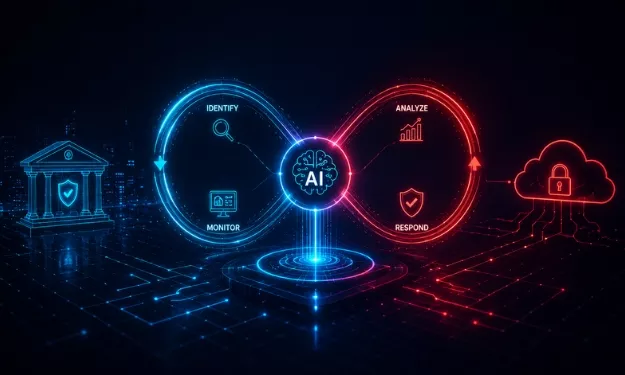
Continuous vendor risk monitoring is the ongoing, largely automated tracking of a third party’s security and business posture between formal assessments, rather than relying solely on a point-in-time questionnaire or annual audit. Instead of asking a vendor once a year to self-report its controls, continuous monitoring pulls in external, verifiable signals on a rolling basis: newly exposed systems, leaked credentials, expired certificates, breach disclosures, adverse financial news, and regulatory actions, among others.
The shift reflects a basic reality about risk: a vendor’s security posture is not fixed on the day it signs a contract. It changes with every new employee, every software update, every misconfigured cloud bucket, and every attacker who finds a way in. A third-party risk management program that only checks in once a year is, by definition, blind for the other 364 days.
How Does Continuous Vendor Risk Monitoring Work?
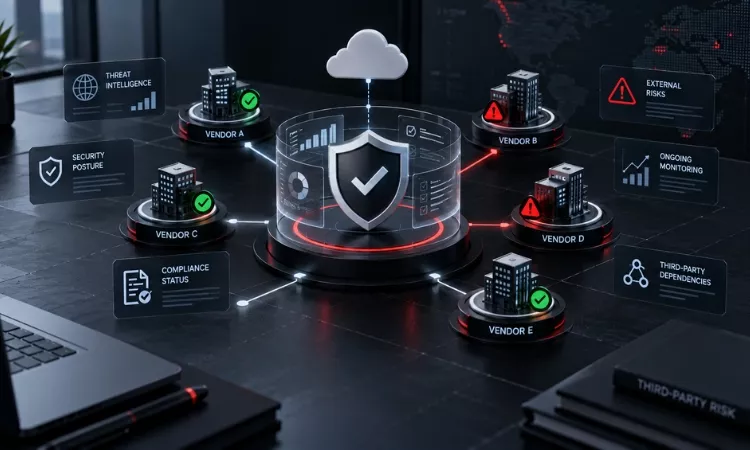
Continuous vendor risk monitoring works by aggregating multiple external and internal data feeds into a single, ongoing risk picture for each vendor, then flagging changes that cross a defined threshold. The specific signals vary by platform and industry, but a mature program typically tracks:
- External attack surface exposure: open ports, exposed admin panels, outdated software versions, and misconfigured cloud storage visible from outside the vendor’s network.
- Security ratings: algorithmic scores, similar in spirit to a credit score, built from observable technical hygiene indicators such as patching cadence and email authentication configuration.
- Breach and dark web signals: public breach disclosures, leaked credential dumps, and mentions of the vendor on criminal marketplaces or forums.
- Certificate and domain health: expired TLS certificates, suspicious domain registrations, and DNS changes that could indicate compromise or neglect.
- Financial and corporate signals: adverse credit events, executive turnover, mergers, or bankruptcy filings that could affect a vendor’s ability to maintain its security commitments.
- Regulatory and sanctions activity: enforcement actions, fines, or sanctions list additions relevant to the vendor’s jurisdiction or sector.
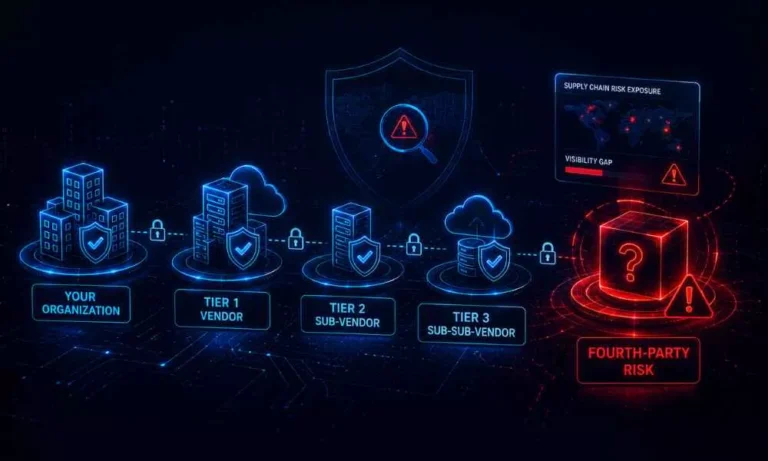
- Fourth-party and sub-processor exposure: the vendor’s own vendors, tracked because a subcontractor’s weakness can become the organization’s problem without a direct contractual relationship to show for it.
These signals feed into a scoring model that raises or lowers a vendor’s risk tier, triggering a re-review, an outreach request, or an escalation when the change is significant enough to matter. Ampcus Cyber’s Wizard platform is built around this model, correlating identity exposure, ecosystem behavior, and dependency mapping so that a posture change surfaces as a prioritized signal instead of another line in a spreadsheet.
What Are the Benefits of Continuous Vendor Risk Monitoring?
The core benefit of continuous vendor risk monitoring is time: catching a vendor posture change in days instead of discovering it during next year’s questionnaire, or worse, during incident response. IBM’s 2025 Cost of a Data Breach Report found that supply chain and vendor compromise breaches took an average of 267 days to identify and contain, longer than almost any other breach category the report tracks, and cost organizations an average of $4.9 million. Every one of those days is a window where continuous monitoring, rather than an annual cycle, has a chance to catch the problem earlier.
Beyond speed, continuous monitoring changes how a security team allocates its attention. Rather than spreading equal effort across every vendor once a year, teams can concentrate ongoing scrutiny on the vendors that carry the most risk, while lower-risk vendors are checked less frequently. This tiered model also gives boards and regulators something they increasingly ask for directly: evidence of ongoing oversight, not just a completed questionnaire on file. Given that third-party involvement in breaches reached 48% of all incidents in Verizon’s 2026 Data Breach Investigations Report, up 60% year over year, that evidence is no longer optional context. It is becoming the baseline expectation for a credible vendor risk program.
What Regulations Are Driving Continuous Monitoring Requirements?
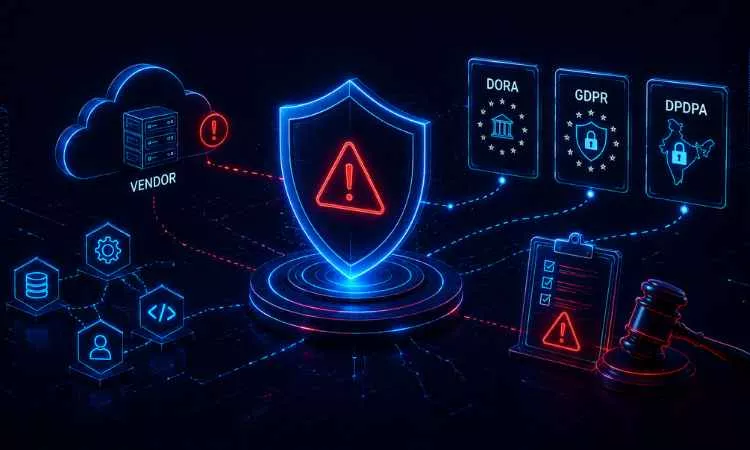
Regulators are increasingly writing continuous oversight into the rules themselves, rather than leaving monitoring frequency to each organization’s discretion. The EU’s Digital Operational Resilience Act, fully applicable since January 2025, requires financial entities to maintain an ongoing register of ICT third parties, assess concentration risk, and demonstrate active oversight of critical providers rather than static due diligence. In the United States, NIST SP 800-161 integrates cybersecurity supply chain risk management into broader enterprise risk practices, explicitly framing supplier risk as something to be assessed and monitored across the relationship lifecycle, not signed off once at onboarding.
Sector-specific rules point the same direction. Banking and payments regulators across multiple jurisdictions now expect financial institutions to show real-time or near-real-time visibility into critical vendor dependencies, not a filed questionnaire from the last audit cycle. The direction of travel is consistent even where the specific rule differs: oversight that can only prove a vendor was safe once a year is treated as a gap, not a control.
What Are Best Practices for Implementing Continuous Vendor Risk Monitoring?
The organizations that get the most value from continuous vendor risk monitoring treat it as a tiered, human-supervised discipline rather than a firehose of alerts pointed at an already stretched security team.
- Tier monitoring intensity to vendor risk: A payment processor with direct access to cardholder data warrants daily or real-time monitoring; a vendor supplying office furniture does not. Matching monitoring depth to actual exposure keeps the program sustainable as the vendor list grows.
- Pair automated signals with human judgment: A security rating drop or a certificate expiry is a prompt to investigate, not an automatic verdict. Teams that route every alert straight to a dashboard without triage tend to develop alert fatigue and start ignoring the feed altogether.
- Define escalation thresholds and owners in advance: Before the first alert fires, decide what score change triggers a re-assessment, what triggers a call to the vendor, and what triggers an executive notification. Ambiguity at the moment of an alert slows response when speed matters most.
- Wire monitoring into procurement, identity access, and incident response: A posture change that isn’t visible to the team managing that vendor’s system access is a missed opportunity. Continuous monitoring earns its value when it changes what someone does next, not when it sits in a separate tool nobody checks.
- Extend visibility to fourth parties: A vendor’s own subcontractors and cloud dependencies can introduce risk the primary contract never anticipated. Programs that stop at the first-tier vendor miss where a meaningful share of cascading exposure originates.
- Revisit tiering periodically, not just vendors: A vendor that starts as low risk can become business-critical as integrations deepen. The risk tier itself needs review on a cadence, not only the vendor’s score within that tier.
Ampcus Cyber’s Modern TPRM Program framework walks through how continuous monitoring fits into a broader, risk-tiered vendor program, including the automation and fourth-party oversight that make it sustainable at scale.
Continuous Monitoring vs. Point-in-Time Assessment
| Dimension | Point-in-Time Assessment | Continuous Monitoring |
| Data freshness | As current as the last questionnaire or audit | Updated on a rolling basis as new signals appear |
| Detection speed | Gaps surface at the next review cycle | Gaps can surface within days of occurring |
| Resource model | Concentrated effort during the assessment window | Ongoing but tiered by vendor risk level |
| Best suited for | Initial onboarding and contractual due diligence | Ongoing oversight of active, in-production relationships |
| Regulatory fit | Demonstrates due diligence occurred | Demonstrates active, ongoing oversight |
Most mature programs use both. Point-in-time assessment remains the right tool for onboarding a new vendor and setting the initial risk tier; continuous monitoring is what keeps that tier accurate for as long as the relationship lasts. For a deeper look at how a specific vendor incident can spread through shared infrastructure once it starts, Ampcus Cyber’s vendor blast radius research walks through how to measure that exposure before it happens rather than after.
To Conclude:
Continuous vendor risk monitoring turns third-party oversight from an annual snapshot into an ongoing practice, one built to catch a vendor’s changing risk posture in days rather than at next year’s review. With third-party involvement in breaches now reaching 48% of all incidents, that shift is less a competitive advantage than a baseline expectation.
| Talk to an Ampcus Cyber third-party risk specialist about building a continuous vendor monitoring program sized to your actual vendor risk, not just your vendor list. |
People Also Ask:
What is continuous vendor risk monitoring, in one sentence?
Continuous vendor risk monitoring is the ongoing tracking of a third party’s security and business posture between formal reviews, using external signals rather than waiting for the next scheduled assessment.
How is continuous monitoring different from a vendor risk assessment?
An assessment is a point-in-time snapshot, typically a questionnaire or audit completed once a year. Continuous monitoring tracks changes to that posture on an ongoing basis in between those snapshots.
What data sources feed continuous vendor risk monitoring?
Common sources include external attack surface scans, security rating services, breach and dark web disclosures, certificate and domain health, financial and corporate news, regulatory actions, and visibility into a vendor’s own subcontractors.
Does continuous monitoring replace vendor questionnaires entirely?
No. Most mature programs use both together: questionnaires and audits establish the initial risk tier and contractual baseline, while continuous monitoring keeps that tier accurate for the life of the relationship.
How often should a vendor’s risk posture be checked under continuous monitoring?
It depends on the vendor’s risk tier. High-risk vendors with access to sensitive data or critical systems often warrant daily or near-real-time monitoring, while low-risk vendors may only need periodic checks.
Is continuous vendor risk monitoring only for large enterprises?
No. While large enterprises with hundreds of vendors have the clearest resourcing case, any organization with vendors that touch sensitive data or critical systems benefits from ongoing visibility into those specific relationships, even if broader vendors are monitored less intensively.
Enjoyed reading this blog? Stay updated with our latest exclusive content by following us on Twitter and LinkedIn.