






A virtual CISO (vCISO) builds and operates a security program remotely by anchoring it to an established framework, standing up continuous monitoring through a GRC platform, and running a fixed cadence of risk reviews, metrics reporting, and escalation. Physical presence is replaced by structured governance, real-time visibility, and assigned ownership, so the program runs whether the leader is in the building or not.
Security leadership was once assumed to require a corner office and daily corridor conversations. That assumption no longer holds. A vCISO delivers the same strategic authority, risk ownership, and program governance as a full-time chief information security officer but does it through structure rather than physical proximity. The real question is not whether a security program can run without an on-site leader. It is how a disciplined vCISO makes distance irrelevant.
What a vCISO Actually Owns
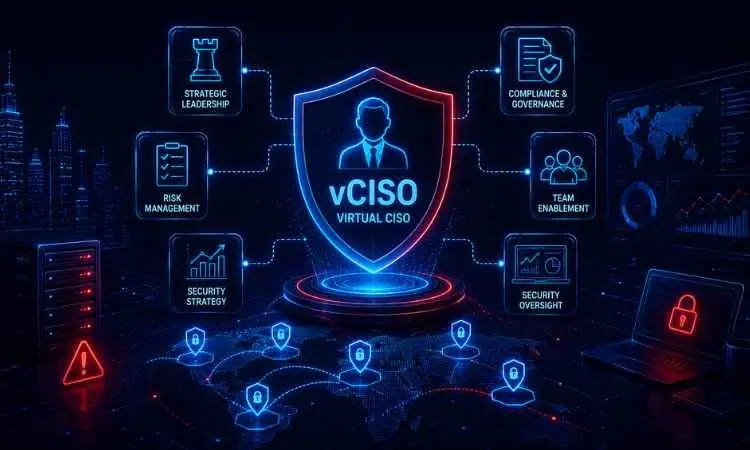
A vCISO is an experienced security executive who leads an organization’s security program on a flexible, part-time, or shared basis. If the model is new to you, our primer on what is a vCISO, covers the fundamentals. The role is deliberately strategic. A vCISO sets direction, defines risk appetite with leadership, selects the controls that matter, and holds the organization accountable to them. None of those responsibilities depend on being physically present. They depend on clarity, cadence, and evidence.
Modern security work is already distributed anyway. Cloud workloads, remote engineering teams, SaaS platforms, and third-party vendors mean the perimeter a CISO once walked no longer exists inside a single building. A leader who governs that reality effectively is measuring telemetry and outcomes, not counting who is at their desk.
How a vCISO Builds the Program Remotely
Building a security program from a distance follows a repeatable sequence.
Assess before acting : The engagement starts with a structured gap assessment against a recognized framework such as the NIST Cybersecurity Framework or ISO/IEC 27001. This produces an objective baseline of where controls exist, where they are weak, and where they are absent. Remote assessment is practical today because most evidence lives in systems, not filing cabinets. Configuration exports, identity logs, policy documents, and architecture diagrams are all reviewable online.
Prioritize by risk, not by noise : A vCISO translates findings into a ranked roadmap tied to business impact. A prioritized model such as the CIS Critical Security Controls helps sequence the work so the highest-value safeguards, including asset inventory, access control, and logging, come first. This prioritization is where experienced judgment matters most, and it travels perfectly well over a video call and a shared roadmap.
Design the governance model : The vCISO defines policies, assigns control owners inside the organization, and establishes how decisions get made and escalated. The output is a program with named accountability at every layer, so execution does not stall when the leader is offline.
How a vCISO Operates the Program Day to Day
Building is a project and operating is a rhythm. This is where remote leadership either proves itself or falls apart, and the difference is almost always discipline.
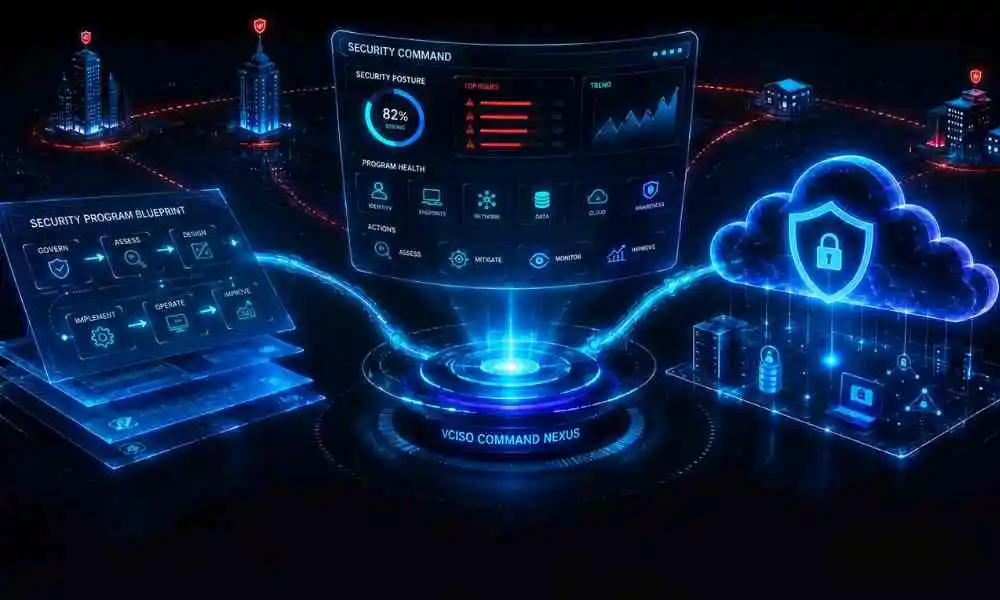
Continuous visibility replaces walking the floor : Instead of relying on hallway updates, a vCISO operates from a live view of control health. A Governance platform centralizes evidence, maps controls to multiple frameworks, and surfaces drift in real time, so a lapsed configuration or an expired certificate is flagged the moment it happens rather than at the next audit. Real-time visibility is precisely what turns physical distance into a non-issue.
A fixed operating cadence : Effective remote programs run on a calendar: weekly operational check-ins with security and engineering leads, monthly risk and metrics reviews with management, and quarterly strategic sessions with executives or the board. This rhythm keeps the program visible, accountable, and moving forward, and none of it requires sharing a building.
Metrics that tell the truth : A vCISO reports on a small set of meaningful indicators, such as open risk exposure, mean time to remediate, patch and vulnerability status, control coverage, and third-party risk posture. Numbers, not impressions, become the shared language of leadership and the board.
Third-party and vendor oversight : A large share of today’s risk lives outside the organization’s own walls. A vCISO extends the program into the supply chain through structured third-party risk management, assessing and continuously monitoring vendors rather than trusting a single point-in-time questionnaire.
Incident readiness and escalation : The vCISO owns the incident response plan and the escalation path, and can lead response remotely by coordinating containment, communication, and recovery through defined runbooks and a clear chain of command. Well-run incidents are governed by preparation, not by who happens to be in the room.
The Tools That Make Remote Security Leadership Work
Remote leadership is not leadership without tools. A vCISO relies on a connected stack: a GRC platform for control and evidence management, identity and access governance for enforcing least privilege, security monitoring and logging for detection, and collaboration tools for cadence and documentation. When these systems feed a single source of truth, the vCISO gains the same situational awareness a permanent CISO would build over months on-site and gains it far faster.
The advantage compounds over time. Because every policy, control owner, and piece of evidence is documented in a shared system rather than held in one person’s head, the program becomes resilient to change. If priorities shift, an audit arrives, or the engagement scales up, the institutional knowledge stays with the organization. That durability is one of the most underrated benefits of running security leadership through structure instead of through a single individual’s daily presence.
When On-Site Presence Still Adds Value
Remote leadership is the operating default, not an absolute rule. There are moments when a vCISO benefits from being in the room: launching the engagement and meeting stakeholders, facilitating a live tabletop exercise, supporting a critical certification audit, or steering the response to a serious incident. A strong engagement is not “never on-site.” It is “on-site when presence changes the outcome, and remote for everything the program is designed to handle.” That flexibility is a feature of the model, not a compromise on it.
Put an Accountable Security Program in Motion
A security program without leadership is. Ampcus Cyber’s Virtual/Shared CISO as a Service gives your organization seasoned security leadership, framework-aligned strategy, and continuous oversight, delivered with the discipline that makes location irrelevant.
| Book a free consultation with Ampcus Cyber today and build a security program that runs on governance and evidence, wherever your team sits. |
Enjoyed reading this blog? Stay updated with our latest exclusive content by following us on Twitter and LinkedIn.