











TL;DR
- PCI KMO does not replace PCI PIN or PCI P2PE. It gives both programs one shared framework for key management, cutting duplicate evidence for organizations validated against both.
- Existing PIN and P2PE key management validations remain unaffected for now. PCI SSC has not published transition guidance, so confirm treatment with your acquirer or payment brand directly.
- Compliance teams should start mapping their key inventory today, even though the PCI KMO assessor program has not fully launched.
PCI Key Management and Operations, known as PCI KMO, is a PCI Security Standards Council standard governing the full lifecycle of cryptographic keys used to protect PIN and point-to-point encryption data. It matters because PCI PIN and PCI P2PE have each carried their own key management requirements, so organizations validated against both have had to satisfy overlapping controls for the same keys.
Version 1.0 covers every stage of a key’s life: generation, conveyance, loading, use, archive, retirement, and destruction. Rather than replacing PCI PIN or PCI P2PE, PCI KMO gives both a single framework to reference for key management requirements, and that consolidation is the direct source of the compliance impact this article covers.
Does PCI KMO Replace Your Existing PCI PIN or P2PE Validation?
No, PCI KMO does not replace your existing PCI PIN or PCI P2PE validation. It is a standalone standard that both programs can reference for key management requirements, while PCI PIN and PCI P2PE continue to govern their own broader scope beyond key management.
PCI SSC has not yet published detailed transition or grandfathering guidance for organizations already validated under PCI PIN or PCI P2PE. Until that guidance appears, treat your current validation as unaffected, and confirm your assessment cycle with your acquirer or payment brand rather than assuming a default outcome. Organizations working with a PCI QSA on their broader PCI DSS program should raise PCI KMO in that same conversation, since key management overlaps across multiple standards at once.
How Does the Assess-Once, Use-Many Model Change Your Compliance Workload?
PCI KMO’s assess-once, use-many model means a single KMO assessment can validate key management controls that support both PCI PIN and PCI P2PE key types, instead of producing separate evidence for each program. That directly addresses the duplicate paperwork problem from the story above.
| Category | Legacy Dual-Audit Model | Unified PCI KMO Model |
| Key management evidence | Produced separately for PIN and P2PE | Produced once, referenced by both |
| Assessor engagements | Separate PIN and P2PE assessors review overlapping controls | A Qualified KMO Assessor reviews key management once |
| Custodian and rotation records | Duplicated across two audit trails | Maintained in one KMO listing |
| Reporting output | Separate PIN and P2PE reports | KMO Report on Compliance and Attestation of Compliance, referenced by downstream programs |
A completed PCI KMO listing can be referenced by a PCI P2PE implementation where applicable, reducing how often the same custodian records, rotation logs, and destruction evidence need to be produced for different reviewers. PCI SSC’s KMO announcement frames this as a direct answer to years of duplicated assessment effort across PIN and P2PE. Procedurally, this is expected to work the way PCI SSC’s other listing programs already do: a Qualified KMO Assessor documents the assessment in a KMO Report on Compliance and Attestation of Compliance, PCI SSC publishes the resulting listing, and a PIN or P2PE assessor references it instead of re-testing the same controls. PCI SSC has not published a KMO-specific description of that exact handoff yet, so confirm it against final program guidance once you are ready to use it.
Will PCI KMO Change How Often Your Organization Gets Reassessed?
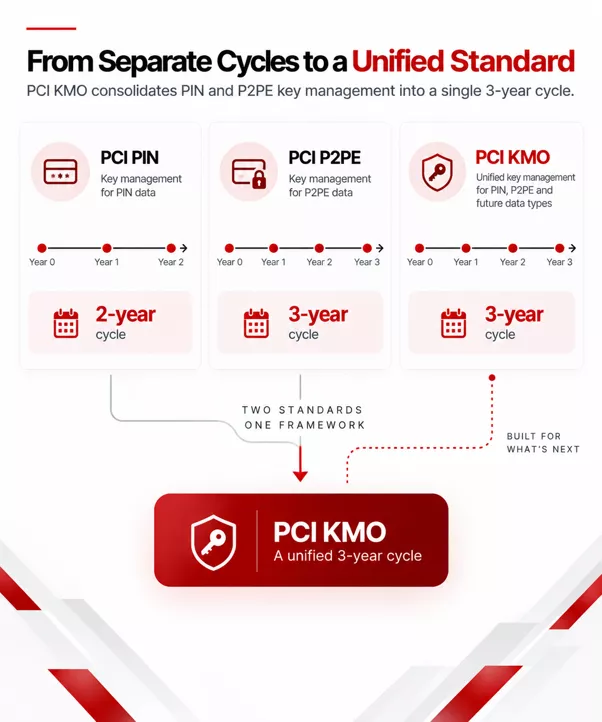
Today, PCI PIN requires a full reassessment every 2 years, and PCI P2PE requires a full reassessment every 3 years with an annual revalidation checkpoint in between. Both cadences apply now, regardless of PCI KMO.
Early PCI KMO program planning materials pointed to a 3-year reassessment cycle for KMO listings, matching P2PE and one year longer than PIN’s current cycle, with an annual checkpoint in between, similar to how P2PE already works. This comes from pre-launch request-for-comment materials rather than the finalized v1.0 Program Guide, so confirm it once PCI SSC publishes complete program details. Governance leaders building multi-year compliance calendars should plan for that possibility while budgeting around the current cadences.
How Does PCI KMO Affect Cloud and Remote HSM Environments?
PCI KMO explicitly addresses cloud-based and remote hardware security module deployments, including HSM-as-a-Service models, so cloud HSM users for PIN or P2PE key operations fall within its scope just as on-premises users do.
PCI KMO was developed in alignment with PCI PTS HSM v5.0, published May 18, 2026, which added cloud, multi-tenant, and remote-administration modules to HSM requirements. PTS HSM v5.0 evaluates the device itself, while PCI KMO evaluates how the keys inside it are generated, used, and retired. In a cloud or remote deployment, responsibility for the device, key ceremonies, custodians, and access controls may be split between provider and customer, so document that split rather than assume a default one. Teams reviewing their broader cloud security posture should fold this in now.
What Should Compliance Teams Do to Prepare for PCI KMO Right Now?
Compliance teams can prepare for PCI KMO today by building a complete key inventory and mapping controls against the KMO lifecycle, while the first wave of assessors completes training.
- Confirm applicability with your payment brand or acquirer, and identify your key custodians.
- Inventory every PIN key, P2PE key, key encryption key, and HSM or cloud HSM service in your environment.
- Map controls against each KMO lifecycle stage, paying close attention to rotation and destruction records.
- Review vendor and HSM provider contracts for shared responsibility documentation.
PCI SSC’s KMO Assessor Qualification program is already open for registration, with training beginning September 28, 2026. Since that is the earliest class, no organization can be listed yet as a Qualified KMO Assessor. Governance leaders who need a structured way to run this exercise can bring in dedicated PCI advisory support to turn the standard into a prioritized plan rather than another audit checkbox.
For a full breakdown of what PCI KMO covers, read our companion explainer, What Is PCI KMO? Taking a Closer Look.
| Talk to Ampcus Cyber’s PCI compliance team about mapping your key management controls against PCI KMO before your next PIN or P2PE assessment. |
People Also Ask:
Is PCI KMO Mandatory for My Organization?
Whether you must comply with PCI KMO is decided by the organization managing your compliance program, such as your payment brand or acquirer, not by PCI SSC.
What Is a Qualified KMO Assessor?
A Qualified KMO Assessor is trained and authorized by PCI SSC to assess environments against the PCI KMO standard, separate from the Qualified Security Assessor credential used for PCI DSS. PCI SSC opened the qualification program for registration alongside the v1.0 launch, with the first training classes starting September 28, 2026.
Where Can I Find Organizations Already Validated Against PCI KMO?
PCI SSC maintains a public directory for Qualified KMO Assessors and will publish validated KMO listings as they occur. Since the earliest assessor training class runs September 28, 2026, no organization can be listed yet.
Enjoyed reading this blog? Stay updated with our latest exclusive content by following us on Twitter and LinkedIn.