




HITRUST e1 isn’t a lightweight checkbox, it’s a threat-informed certification built on 44 controls that address the most common real-world attack vectors. This blog breaks down what e1 covers, who it’s best suited for, and how it delivers a practical, cost-effective path to validated security assurance and stronger vendor trust.
If you’ve started exploring HITRUST certification, you’ve likely encountered three tiers: e1, i1, and r2. Most conversations gravitate toward the r2, the so-called gold standard or the i1 for mid-range assurance. The e1, however, is frequently misunderstood, underestimated, and underused. That’s a missed opportunity.
The HITRUST Essentials 1-Year (e1) Assessment is not a watered-down compliance checkbox. It is a strategically focused, threat-informed certification built around 44 controls that address the most common and damaging attack vectors organizations face today. For the right organization, it may be the single most efficient investment in validated security assurance available. Here’s what you need to know.
What the HITRUST e1 Assessment Actually Is
The e1 sits at the foundation of the HITRUST CSF (Common Security Framework). It was designed to make validated, third-party cybersecurity assurance accessible to organizations that cannot immediately shoulder the complexity or cost of an i1 (182 controls) or r2 (customized, risk-based) assessment.
What makes it credible is HITRUST’s Cyber Threat-Adaptive engine. The 44 controls are not static, they are curated and updated based on real-world threat intelligence, MITRE ATT&CK data, and current attack patterns.
HITRUST has reported that e1 controls address over 99% of identified MITRE ATT&CK techniques based on their internal threat evaluation methodology. It is important to understand what this means precisely: MITRE ATT&CK catalogues adversary techniques, not breach probabilities or organizational risk profiles.
overage of a technique taxonomy is not equivalent to immunity from attack. Governance and compliance leaders presenting this figure to a board or regulator should reference HITRUST’s official e1 documentation for the underlying methodology before drawing operational conclusions.
One important governance consideration: HITRUST e1 certification provides validated security assurance, but it is not a substitute for legal or regulatory compliance. Organizations operating in regulated environments should treat e1 as a complementary control framework alongside applicable obligations such as HIPAA, GDPR, or PCI DSS.
What the 44 Controls Actually Cover
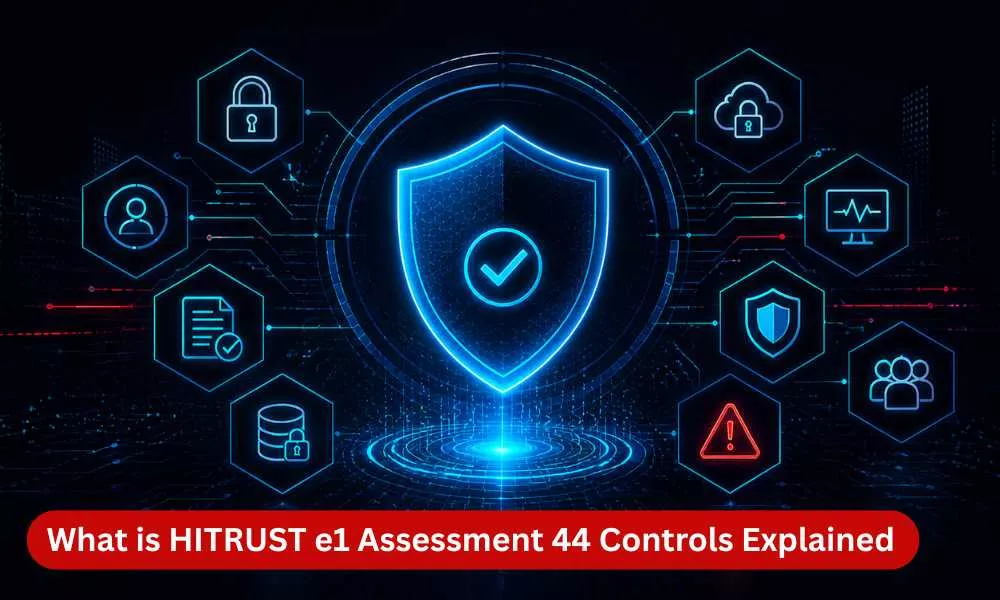
Think of the e1 as a precision tool, not a broad sweep. The 44 controls are organized across several critical domains; but not limited to:
- Access Control addresses who get into your systems and how. This includes strong password policies, MFA implementation, and least-privilege access principles, controls that directly counter credential-based attacks, which account for most breaches.
- Network Protection covers perimeter security and internal traffic management. Firewall configurations, network monitoring, and restriction of unnecessary services all fall here.
- Data Protection and Privacy establish baseline encryption and handling requirements for sensitive data, whether that’s PHI, PII, or financial records.
- Incident Management requires organizations to have a documented, practiced plan for detecting, responding to, and recovering from a security breach. This is not a “write it and file it” requirement, it demands evidence of implementation.
- Business Continuity is where e1 often surprises organizations. It specifically requires offline, immutable backups, a requirement that many SOC 2 audits do not explicitly mandate. In a ransomware scenario, this single control can be the difference between a recoverable incident and a catastrophic one. For governance leaders, this is a concrete, board-reportable control with clear consequence framing.
- Physical Security addresses the protection of hardware and facilities where data lives or is processed.
- Risk Management establishes the foundational discipline of identifying, assessing, and mitigating organizational risks.
According to HITRUST’s official framework documentation, certification is valid for one year, requires a passing score of 83 or above for all 19 domains, and typically takes four to six weeks to complete with a qualified external assessor. When selecting an assessor, governance leaders should verify HITRUST authorization status directly through the HITRUST assessor registry, as assessor quality directly affects the defensibility of the resulting certification.
Who Should Choose the e1 Assessment?
The e1 is strategically suited for four types of organizations:
- Startups and small businesses entering regulated markets or enterprise supply chains. Rather than waiting years to build toward an r2, an e1 delivers a validated, third-party certification that larger partners and customers will recognize, at a fraction of the cost and complexity.
- Low-to-moderate risk profile organizations that handle some sensitive data but are not managing the scale of PHI or financial data that would trigger r2 requirements. If your data footprint is limited but clients demand proof of security hygiene, the e1 is purpose-built for this.
- Organizations using a stepping-stone strategy. HITRUST’s framework is designed so that work completed for an e1 is nested and reusable when advancing to i1 or r2, you are building, not restarting. This reduces the total certification cost curve over time. One governance caveat: before committing to e1 as an entry point, confirm the tier your enterprise partners and key clients contractually require. Some agreements specify i1 or r2 explicitly, and holding only e1 may not satisfy those obligations.
- Third-party risk and vendor management programmes. Enterprise organizations increasingly require vendors to hold HITRUST certification as a condition of doing business. An e1 provides a credible, standardized response, far more defensible than a self-reported security questionnaire.
e1 as a SOC 2 Complement
If your organization already holds a SOC 2 report, the e1 is a natural next step. Approximately 80–90% of e1 controls overlap with existing SOC 2 work, meaning the incremental lift is significantly reduced.
What the e1 adds is something SOC 2 cannot offer: an actual certification rather than an attestation, standardized scoring, and specific requirements, such as immutable backups, that SOC 2 leaves to the organization’s own interpretation.
For organizations in healthcare, fintech, or insurance, pairing SOC 2 with an e1 provides a substantially stronger assurance posture. A gap analysis mapping existing SOC 2 controls to e1 requirements is typically the most efficient starting point, it identifies exactly what additional work is needed before evidence collection begins.
How Ampcus Cyber Supports Your HITRUST Certification Journey?
Achieving HITRUST certification requires more than understanding the framework, it requires a structured process, qualified assessors, and a partner who knows where organizations lose time and credibility during the assessment. Ampcus Cyber delivers intelligent cybersecurity across the full HITRUST engagement lifecycle: from an initial HITRUST gap analysis that maps your current controls against e1 requirements, through a structured HITRUST readiness assessment that identifies and remediates documentation gaps before a single assessor review begins, to full support through the validated assessment submission and HITRUST Quality Assurance process. Organizations working with an experienced HITRUST consulting firm avoid the two most common and costly failure modes, underprepared evidence packages and scope misalignment, both of which can delay certification by months. Whether you are pursuing e1 as a standalone credential, as a vendor management requirement, or as the first step toward i1 or r2, Ampcus Cyber’s
HITRUST certification services are built to get you to a clean, first-attempt result on a timeline that fits your business.
Not sure which HITRUST tier is right for you? Let us help you define your scope, identify the right certification, and kickstart your assessment journey.
Enjoyed reading this blog? Stay updated with our latest exclusive content by following us on Twitter and LinkedIn.