









Every piece of enterprise data is created, used for a while, and then either forgotten or deleted. In practice, most organizations are far better at the first two stages than the last one. Data piles up in cloud storage, backups, shared drives, and retired applications long after it has stopped serving any business purpose, quietly expanding the attack surface and the compliance burden with it. A data lifecycle management policy is the control that closes this gap, defining exactly how information should be handled from the moment it is created until the moment it is permanently destroyed.
This is not a records-management footnote. It is a core control that determines how much sensitive data an organization is exposed to at any given time.
What Is a Data Lifecycle Management Policy?
A data lifecycle management policy is a formal set of rules that governs how data is created, classified, stored, used, shared, retained, and disposed of throughout its existence. It assigns ownership, sets retention timelines by data type, and defines the security controls required at each stage, so that data does not linger in systems beyond its useful or legally required life.
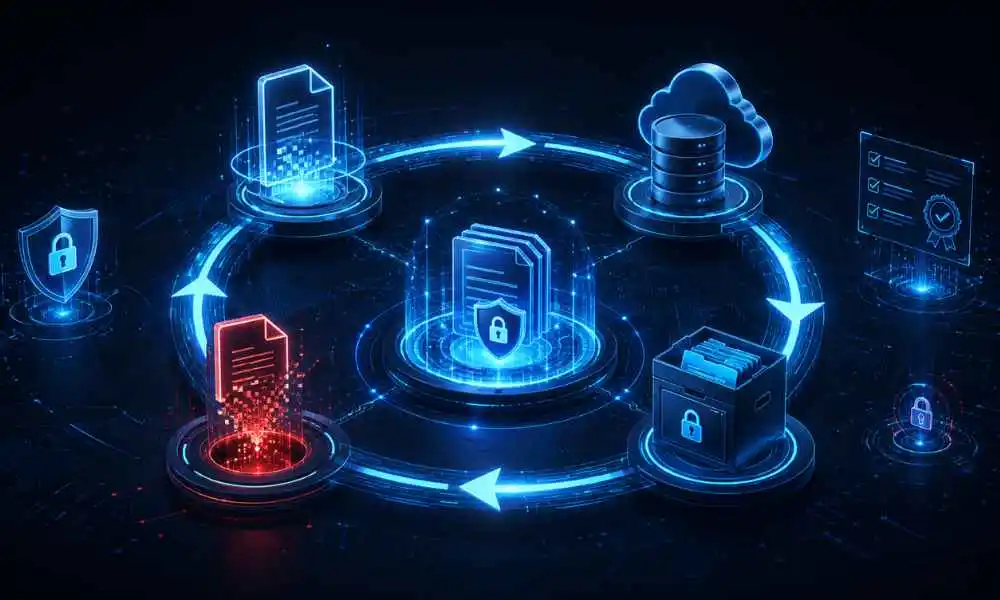
The National Institute of Standards and Technology defines the underlying concept, the information life cycle, as the stages through which information passes, typically characterized as creation or collection, processing, dissemination, use, storage, and disposition, including destruction and deletion. A lifecycle management policy operationalizes that definition into enforceable rules an organization can run.
How Does Data Move Through the Lifecycle?
Most data lifecycle frameworks break the process into five or six stages, each with its own risk profile and control requirements.
- Creation and collection : Data enters the organization through customer transactions, employee input, third-party integrations, or automated systems. This is the point where classification should begin.
- Storage and access : Once created, data needs to be stored securely and made available only to authorized users, typically through role-based access controls and encryption at rest.
- Use and processing : Data is actively queried, analyzed, or modified to support business operations. This stage carries the highest exposure, since data is most vulnerable while it is in active use.
- Sharing and distribution : Data moves between departments, applications, and external vendors. Every handoff introduces a new point where policy enforcement can break down.
- Archival and retention : Data that is no longer actively used but must be retained for legal, regulatory, or business reasons moves to lower-cost, less accessible storage under defined retention rules.
- Disposal and destruction : Data that has passed its retention period is permanently and verifiably destroyed, closing the lifecycle and removing it from the organization’s risk surface.
Why Does a Data Lifecycle Management Policy Matter for Cybersecurity and Compliance?
Data that no longer serves a business purpose does not stop being a liability. It still needs to be secured, and if it is compromised, it still counts as a breach. Every dataset without a clear retention and disposal rule effectively becomes permanent, expanding the volume of sensitive information an attacker can potentially reach.
The financial impact of this exposure is measurable. According to IBM’s Cost of a Data Breach Report, breaches involving data spread across multiple environments cost an average of 5.05 million dollars, notably higher than breaches confined to a single environment, reflecting how fragmented, poorly governed data sprawl directly increases both detection difficulty and financial impact. Regulatory frameworks reinforce the same principle from a different angle. Data protection laws increasingly mandate defined retention limits and time-bound erasure, making disciplined lifecycle governance not just a security best practice but a legal requirement in many jurisdictions.
What Should a Data Lifecycle Management Policy Include?
An effective policy needs to be specific enough to guide daily operational decisions, not just a statement of intent.
- Data classification standards : That define categories such as public, internal, confidential, and restricted, so retention and security requirements can be applied consistently.
- Retention schedules by data type : Tied to regulatory requirements, contractual obligations, and genuine business need rather than indefinite default retention.
- Ownership and accountability : Naming data owners and stewards responsible for each dataset’s classification, quality, and lifecycle compliance.
- Access and storage controls : Appropriate to each stage, including encryption, role-based access management, and secure configuration for cloud storage environments.
- Verifiable disposal procedures : That ensure data is destroyed completely, including copies held in backups, archives, and third-party systems, not just deleted from the primary system of record.
- Audit and monitoring requirement : To confirm the policy is being followed, not just documented.
Who Owns Data Lifecycle Management in an Enterprise?
Lifecycle governance works best as a shared responsibility rather than a single owner’s mandate. Data owners, typically business unit leaders, decide how their datasets should be classified and used. Data stewards handle day-to-day classification, quality, and policy compliance. The security team implements the technical controls that enforce the policy, including encryption, access restrictions, and monitoring. Compliance and legal teams translate regulatory retention requirements into concrete rules. Without clear accountability across these roles, lifecycle policies tend to exist only on paper.
Where Do Data Lifecycle Policies Break Down?
Even well-designed policies fail in predictable places. Backups and archival copies are often excluded from disposal processes, meaning data marked for deletion in a primary system quietly survives elsewhere. Shadow IT and unsanctioned SaaS tools create data stores that were never mapped into the lifecycle policy in the first place. Third-party vendors and processors frequently cannot guarantee complete deletion on request, particularly across shared infrastructure and long-retained logs, which is why vendor risk assessments increasingly need to evaluate a partner’s actual deletion capability rather than accepting a policy statement at face value. AI systems add a further complication: once personal or regulated data is used in model training or fine-tuning, it may become embedded within model parameters in a way that cannot simply be deleted the way a database record can.
How to Implement a Data Lifecycle Policy?
Implementation should start with discovery. Organizations cannot govern data they cannot locate, so mapping where sensitive data lives, across cloud platforms, on-premises systems, backups, and vendor environments, must come before any retention rule is written. From there, classification standards should be applied consistently, retention schedules should be tied to specific regulatory and business justifications rather than convenience, and disposal processes should be automated wherever possible to remove reliance on manual follow-through.
Aligning the policy with recognized frameworks such as ISO 27001 and NIST also gives the program a structure that can withstand audit scrutiny rather than an internal document built in isolation. Regular audits should confirm that data is being deleted on schedule, not simply that a policy document exists describing how it should be.
Final Thoughts
A data lifecycle management policy turns an abstract governance principle into an operational discipline: know what data exists, control it while it is useful, and remove it the moment it stops being necessary. Organizations that treat this as a continuous operational program, rather than a one-time documentation exercise, meaningfully reduce both their breach exposure and their regulatory risk.
As data volumes and regulatory pressure continue to grow, the organizations that struggle will be those still treating retention as an afterthought rather than a designed control.
| Unmanaged data retention quietly expands breach exposure and regulatory risk. Talk to Ampcus Cyber to assess where your data lifecycle policy has gaps before an audit or an attacker finds them first. |
Enjoyed reading this blog? Stay updated with our latest exclusive content by following us on Twitter and LinkedIn.