









Imagine an employee asking an internal AI assistant, “What is our current remote-work policy?” A standalone language model may know what remote work generally means, but it does not automatically know what the company approved last month. Its training data may be outdated, and the organization’s private documents were never part of its training.
Now connect that assistant to the company’s policies, HR documents, and internal knowledge base. The system can retrieve the latest relevant policy, provide it to the model as context, and generate an answer based on the organization’s actual information.
That simple shift, from asking a model what it knows to giving it the right information at the moment it answers, is the foundation of Retrieval-Augmented Generation (RAG).
What Is Retrieval-Augmented Generation (RAG)?
Retrieval-augmented generation (RAG) is an AI architecture that retrieves relevant information from an external knowledge base at query time and feeds it to a language model as context, so the model’s answer is grounded in an organization’s actual data rather than only what it learned during training.
A standalone large language model answers from what it absorbed during training, which is fixed at a point in time and does not include an organization’s internal documents, product data, or anything that changed after training concluded. RAG fixes this by connecting the model to a live, searchable knowledge base. When a user asks a question, the system first searches that knowledge base for the most relevant content, then passes both the question and the retrieved content to the model, which generates its answer using that context instead of relying purely on memorized training data.
This is why RAG has become the dominant pattern for deploying language models against organizational knowledge: customer service bots that answer from current product documentation, internal assistants that answer from policy manuals, and code assistants that pull from a company’s own codebase all rely on some form of RAG. It reduces fabricated answers and lets an organization update what the model “knows” simply by updating the underlying documents, with no retraining required.
How Does RAG Actually Work?
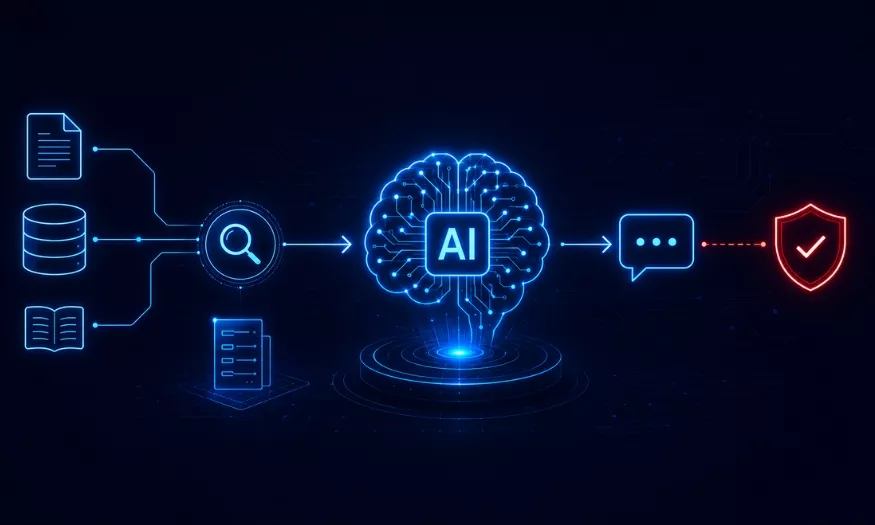
RAG runs in three stages: documents are converted into searchable vector embeddings and stored in a vector database, a retriever finds the most relevant chunks for a given query, and a generator model combines those chunks with the user’s question to produce a grounded answer.
Ingestion and embedding: Source documents, policies, product manuals, support tickets, code, are broken into smaller chunks and converted into vector embeddings, numerical representations that capture semantic meaning, using an embedding model. These vectors are stored in a vector database, indexed for fast similarity search.
Retrieval: When a user submits a query, it is also converted into a vector embedding and compared against the vector database to find the chunks most semantically like the question. This is a similarity search, not a keyword search, which is why RAG can retrieve a relevant policy paragraph even if the query does not share exact wording with it.
Generation: The retrieved chunks are inserted into the prompt as context, alongside the original question, and passed to the language model. The model then generates its response using that retrieved context, ideally citing or grounding its answer in the specific material it was given rather than drawing purely on its training data.
The practical result is a model that can answer questions about information it was never trained on, current pricing, this quarter’s policy update, a document uploaded an hour ago, because that information is retrieved fresh at the moment of the query rather than baked into the model’s weights.
Why Are Enterprises Adopting RAG So Quickly?
RAG lets organizations ground AI outputs in their own current data without the cost and complexity of retraining a model, and enterprise adoption has grown rapidly as a result, reportedly exceeding 50 percent by 2024, up from roughly 31 percent the year before.
Retraining or fine-tuning a large language model on proprietary data is expensive, slow, and has to be repeated every time the underlying information changes. RAG sidesteps that entirely: updating what the model can answer is as simple as updating the documents in the knowledge base. This makes RAG the practical default for use cases where information changes frequently, product catalogs, internal policies, support documentation, and where factual accuracy grounded in a specific, citable source matters more than open-ended creativity.
What New Attack Surface Does RAG Introduce?
RAG turns the knowledge base and vector database into a new trust boundary and attack surface; the model’s output is only as trustworthy as the content it retrieves, and attackers who can influence that content can manipulate the model’s answers without touching its weights or its prompt.
This is the detail security teams most often underweight when evaluating a RAG deployment. The model itself may be well-aligned and thoroughly tested, but RAG introduces an entirely separate set of risks tied to the data it retrieves from.
| Attack type | How it works | Primary mitigation |
| Knowledge base (data) poisoning | An attacker inserts malicious or misleading content into the source documents or vector database so it gets retrieved and treated as fact. | Source vetting, ingestion-time content validation, restricted write access to the knowledge base. |
| Indirect prompt injection | Malicious instructions are hidden inside a retrieved document and are treated by the model as legitimate commands once retrieved into context. | Treat retrieved content as untrusted input, strip or sandbox embedded instructions before passing to the model. |
| Embedding inversion | An attacker reconstructs the original sensitive text from its stored vector embedding. | Access controls on the vector store itself, encryption at rest, minimizing storage of raw sensitive text. |
| Membership inference | An attacker infers whether specific sensitive data exists in the knowledge base by analyzing model response confidence or patterns. | Output filtering, rate limiting, differential privacy techniques on sensitive corpora. |
| Ingestion-toolchain exploitation | Malicious content hidden inside a document’s file format is silently introduced during parsing, before it ever reaches the visible corpus. | Harden and sandbox the document parsing and loading pipeline, not just the final indexed content. |
The common thread across all five is that traditional LLM security testing, red teaming the model’s alignment and refusal behavior, does not catch any of them, because none of these attacks touch the model itself. They target the data pipeline feeding it.
How Is RAG Different From Fine-Tuning?
Fine-tuning changes a model’s internal weights using a training dataset, permanently embedding that knowledge into the model, while RAG leaves the model unchanged and instead retrieves relevant information at query time, making updates faster and keeping sensitive source data outside the model itself.
This distinction matters for both cost and governance. Fine-tuned data becomes embedded in model parameters and is difficult or impossible to cleanly remove if a document needs to be retracted or a regulator asks what training data was used. RAG keeps the source data in an external, auditable knowledge base, so removing a document from the knowledge base removes it from what the model can retrieve, without any retraining. For most enterprise knowledge-grounding use cases, RAG is now the faster, cheaper, and more governable choice, with fine-tuning reserved for cases where the model needs to learn a new skill or style rather than new facts.
What Does the OWASP LLM Top 10 Say About RAG Risk?
The OWASP Top 10 for Large Language Model Applications treats prompt injection and excessive agency as top-tier risks, both of which are amplified in RAG deployments because retrieved content becomes part of the model’s effective instruction set.
OWASP’s framework does not treat RAG as a separate category, but several of its top risks map directly onto the RAG attack surface described above: prompt injection covers both the direct case and the indirect case where instructions arrive hidden inside retrieved documents, and excessive agency becomes a compounding risk when a RAG-grounded model is also given the ability to take action based on what it retrieves, turning a poisoned document into a trigger for an unwanted system action rather than just a wrong answer. Any organization deploying RAG should treat this OWASP taxonomy as a baseline checklist, not a general AI safety reference, since the retrieval layer is precisely where several of its highest-severity categories concentrate.
How Should Organizations Secure a RAG Deployment?
Treat the vector database and knowledge base as a distinct trust boundary with its own access controls, validate and sanitize content at ingestion time, and log retrieval and generation activity into existing security monitoring rather than letting the RAG pipeline operate as an unmonitored side system.
Apply retrieval-time authorization so the system only retrieves content the requesting user is permitted to see, rather than assuming anything in the knowledge base is safe to surface to any user. Vet and sanitize documents before ingestion, since malicious content can be introduced through the parsing and loading toolchain itself, not only through the visible text of a document. Feed prompts, retrieved chunks, and generated outputs into your existing SIEM platform so anomalous retrieval patterns or suspicious outputs are correlated with other security telemetry rather than reviewed in isolation. Extend DLP coverage to the RAG pipeline itself, since a knowledge base built from internal documents is, functionally, a new and often under-classified store of sensitive data. Where third-party or open-source components are used for embedding models, vector databases, or document loaders, run them through your TPRM program the same way you would any other vendor dependency. Teams building internal AI security skills should also look at structured programs such as the NIST CSF and AI RMF workshop track, which covers AI-specific risk assessment alongside traditional framework mapping.
Conclusion
RAG has become the practical default for grounding AI in enterprise knowledge because it is faster, cheaper, and more auditable than retraining a model every time information changes. That same architecture, however, turns the knowledge base and vector database into a new trust boundary that most existing AI security testing was never designed to cover. Organizations that treat RAG only as a model deployment, rather than as a data pipeline with its own access controls, ingestion validation, and monitoring, are the ones most likely to discover its attack surface the hard way.
| Connect with Ampcus Cyber’s security experts to assess your organization’s RAG and AI deployment pipeline for data exposure, access control gaps, and monitoring coverage. |
Enjoyed reading this blog? Stay updated with our latest exclusive content by following us on Twitter and LinkedIn.