









TL;DR
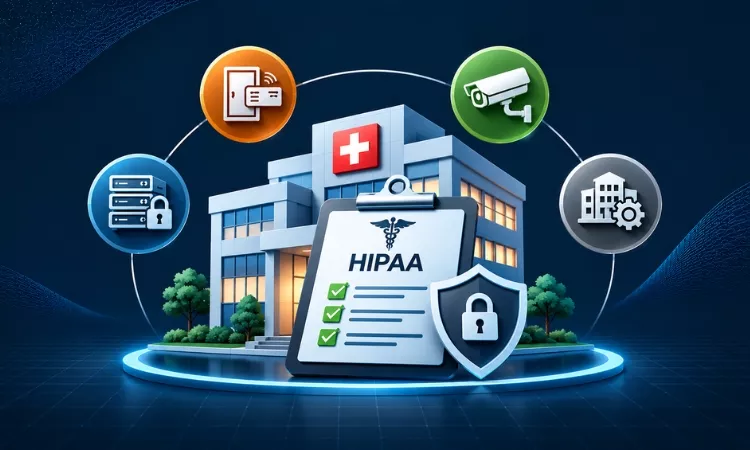
- HIPAA physical safeguards under 45 CFR 164.310 consist of four standards: facility access controls, workstation use, workstation security, and device and media controls. They apply to covered entities and business associates wherever ePHI is housed or accessed.
- Addressable never means optional. Each addressable specification needs implementation, an equivalent alternative, or a documented risk-based justification.
- Evidence decides outcomes. Dated access logs, asset inventories, disposal certificates, and a current risk analysis show that controls operate in practice.
Healthcare infrastructure no longer sits in one server room. Electronic protected health information (ePHI) now moves across clinical workstations, remote coders’ laptops, medical devices, colocation cages, and cloud platforms run by business associates. Each location carries physical exposure, from an unlocked network closet to a retired laptop that still holds patient records. HHS reports that OCR received more than 50 large breach reports between 2020 and 2023 attributed to stolen equipment and devices, affecting over 1,000,000 individuals. HIPAA physical safeguards exist to control that exposure.
This article explains the four standards, how to implement them, what evidence reviewers expect, and where organizations fall short.
What Do HIPAA Physical Safeguards Require Under 45 CFR 164.310?
HIPAA physical safeguards are the physical measures, policies, and procedures that protect electronic information systems, buildings, and equipment from unauthorized access and environmental hazards.
They sit in 45 CFR 164.310 beside the administrative and technical safeguards of the HIPAA Security Rule, and they bind both covered entities and business associates. They apply wherever ePHI is created, stored, or accessed.
| Standard | Citation | Implementation Specifications | Status |
| Facility Access Controls | 164.310(a)(1) | Contingency operations, facility security plan, access control and validation procedures, maintenance records | All addressable |
| Workstation Use | 164.310(b) | None | Standard is required |
| Workstation Security | 164.310(c) | None | Standard is required |
| Device and Media Controls | 164.310(d)(1) | Disposal, media re-use | Required |
| Device and Media Controls | 164.310(d)(1) | Accountability, data backup and storage | Addressable |
Are HIPAA Physical Safeguards Required or Addressable?
Every standard is required. Only the implementation specifications carry a required or addressable label. For an addressable specification, the organization must decide whether it is reasonable and appropriate, then implement it, adopt an equivalent alternative, or document why neither fits. Addressable never means optional.
The January 2025 proposal to overhaul the Security Rule would remove the addressable category. As of November 2026, federal agenda listings point to July 2027 for final action, so the current rule governs. Programs that already treat every specification as expected will face less disruption if the proposal is finalized.
How Do Facility Access Controls Protect ePHI Environments?
Facility access controls limit physical entry to systems and the facilities housing them while allowing properly authorized access. They cover data centers, server rooms, network closets, and clinical areas, and they reach colocation and cloud environments through business associate agreements.
Four addressable specifications shape the program:
- Contingency operations: Procedures for facility access during emergencies so teams can restore data under disaster recovery plans. Align them with your business continuity and disaster recovery program.
- Facility security plan: Safeguards against unauthorized access, tampering, and theft, such as badges, cameras, alarms, and escorts. OCR guidance recommends a named owner, annual review, and testing.
- Access control and validation: Role-based entry rules that include visitors, contractors, and vendors, supported by sign-in logs.
- Maintenance records: Dated logs of repairs to doors, locks, walls, and hardware.
Moving workloads to the cloud changes who operates the data center while accountability for diligence stays with you.
What Is the Difference Between Workstation Use and Workstation Security?
Workstation use is the policy standard. It requires procedures that define the proper functions, the manner of performance, and the physical surroundings of any workstation that can access ePHI. Workstation security is the control standard. It requires physical safeguards that restrict those workstations to authorized users.
A policy might state that triage terminals may not face the waiting room. Security then enforces that placement through privacy filters, cable locks, badge-controlled rooms, and automatic screen locks.
How Do HIPAA Physical Safeguards Apply to Remote and Mobile Workstations?
They apply wherever the device sits. A laptop in a home office or a tablet in a patient room is a workstation, so policies should cover screen privacy, locked storage, and travel handling. Mobile device management can enforce lock timers and remote wipe, but the physical expectations still need to be written and trained.
How Should Organizations Implement Device and Media Controls?
Device and media controls govern the receipt, removal, movement, reuse, and disposal of hardware and electronic media containing ePHI. Disposal and media re-use are required. Accountability and data backup and storage are addressable. A workable sequence looks like this:
- Inventory every device and media type that holds ePHI, including backups, copiers, removable drives, and medical devices.
- Assign custody and record each movement in and out of facilities.
- Create a retrievable copy of ePHI before moving equipment that holds the only version.
- Sanitize media before reuse or disposal using NIST SP 800-88 Rev. 2 methods, and keep certificates.
- Review the process after equipment refresh cycles and vendor changes.
What Evidence Do Auditors Expect for Physical Safeguards?
Reviewers expect dated records showing each safeguard operates in practice, alongside written policies. Useful artifacts include:
- A current risk analysis that covers physical locations, devices, and third-party facilities.
- A facility security plan with an owner, review date, and test results.
- Badge, key, and visitor logs for restricted areas.
- Maintenance records for physical security components.
- Asset inventories and workstation location maps.
- Sanitization certificates and chain-of-custody records.
- Business associate agreements and provider attestations for hosted environments.
- Documented decisions for each addressable specification.
What Are the Most Common Gaps in Physical Safeguards?
The most frequent gaps are unlocked network closets, unattended logged-in workstations, incomplete asset inventories, undocumented addressable decisions, and unverified disposal. OCR’s $3.5 million settlement with Fresenius Medical Care Holdings, which involved three breaches of stolen equipment, cited among other failures the lack of policies to safeguard facilities and equipment from unauthorized access, tampering, and theft.
Consider a hypothetical outpatient group that retires 40 laptops through a recycler. If no one recorded serial numbers, the sanitization method, or a destruction certificate, the group cannot prove that the required Disposal specification was met, even if the drives were wiped. Documentation gaps like this one are easy to prevent and hard to repair after an inquiry.
What Should Security and Compliance Leaders Do Next?
Start with a current, documented risk analysis that includes physical locations, devices, and third-party facilities, then close gaps by ePHI exposure and record every addressable decision.
- Map where ePHI physically resides, including offsite storage and hosted environments.
- Walk each site to test locks, screen placement, visitor handling, and closet access.
- Reconcile asset inventories against disposal and transfer records.
- Review business associate agreements for physical security terms.
- Re-evaluate after relocations, mergers, and technology refreshes.
Organizations that find gaps often need an independent assessment that validates controls and produces a remediation plan. A structured HIPAA compliance roadmap from gap assessment to certification helps sequence that work and prepare audit-ready evidence.
Why HIPAA Physical Safeguards Still Anchor Healthcare Resilience
HIPAA physical safeguards connect facility security, workstation discipline, and device lifecycle control to a single outcome: ePHI stays available to authorized people and out of reach of everyone else. Documented, tested controls reduce breach exposure, shorten recovery, and give leadership evidence that stands up to scrutiny. Organizations that run all four standards as operating controls are better positioned for today’s rule and for a stricter one.
| Assess Your HIPAA Physical Safeguards With Ampcus Cyber. Find the gaps in your facilities, workstations, and device lifecycle before an auditor or OCR does. Speak with Ampcus Cyber to start your HIPAA gap assessment. |
People Also Ask
Are HIPAA physical safeguards required for cloud-hosted ePHI?
Yes, with shared responsibility. Cloud providers that maintain ePHI are business associates directly subject to the Security Rule for their own data centers. The customer remains responsible for its own offices, devices, and workstations, and for obtaining assurance through a business associate agreement and provider documentation.
Does HIPAA apply to employees who work from home?
Yes. HIPAA applies wherever ePHI is accessed. A home laptop falls under workstation use, workstation security, and device and media controls, so organizations should define approved locations, screen privacy rules, automatic lock settings, secure storage, and disposal expectations, then train staff and verify compliance.
Are addressable HIPAA specifications optional?
No. For each addressable specification, the organization must implement it, implement an equivalent alternative, or document why it is not reasonable and appropriate based on its risk analysis. Skipping the documentation is the most common mistake.
How should organizations dispose of devices that held ePHI?
Disposal is a required specification. Final disposition must make ePHI unrecoverable, and HIPAA does not prescribe a single method. Most programs follow NIST SP 800-88 Rev. 2 for clear, purge, or destroy techniques and retain certificates and chain-of-custody records.
Do HIPAA physical safeguards cover paper records?
The Security Rule’s physical safeguards address ePHI and the systems that hold it. Paper PHI falls under the Privacy Rule’s safeguard requirement at 45 CFR 164.530(c). Many healthcare organizations manage both under one physical security program.
Enjoyed reading this blog? Stay updated with our latest exclusive content by following us on Twitter and LinkedIn.