










TL;DR
- Cambodia’s binding cyber obligations come mainly from criminal law and sector guidance, not a general cybersecurity statute. The general cybersecurity and personal data protection laws remain in draft.
- Compliance shows that a control existed when it was assessed. Cyber resilience shows that an organization can detect, withstand, and recover from disruption. NIST CSF 2.0 and ISO/IEC 27001:2022 provide the structure to pursue both.
- Draft obligations define the planning horizon. Mapping controls to likely requirements now shortens the path to readiness once the data protection law is promulgated.
Digital adoption in Cambodia is moving faster than the rules intended to govern it. Mobile payments, cloud-hosted applications, and third-party software platforms now sit at the center of business operations for banks, telecom operators, and enterprises with regional footprints.
Each new integration widens the attack surface, while the regulatory picture remains split between enacted criminal law, sector guidance, and draft legislation that has not yet settled. The operational question is less about which obligation applies today and more about whether the organization can withstand an incident and prove it can recover.
This article reviews the current legal landscape, explains why a compliance-only posture leaves gaps, and outlines a practical path toward cyber resilience.
A Look at Cambodia’s Existing Cybersecurity Laws
Cambodia does not yet have a general cybersecurity law or an enacted personal data protection law. The instruments in force are criminal statutes, an e-commerce law with consumer data provisions, and National Bank of Cambodia (NBC) guidance for banks and financial institutions.
In April 2026, the National Assembly approved a cybercrime law, which the Senate subsequently passed. Alongside the Law on Combating Technology-Based Fraud, it targets cybercrime, scam recruitment, money laundering, and the malicious collection of personal data. These laws establish criminal liability. They do not prescribe technical controls that organizations must implement.
| Instrument | Status | Primary Scope | Defines Organizational Controls |
| Law on Combating Technology-Based Fraud | In force | Fraud and related offenses | No |
| Cybercrime Law | Passed April 2026 | Cybercrime and criminal liability | No |
| Law on Electronic Commerce | In force | Digital commerce and consumer data | Partial |
| NBC guidelines | In force | Banks and financial institutions | Yes |
| Draft Cybersecurity Law | Under technical review at MPTC | National cybersecurity framework | Not yet defined |
| Draft Law on Personal Data Protection | Draft, not promulgated | Processing of personal data | Not yet defined |
The draft Law on Personal Data Protection, published in July 2025, adopts principles familiar from European frameworks. As drafted, it would require designated data protection officers for specified controllers and processors, with appointments notified within 30 working days. The implementation window is intended to run for two years from promulgation, and consultation has continued into 2026. Leaders who want to understand how Cambodia’s regulatory pace compares with its digital growth can read Is Cambodia’s Cybersecurity Keeping Pace with Its Digital Growth ?
Compliance and Cyber Resilience Combined for Organizations in Cambodia
Compliance demonstrates that defined controls existed at the moment of assessment. Cyber resilience demonstrates that the organization can keep critical services running, contain damage, and restore operations when those controls fail.
The distinction matters because assessments are periodic and threats are continuous. A control that passed an annual review may drift within a quarter through configuration changes, expired credentials, or an unpatched third-party component. Scam networks and business email compromise campaigns also exploit people and processes that a checklist may not reach. A policy library without tested recovery produces evidence of intent rather than evidence of capability, and that gap is what boards and regulators probe after an incident.
Resilience frameworks treat recovery as a measurable outcome. ISO 22301 sets requirements for a business continuity management system, covering how continuity arrangements are established, operated, and tested. It complements ISO/IEC 27001:2022 rather than replacing it.
How Do NIST CSF 2.0 and ISO/IEC 27001:2022 Work Together?
NIST CSF 2.0 organizes cybersecurity outcomes into six functions: Govern, Identify, Protect, Detect, Respond, and Recover. ISO/IEC 27001:2022 defines the management system and lists 93 reference controls across four themes. Used together, the two frameworks let leaders set strategic outcomes in NIST terms and evidence control operation in ISO terms.
A practical sequence for building resilience across both frameworks includes these steps:
- Govern: Assign named owners for cyber risk, approve risk appetite at board level, and document the obligations being tracked, including draft laws.
- Identify: Inventory critical services, data flows, and third-party dependencies, with particular attention to where personal data crosses borders.
- Protect and Detect: Apply baseline hardening, access control, and centralized logging, and confirm that alerts reach people who can act on them within defined timeframes.
- Respond and Recover: Test incident response and system restoration against documented recovery time objectives, not only written plans.
- Improve: Feed exercise results and audit findings back into the risk register and control set on a fixed cycle.

Each step closes a specific failure pattern. Governance gaps leave accountability unclear during an incident. Identification gaps cause monitoring to cover the systems that were easiest to instrument rather than the ones that matter most.
What Evidence Should Cambodian Leaders Maintain for Regulatory Readiness?
Leaders should maintain operating evidence that shows controls working over time. This includes current asset inventories, risk registers with named owners, access review records, remediation timelines, incident logs, and restoration test results.
Point-in-time documentation rarely satisfies a supervisor or a board committee. Reviewers increasingly test whether evidence is recent, complete, and linked to decisions. For example, a hypothetical payments provider that restores its transaction database each quarter and records the results can show a sequence of outcomes. That sequence carries more weight than a single signed backup procedure. Third-party due diligence records matter for the same reason, since many enterprises depend on vendors whose infrastructure sits outside Cambodia.
Common Struggle for Organization in Cambodia?
The most frequent gaps are treating draft legislation as irrelevant, unclear cross-border data flows, untested recovery plans, and fragmented ownership between IT, security, compliance, and business units.
Cross-border transfer is the most contested issue in the regulatory pipeline. Debate over the pending cybersecurity draft has centered on restrictions on moving data across international borders. The October 2025 Agreement on Reciprocal Trade between the United States and Cambodia also includes provisions on cross-border data transfer regulation. An organization that cannot identify where its personal data is stored, processed, and accessed will struggle to answer a future local requirement or a partner’s due diligence questions. Teams that wait for enactment before building data inventories usually face a compressed project once a deadline is set.
What Should Organizations Do Next?
Organizations should start with a regulatory and data map, run a cross-functional recovery exercise within the next two quarters, and assign an owner to every control that supports a critical service.
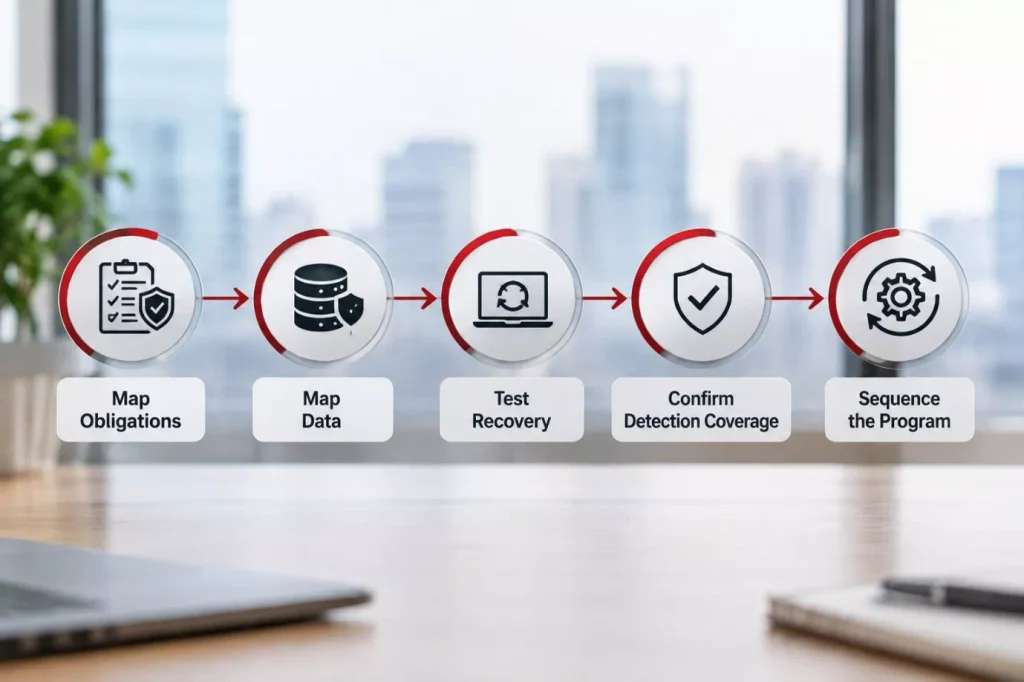
- Map obligations: List enacted laws, applicable NBC requirements, and draft laws with their current status.
- Map data: Record where personal data is collected, stored, transferred, and processed, including third-party systems.
- Test recovery: Run a tabletop exercise, followed by a technical restoration test against documented targets.
- Confirm detection coverage: Verify 24/7 monitoring for critical systems and define escalation paths.
- Sequence the program: Apply the T-SAMA methodology (Train, Scope, Assess, Mitigate, Audit) so each phase produces measurable outputs.
Where internal capacity is limited, managed security operations can extend detection and response coverage.
Security leaders who want to test these priorities with regional peers are invited to join the cybersecurity summit on 20 November 2026 in Cambodia.
Building Resilience That Outlasts Any Single Regulation
Cambodia’s cybersecurity framework is still forming, and the organizations that move first will not be those waiting for a final statute. Compliance answers whether a control exists. Resilience answers whether the business keeps operating when that control fails. Mapping obligations, tracing data flows, and testing recovery now prepares an enterprise for the draft data protection and cybersecurity laws, and it strengthens its position under the criminal and sector rules already in force.
Join the Cambodia Cybersecurity Summit 2026
| Join us for the cybersecurity summit on 20 November 2026 in Cambodia. CISOs, CIOs, and governance leaders will examine how to turn Cambodia’s shifting regulatory landscape into measurable resilience. Register for the Cambodia Cybersecurity Summit 2026. |
People Also Ask
Is compliance the same as cyber resilience?
No. Compliance shows that required controls existed at the time of assessment. Cyber resilience shows that an organization can keep critical services running, contain incidents, and recover. Regulators and boards increasingly test the second capability.
Do banks in Cambodia have to follow National Bank of Cambodia guidelines?
Yes. NBC guidelines apply to banks and financial institutions. Organizations should confirm current obligations directly with the NBC, since guidance can be updated.
What is the difference between a draft law and an enacted law in Cambodia?
An enacted law is passed and promulgated, so it carries binding force. A draft law is still under consultation or review and can change before promulgation. Organizations should track drafts as planning inputs without treating their provisions as settled obligations.
Enjoyed reading this blog? Stay updated with our latest exclusive content by following us on Twitter and LinkedIn.