








TL;DR
- Generative models have removed the spelling errors, awkward phrasing, and generic greetings that most phishing simulations still train employees to spot, so programs must shift from spotting flaws to verifying requests.
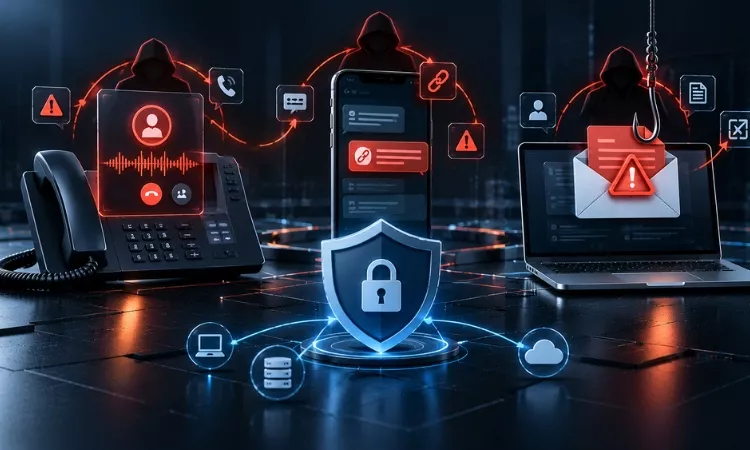
- Attacks now arrive by voice, text, collaboration apps, and video, and the Verizon 2026 DBIR found median click rates in mobile-centric simulations are 40% higher than for email, so email-only simulation programs leave major gaps.
- The metrics that matter most are reporting rate, time to report, and verification behavior on high-risk requests, with click rate as one input among several.
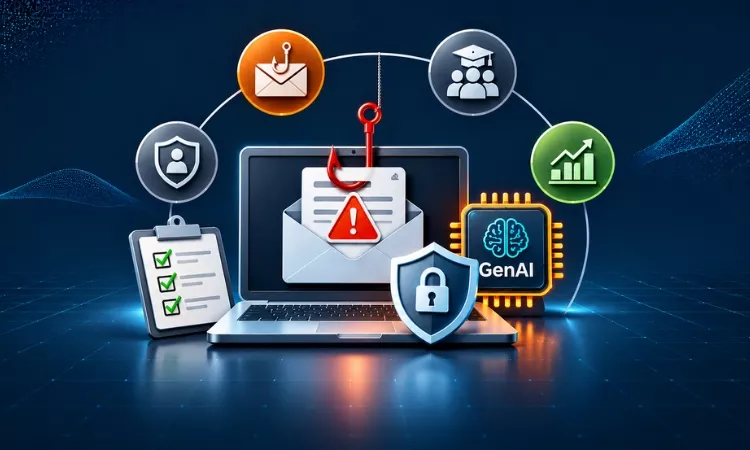
Phishing has always relied on persuasion, but generative tools have changed its economics. Attackers can now produce fluent, context-aware messages in any language, clone a familiar voice from a short audio sample, and generate convincing pretexts at scale.
Many phishing simulations, however, still reflect an older threat: obvious lures, poor grammar, and suspicious links that teach employees to look for mistakes that attackers no longer make.
The pressing question is whether current simulations still prepare people for the attacks they will face.
Why Are Traditional Phishing Simulations Falling Behind?
Traditional phishing simulations fall behind because they train employees to detect surface-level flaws, and generative tools have largely removed those flaws. When a message is grammatically perfect, personalized, and timed to a real business event, “look for typos” becomes poor guidance.
The threat data supports this shift. The Verizon 2026 Data Breach Investigations Report found the human element present in 62% of breaches, with phishing at 16% of initial access vectors and pretexting rising to 6%. It also documents threat actors using generative tools for targeting and initial access.
Three gaps are most common in legacy programs:
- Template-driven lures that look nothing like the tailored messages employees now receive.
- Email-only coverage that ignores voice, SMS, messaging apps, and video.
- Click-rate obsession that rewards avoidance rather than reporting and verification.
How Has GenAI Changed Phishing and Social Engineering?
GenAI has made phishing more fluent, more personalized, and more multichannel. Attackers use it to write convincing messages, translate them without errors, research targets, and impersonate trusted people through synthetic voice and video.
The FBI’s public service announcement on criminal use of generative AI describes how criminals use generated text to craft messages faster and remove grammar errors, cloned audio to impersonate known contacts, and real-time video to pose as executives or authority figures. A December 2025 FBI update described campaigns impersonating senior US officials through text messages and voice messages that may use cloned voices, before moving targets to encrypted messaging apps.
For enterprises, this translates into scenarios such as:
| Attack Type | What Changed | Business Risk |
| Spear phishing email | Fluent, personalized content at scale | Credential theft and initial access |
| Business email compromise | Accurate tone and context from public and stolen data | Fraudulent payments and data release |
| Vishing | Cloned voices of executives or IT staff | MFA resets, wire transfers, credential disclosure |
| Smishing and messaging apps | Fast, informal channels outside email controls | Session hijacking and malware delivery |
| Deepfake video | Real-time impersonation on calls | High-value fraud approvals |
What Must Security Awareness Programs Change?
Security awareness programs must move from teaching people to spot bad messages to teaching them to verify unusual requests, regardless of how legitimate the message looks. This requires changes in scenarios, channels, cadence, and measurement.
Shift From Red Flags to Verification Behaviors
Train employees to recognize risky requests rather than imperfect messages. Payment changes, credential or MFA requests, urgent data transfers, and requests to move to another channel should all trigger out-of-band verification through a known contact method. The FBI’s guidance reinforces this: verify identity independently before acting.
Expand Phishing Simulations Beyond Email
Modern phishing simulations should include vishing, smishing, QR code lures, and messaging-app scenarios. The Verizon 2026 DBIR found the median click rate in mobile-centric simulations, such as voice and text, to be 40% higher than for email. Programs that test only email measure only part of the exposure.
Make Scenarios Realistic and Role-Specific
Finance teams need payment fraud and supplier impersonation scenarios. Help desks need voice-based password and MFA reset pretexts. Executives and their assistants need deepfake and impersonation scenarios. Developers and administrators need lures that target tokens, repositories, and cloud consoles.
Replace Annual Training With Continuous Learning
NIST SP 800-50 Rev. 1 frames security learning as a lifecycle tied to organizational risk rather than a one-time event. In practice, this means frequent, short simulations with immediate, constructive feedback.
How Should Organizations Measure Phishing Simulation Success?
Organizations should measure phishing simulation success by how quickly and consistently employees report and verify suspicious activity, with click rate as a secondary measure. A low click rate can hide a workforce that never reports anything.
Track these metrics together:
- Reporting rate: The share of recipients who report a simulation through the approved channel.
- Time to report: How quickly the first report reaches the security team, which determines how fast a real campaign can be contained.
- Verification rate: How often employees confirm high-risk requests through an independent channel.
- Repeat susceptibility: Whether the same individuals or roles fail repeatedly.
- Channel-specific results: Separate outcomes for email, voice, SMS, and messaging scenarios.
Report these by role and business unit so leadership can direct training where risk is highest.
What Are the Common Mistakes in Modern Phishing Simulation Programs?
The most common mistake is treating simulations as a test to catch employees rather than a practice that builds habits. Punitive programs reduce reporting, which is the behavior security teams need most. Other frequent mistakes include:
- Running the same templates repeatedly, so employees learn the simulation rather than the threat.
- Simulating deepfakes or voice cloning without HR, legal, and leadership approval and clear ethical boundaries.
- Ignoring technical controls such as phishing-resistant MFA and email authentication that reduce reliance on human judgment.
- Failing to connect simulation results to incident response, so real reports go unanswered.
For organizations handling payment card data, these programs also carry compliance weight. PCI DSS v4.0.1 Requirement 12.6.3.1 requires security awareness training to cover phishing and related attacks and social engineering, and Requirement 5.4.1 requires mechanisms to detect and protect personnel against phishing attacks.
What Should Security Leaders Do Next?
Security leaders should benchmark their current program against modern attack channels, update scenarios to reflect AI-crafted pretexts, and validate human defenses through realistic testing. A practical sequence:
- Assess current simulation coverage across email, voice, SMS, and messaging channels.
- Define high-risk requests that always require out-of-band verification.
- Build role-based scenarios for finance, help desk, executives, and technical staff.
- Shift reporting toward reporting rate, time to report, and verification.
- Validate defenses through social engineering testing and red team assessments that reflect real adversary techniques.
Building Phishing Simulations That Match the Threat
Phishing simulations remain one of the most practical ways to build human resilience, but only when they reflect the attacks employees face today. GenAI has made fluent, personalized, multichannel social engineering routine. Programs that focus on verification behavior, cover every channel, and measure reporting rather than clicks will prepare people for that reality.
Are your phishing simulations keeping pace with AI-crafted attacks?
| Talk to Ampcus Cyber to assess your security awareness program, test it against realistic social engineering, and build a human defense that holds up under pressure. |
People Also Ask
Are phishing simulations still effective against AI-generated phishing?
Yes, when they are updated. Simulations that use realistic, role-specific scenarios across multiple channels and reward reporting remain effective. Simulations built on obvious red flags no longer reflect current threats.
How can employees spot AI-generated phishing emails?
Content quality is no longer a reliable signal. Employees should focus on the request itself: urgency, payment or credential changes, unusual channels, and pressure to bypass process, and verify through a known contact method.
Should phishing simulations include deepfake voice or video?
They can, with care. Voice-based simulations for help desk and finance teams are increasingly common. Deepfake scenarios should be approved by legal, HR, and leadership, and should never use a real person’s likeness without consent.
How often should organizations run phishing simulations?
Many organizations run simulations monthly or more often, using short, varied scenarios. Frequency matters less than variety, realism, and immediate feedback.
Does PCI DSS require phishing awareness training?
Yes. PCI DSS v4.0.1 Requirement 12.6.3.1 requires security awareness training to include phishing and related attacks and social engineering.
Enjoyed reading this blog? Stay updated with our latest exclusive content by following us on Twitter and LinkedIn.