










TL;DR
- Build the scope of an AI red team engagement around named systems, business-relevant threat scenarios, and the specific harms your organization cannot accept.
- Put the boundaries in writing, including in-scope models, agents, tools, data sources, environments, test accounts, and stop conditions for production systems.
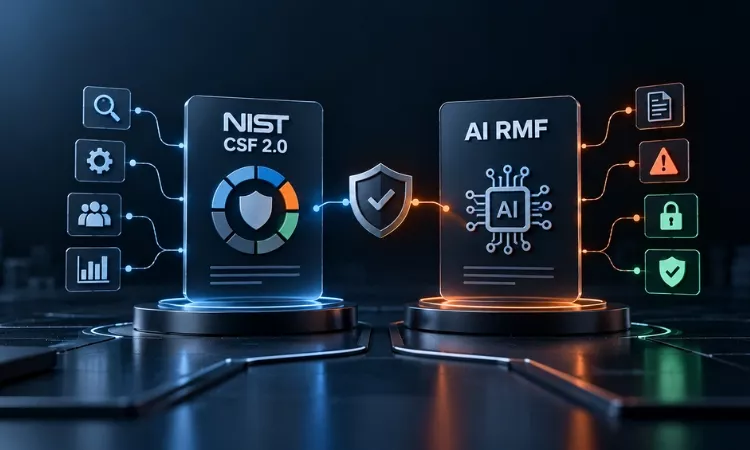
- Ask vendors for findings mapped to OWASP, MITRE ATLAS, and NIST AI RMF, with reproducible attack evidence and an agreed retest window.
SECURITY SCOPE ALERT
Your AI Red Team Test May Be Missing the Real Threat.
[STATUS] Model-level testing: PASSED
[WARNING] Agent tool permissions: NOT TESTED
[WARNING] Sensitive data exposure: NOT VERIFIED
[WARNING] Downstream API abuse: OUT OF SCOPE
Your model passes the jailbreak tests, your guardrails hold, and your report looks clean, but can an attacker still manipulate an AI agent into exposing customer data, abusing an API, or triggering an unauthorized transaction, and if these attack paths fall outside the engagement’s scope, how much assurance does a successful test really offer about the risks that matter most to the business?
This guide explains how to scope an AI red team engagement, evaluate vendor proposals, and ensure the assessment delivers actionable evidence of security weaknesses rather than a collection of isolated prompt failures.
What Is An AI Red Team Engagement And How Does It Differ From A Traditional Penetration Test?
An AI red team engagement is a structured adversarial exercise that tests how an AI system, its data, and its connected tools behave under deliberate attack. A traditional penetration test looks for exploitable weaknesses in networks, applications, and infrastructure. AI red teaming adds a behavioral layer, because large language models and agents can be manipulated through natural language without any code-level vulnerability.
The OWASP Gen AI Red Teaming Guide describes this scope as spanning model-level issues, such as toxicity and bias, through system-level problems, such as API misuse and data exposure. In practice, a mature engagement combines classic application testing with adversarial prompting, data manipulation, and agent abuse. Our article on how AI red teaming helps secure generative AI applications explains these attack categories in more depth.
Which AI Systems And Assets Should Be In Scope For An AI Red Team Engagement?
The scope of an AI red team engagement should include every component that an attacker could influence or abuse to reach a harmful outcome, along with the model itself. Security leaders should build an inventory before requesting proposals, because vendors can only price and plan against what they can see.
A complete scope inventory typically covers:
- Models: Foundation models, fine-tuned models, and model versions, including whether each one is hosted by a third party or self-managed.
- Application layer: System prompts, guardrails, input filters, output filters, and user interfaces such as chat, voice, or embedded copilots.
- Retrieval and data sources: Vector databases, knowledge bases, document stores, and any data pipeline that feeds the model context.
- Agents and tools: Function calls, plugins, Model Context Protocol (MCP) servers, APIs, and the permissions each tool holds.
- Identities and integrations: Service accounts, API keys, and downstream systems such as CRM, payment, or ticketing platforms.
Agentic systems deserve special attention, because one manipulated instruction can travel across several tools and systems. Measuring the potential AI agent blast radius helps teams decide which integrations require the deepest testing. The OWASP Top 10 for Agentic Applications, released in December 2025, offers a useful checklist of agent-specific risks to include.
How Do You Define Threat Scenarios And Success Criteria For AI Red Teaming?
Threat scenarios for AI red teaming should start from business harms, such as data leakage, fraudulent transactions, or unsafe advice, and then work backward to the attack paths that could cause them. This approach keeps the engagement focused on outcomes that leadership and regulators care about.
Effective scenarios name the attacker, the entry point, and the harm. Examples include an external user who extracts another customer’s records through prompt injection, a malicious document in a knowledge base that redirects an agent’s actions, or an insider who corrupts training data through AI data poisoning.
Success criteria should define what counts as a confirmed finding. Strong criteria include:
- Measurable thresholds: The attack success rate across repeated attempts, since model responses are probabilistic and one failure can hide many successes.
- Severity definitions: A rating scale that ties each finding to business impact, data sensitivity, and exploitability.
- Framework mapping: Alignment with the OWASP Top 10 for LLM Applications, MITRE ATLAS, and the NIST AI Risk Management Framework for consistent reporting.
What Should The Rules Of Engagement Cover For An AI Red Team Test?
The rules of engagement for an AI red team test should define what testers may do, where they may do it, and when they must stop. Written rules protect production systems, customers, and the legal position of both parties.
At a minimum, the rules of engagement should address:
- Environments: Whether testing runs in production, staging, or a dedicated replica, and which data each environment contains.
- Data handling: How testers store prompts, responses, and any sensitive data they extract, along with deletion timelines after the engagement.
- Rate and cost limits: Query volumes and token budgets, since automated attacks can create large inference bills from model providers.
- Stop conditions: Events that pause testing, such as access to live customer data, real transactions, or service degradation.
- Third-party permissions: Written approval from model providers or SaaS vendors whose acceptable use policies may restrict adversarial testing.
- Escalation contacts: Named people on both sides who can approve changes or halt the engagement at any hour.
What Deliverables Should Security Leaders Expect From An AI Red Teaming Vendor?
Security leaders should expect an AI red teaming vendor to deliver reproducible evidence, prioritized remediation guidance, and a retest that confirms fixes work. A report that lists jailbreak screenshots without context will not support governance decisions or audit requirements.
A strong deliverable package includes:
- Executive summary: Business risk in plain language for boards and AI governance committees.
- Technical findings: Exact prompts, payloads, tool calls, and responses, with clear proof of exploit for each confirmed issue.
- Remediation guidance: Specific fixes across guardrails, permissions, retrieval controls, and monitoring, ranked by severity.
- Regression assets: A reusable test set that internal teams can run after every model update or prompt change.
- Retest window: A defined period, often 30 to 60 days, to validate remediation.
Because models, prompts, and tools change frequently, many organizations pair periodic engagements with autonomous red teaming for continuous coverage between formal tests.
| Plan your next AI red team engagement with confidence through Ampcus Cyber’s AI Red Teaming and Security Testing services. |
People Also Ask
How long does an AI red team engagement take?
Most focused engagements take two to six weeks, depending on the number of models, agents, and integrations in scope and the depth of manual testing required.
Is AI red teaming required by regulation?
The EU AI Act requires adversarial testing for providers of general-purpose AI models with systemic risk, and NIST guidance recommends red teaming as part of AI risk management.
Can AI red teaming be fully automated?
Automated tools provide broad and repeatable coverage, while human testers find creative, multi-step attack paths that automation often misses. Most programs combine both approaches.
How often should organizations red team their AI systems?
Organizations should test before launch, after significant model or tool changes, and at least annually, with automated testing running between formal engagements.
Enjoyed reading this blog? Stay updated with our latest exclusive content by following us on Twitter and LinkedIn.