









You just received your organization’s penetration testing report. It’s dense, packed with CVE numbers, CVSS scores, severity ratings, and technical language. But one phrase keeps appearing throughout the confirmed findings section: Proof-of-Exploit provided.
What does that mean? Is it different from a standard vulnerability finding? Should you treat it differently?
In this blog, we’ll unpack proof-of-exploit from the ground up, what it is, why it’s the most important finding type in any penetration testing report, and how AI-powered platforms such as Mirror are making validated exploitation of the new standard.
What Is Proof-of-Exploit in a Penetration Testing Report?
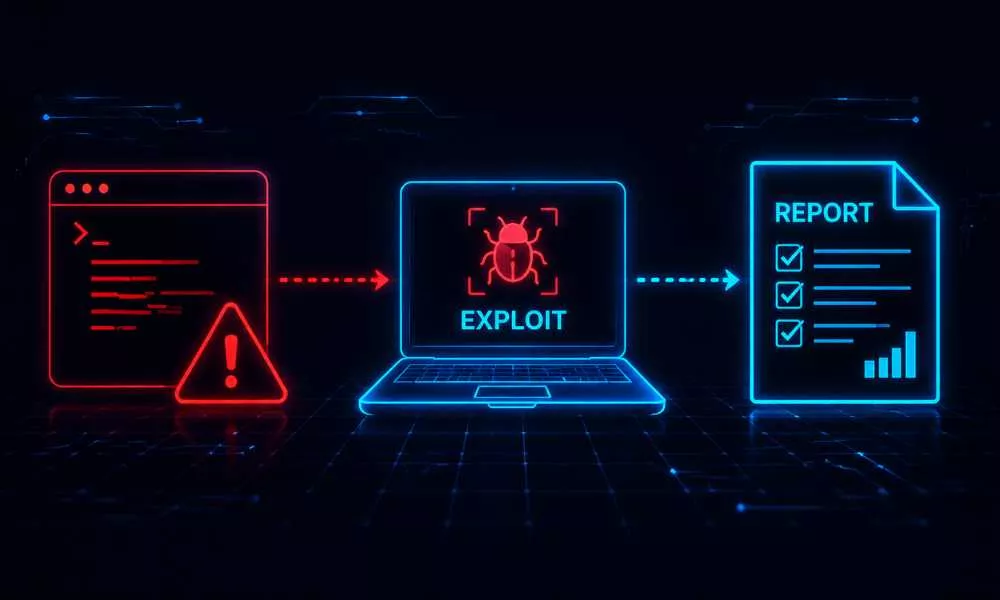
Proof-of-Exploit (PoE) is documented, reproducible evidence that a specific vulnerability was not just discovered, but successfully triggered and exploited under controlled, authorized conditions.
It is the difference between a tester saying this door looks weak and opening it, walking through, and capturing a photograph from inside. In a penetration testing report, a PoE entry typically contains:
- The vulnerability exploited and its CVE reference (if applicable)
- The step-by-step attack chain that led to exploitation
- Screenshots, command-line outputs, HTTP request/response captures, or session tokens
- The level of access, data, or system control achieved
- The real-world impact, what a threat actor could have done from that position
- A specific remediation recommendation
A PoE converts a theoretical risk into demonstrated, evidence-backed reality. It tells developers, security teams, and executives: this is not a scanner alert. This vulnerability was reached, triggered, and confirmed.
What Is the Difference Between Vulnerability and Exploit?
A vulnerability is a weakness such as a flaw in code, misconfiguration, an outdated component, or an unpatched service. Vulnerabilities are catalogued in public databases such as the NIST National Vulnerability Database (NVD) and assigned CVE identifiers. Their theoretical severity is measured by CVSS scores published by FIRST.org, which rate characteristics like attack complexity, required privileges, and impact scope on a scale of 0–10.
An exploit is the act of weaponizing that vulnerability, using a specific technique to trigger the flaw in a way that produces an unauthorized outcome: gaining access, escalating privileges, exfiltrating data, or disrupting operations.
Here is the critical insight every analyst must internalize: a high CVSS score does not mean a vulnerability is exploitable in your environment. Firewalls, network segmentation, authentication requirements, and application-layer controls can all prevent a theoretically critical CVE from ever being reachable by an attacker. CVSS quantifies severity in the abstract; it says nothing about your specific exposure.
| Factor | CVSS Score | Proof-of-Exploit |
| What it measures | Theoretical severity | Actual exploitability in your environment |
| Based on | Vulnerability characteristics | Live exploitation evidence |
| Output | Numeric score (0–10) | Attack narrative + evidence artefacts |
| Remediation priority value | Moderate (context-free) | High (environment-confirmed) |
| False positive risk | High | Minimal |
Proof-of-exploit closes the gap between theoretical risk and real-world danger.
What is the Importance of Proof-of-Exploit in a Penetration Testing Report?
Without PoE, a penetration testing report is an educated guess. With PoE, it becomes actionable intelligence, and the difference has measurable consequences.
Vulnerability scanners generate significant noise. According to VulnCheck’s 2026 Exploit Intelligence Report, proof-of-concept exploit code for new CVEs increased by 16.5% in 2025, meaning more vulnerabilities than ever have publicly available attack code and more scanner alerts than ever require human validation to distinguish real risk from theoretical exposure.
PoE cuts through that noise by confirming which findings actually matter in your environment.
It drives smarter remediation prioritization: Knowing that an attacker can pivot from a web application vulnerability to gain administrative access to a backend database is fundamentally different from knowing they might be able to. For structured guidance after findings are confirmed, our Vulnerability Remediation Guidance service provides hands-on support through the full remediation lifecycle.
It builds a real business case: PoE translates technical findings into executive language. Showing leadership a screenshot of a tester accessing customer records from a publicly reachable endpoint communicates risk in a way that a CVSS 9.1 score never will.
It meets compliance requirements: Frameworks including PCI DSS, ISO 27001, and HIPAA increasingly require organizations to demonstrate that security testing validates exploitability, not just theoretical exposure. A report backed by PoE provides auditors with defensible documentation.
See Which of Your Vulnerabilities Are Actually Exploitable
Most pen tests tell you what is vulnerable. Mirror shows you what’s exploitable, with AI-validated proof-of-exploit evidence across your full attack surface.
What Does a Proof-of-Exploit Evidence Block Actually Look Like?
Understanding the structure helps analysts read and communicate findings more effectively. Here is a representative example of how a PoE is documented in a professional penetration testing report:
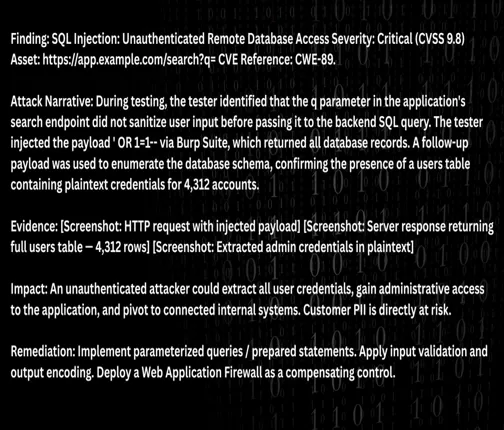
A finding like this leaves no ambiguity. It is clear what happened, what was accessed, and what must be fixed, and it compels immediate action in a way that a scanner’s alert never could.
How Is Proof-of-Exploit Produced During a Pen Test?
PoE is generated in the exploitation phase of a structured penetration test, following reconnaissance, scanning, and vulnerability enumeration per the Penetration Testing Execution Standard (PTES). Skilled testers don’t just find weaknesses; they chain them.
A single low-severity misconfiguration combined with a medium-severity authentication flaw may together enable a critical breach that neither vulnerability could achieve independently. This chaining is what real attackers do, and it is what separates deep-dive penetration testing from automated scanning.
Understanding where your exploitable vulnerabilities live require a full view of what’s exposed. Attack Surface Analysis Maps every reachable entry point before testing begins, ensuring that no attack path goes unexamined.
For complex, multi-layer environments, Advanced Penetration Testing service combines experienced human testers with AI-augmented capabilities to produce PoE-backed findings at depth and speed that manual-only engagements cannot match.
How Is AI Changing Proof-of-Exploit Generation?
Traditional penetration testing is constrained by human bandwidth. An engagement window of one- or two-weeks limits how much of an environment any team can cover, meaning some attack paths go untested by default. AI-powered platforms are rewriting that constraint.
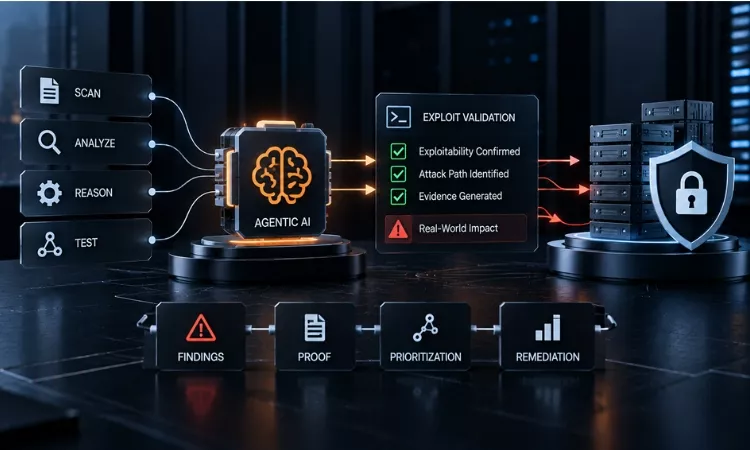
Mirror is an autonomous AI penetration testing platform that discovers, chains, and validates vulnerabilities across web applications, APIs, infrastructure, and mobile apps delivering proof-of-exploit evidence at a coverage level and speed that manual testing cannot replicate alone.
Where traditional vulnerability scanners produce thousands of unvalidated alerts, Mirror’s autonomous AI agents simulate real-world attacker behavior: finding vulnerabilities, chaining them across systems, and confirming actual exploitability. Security teams receive verified, evidence-backed findings, not theoretical risks giving them the clarity to act fast and remediate with confidence.
Stop Guessing. Start Proving.
The most dangerous vulnerabilities in your environment aren’t the ones with the highest CVSS scores. They’re the ones that can actually be exploited, right now, from the outside, by an attacker who has no intention of documenting anything.
Mirror delivers AI-powered penetration testing that goes beyond discovery to produce verified proof-of-exploit findings across your entire attack surface so your remediation effort goes exactly where the real risk is.
Enjoyed reading this blog? Stay updated with our latest exclusive content by following us on Twitter and LinkedIn.