









Your last VAPT report is outdated.By the time the final PDF lands in your inbox, after weeks of scoping, testing, and remediation tracking, your developers have shipped three new releases, your cloud team has spun up two new environments, and threat actors have published fresh exploits targeting the exact stack you run in production.
Annual VAPT was designed for a world where infrastructure changed slowly, attack surfaces were predictable, and a point-in-time snapshot gave meaningful assurance. That world no longer exists.
The Mandiant’s M-Trends 2024 reports found that the median time from vulnerability disclosure to exploitation has dropped to as little as 5 days for some critical CVEs, down from 32 days just a few years ago.
What Is a Continuous Security Validation Program?
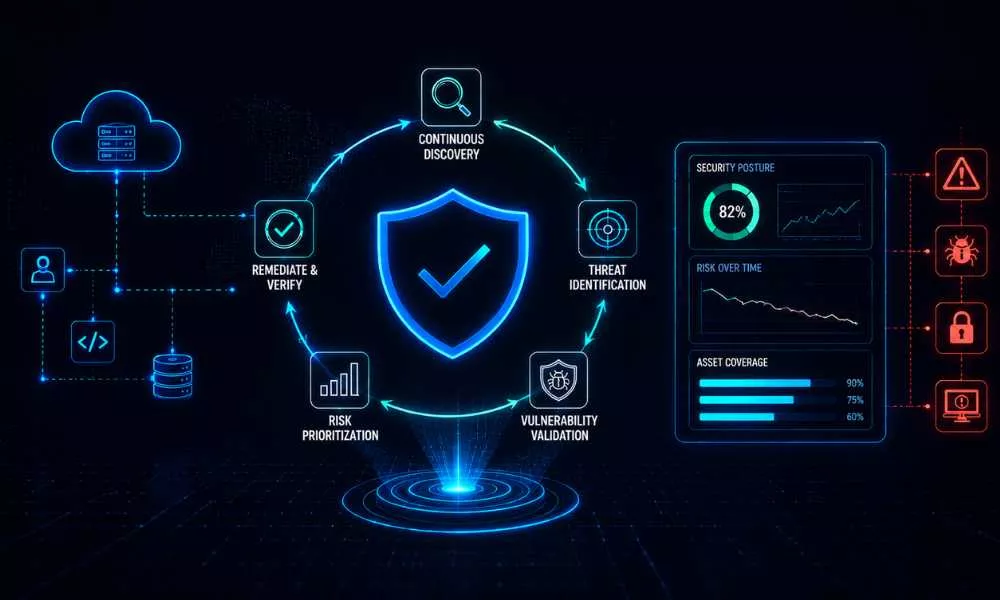
A continuous security validation program is a structured, always-on approach to security testing that validates your real attack surface, not a frozen snapshot of it. Unlike traditional VAPT, which treats testing as a project with a start date and end date, continuous validation treats security testing as an ongoing operational function.
The core components of a mature continuous security validation program include:
1. Automated, recurring penetration testing across web applications, APIs, infrastructure, and mobile surfaces, triggered by code changes, new deployments, or scheduled cadences.
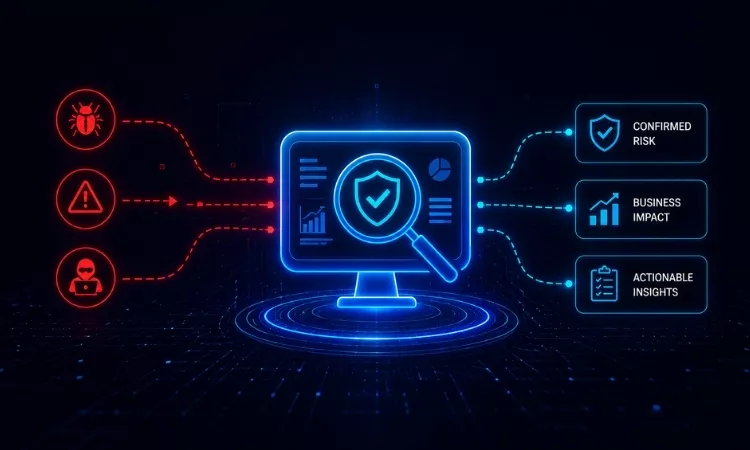
2. Proof-of-exploit validation, not just vulnerability scanning. The critical distinction: a scanner tells you a CVE exists; a continuous validation program tells you whether that CVE is exploitable in your specific environment.
3. Attack chain simulation, where individual vulnerabilities are tested in combination, the way real attackers chain low-severity issues critical compromise paths.
4. Continuous attack surface management that tracks new assets, shadow IT, third-party integrations, and exposed endpoints as they emerge.
5. Real-time remediation intelligence that prioritizes findings by verified exploitability rather than CVSS score alone.
Annual VAPT vs. Continuous Security Validation: The Real Difference
Annual VAPT provides a point-in-time security assessment conducted once or twice a year, generating a static report of theoretical vulnerabilities. Continuous security validation runs autonomously and repeatedly, validating actual exploitability across your live attack surface and delivering real-time, evidence-backed findings throughout the year.
| Dimension | Annual VAPT | Continuous Security Validation |
| Frequency | Once or twice per year | Always-on, triggered by change or schedule |
| Coverage | Scoped, point-in-time | Full attack surface, ongoing |
| Findings | Theoretical vulnerabilities | Verified, proof-of-exploit evidence |
| Time to Insight | Weeks after testing ends | Real-time or near-real-time |
| Attack Chaining | Limited (manual) | Automated, multi-hop simulation |
| Remediation Guidance | Static report | Continuous, prioritized by real risk |
| Compliance Alignment | Meets minimum requirement | Exceeds requirement, reduces audit burden |
The gap isn’t just operational; it’s existential. Organizations that rely solely on annual VAPT are essentially flying blind for the better part of every calendar year.
Why Traditional Vulnerability Scanners Don’t Fill the Gap
A common misconception is that running a vulnerability scanner between annual VAPT cycles constitutes continuous security validation. It does not.
Vulnerability scanners are detection tools. They identify the presence of known weaknesses, missing patches, misconfigured headers, and outdated dependencies. What they cannot do is determine whether those weaknesses are exploitable in context, or whether they can be chained with other low-severity issues to achieve a critical outcome.
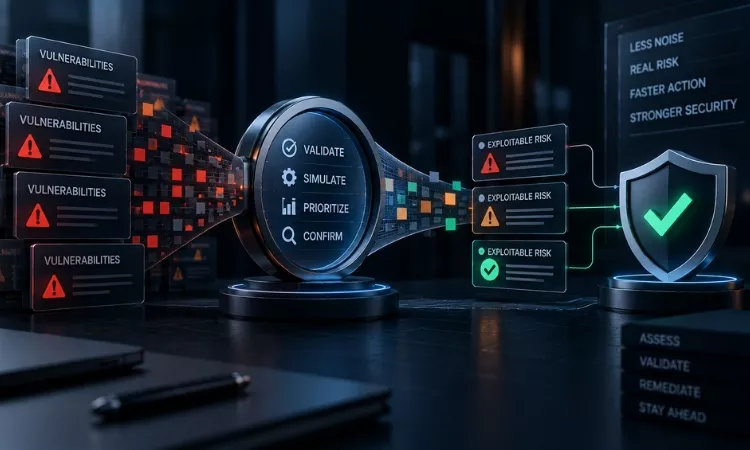
The result is alert fatigue at an industrial scale. Security teams drowning in thousands of scanner findings, the vast majority of which represent no real exploitable risk, cannot effectively prioritize remediation. High-severity exploitable vulnerabilities get buried alongside thousands of theoretical findings that would never survive real-world attack conditions. Continuous security validation solves this by proving exploitability, not just cataloging exposure.
How to Design a Continuous Security Validation Program: 6 Core Pillars
Pillar 1: Define Your Living Attack Surface
A continuous validation program begins with a comprehensive, dynamically updated inventory of your attack surface, web applications, APIs, cloud workloads, internal infrastructure, mobile apps, and third-party integrations. Static asset registers become stale within weeks. Your validation program needs to discover new assets as they emerge, not only test what was scoped months ago.
Pillar 2: Integrate Security Testing into the Development Lifecycle
Shift-left security isn’t a buzzword; it’s a necessity for continuous validation. Security testing should be triggered automatically when new code is deployed, when infrastructure configurations change, and when new third-party services are integrated. This means embedding your continuous penetration testing capability directly into your CI/CD pipeline, so every release is tested before it hits production.
Pillar 3: Deploy AI-Driven Exploit Validation
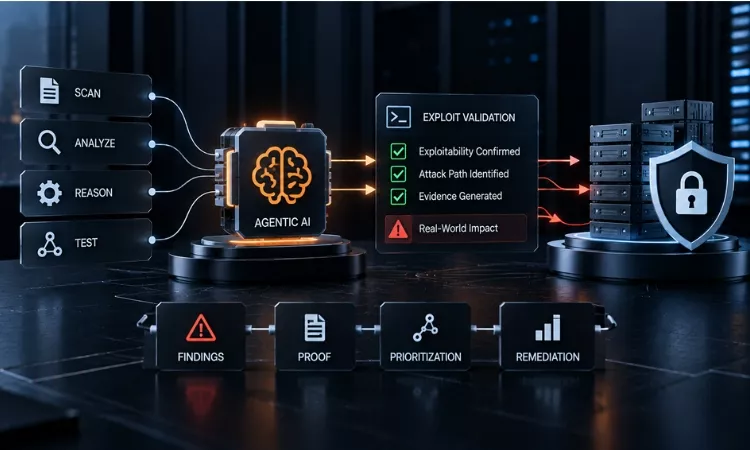
Modern AI-driven platforms deploy specialized autonomous agents, each trained in a specific attack discipline (web injection, API authentication, business logic abuse, mobile insecure storage). These agents share findings in real time, chain weaknesses across systems, and validate exploitability automatically. The result: continuous, machine-scale offensive testing that no human red team can match in coverage or speed.
Pillar 4: Implement Attack Chain Simulation
Real attackers don’t exploit vulnerabilities in isolation. They chain up a sequence of low-to-medium severity weaknesses, a misconfigured S3 bucket, an overprivileged service account, an unvalidated redirect, into a path to critical impact. Your continuous validation program must replicate this behavior. Attack chain simulation reveals composite risk that point-in-time assessments and standalone scanners routinely miss.
Pillar 5: Prioritize by Verified Exploitability, Not CVSS Score
CVSS scores measure theoretical severity. They do not measure whether a vulnerability is exploitable in your specific environment, whether a patch or compensating control already mitigates it, or whether it can be reached from an external attack path. Continuous security validation programs should surface findings ranked by actual, verified exploitability, enabling remediation teams to address what matters most, first.
Pillar 6: Close the Loop with Development
Continuous validation generates value only if findings are acted upon. Build structured feedback loops between your security functions and development teams, with real-time alerting, clear remediation guidance, and tracking of fix verification. The goal is to shrink mean time to remediation (MTTR) from weeks to days.
The Role of AI-Powered Penetration Testing in Continuous Validation
Traditional penetration testing, even when conducted by skilled human testers, faces inherent limitations of scale, speed, and scope. A human red team can test a defined scope over a defined engagement window. They cannot continuously monitor an evolving attack surface across thousands of assets and alert in real time when a new exploitable path appears.
This is the core value proposition of AI-powered penetration testing in a continuous validation model.
Mirror is purpose-built for this challenge. Rather than generating long lists of theoretical vulnerabilities, Mirror deploys autonomous AI agents that simulate real attacker behavior, discovering vulnerabilities, chaining them across systems, and validating actual exploitability with proof-of-exploit evidence.
Where do traditional scanners ask, “does this vulnerability exist?” Mirror asks, “can this vulnerability be exploited in this environment, and what is the real-world impact?”
The platform covers six attack surfaces autonomously: web applications, APIs, network infrastructure, source code, Android, and iOS, delivering findings that security teams can act on immediately, not after weeks of manual triage.
For organizations serious about moving beyond annual VAPT, Mirror provides the continuous validation engine that makes it operationally possible.
Addressing Compliance Requirements with Continuous Validation
Organizations subject to PCI DSS, HIPAA, SOC 2, ISO 27001, NIST CSF, or DPDP requirements often ask whether continuous security validation satisfies penetration testing mandates. The answer is that continuous validation not only meets compliance requirements, but it also consistently exceeds them.
PCI DSS v4.0 Requirement 11.4 mandates penetration testing at least annually and after any significant change to the environment. A continuous validation program satisfies both requirements simultaneously: scheduled recurring tests address the annual mandate, and change-triggered testing covers the post-change requirement automatically.
More importantly, continuous validation generates the ongoing evidence of security assurance that auditors increasingly want to see, not just a single annual report, but a documented history of testing, findings, and remediation activity throughout the year.
Building the Business Case for Continuous Security Validation
Security leaders who want to replace annual VAPT with a continuous validation program often face the same internal question: Is the investment justified?
Consider asymmetry. A single exploited vulnerability, a data breach, a ransomware event, a supply chain compromise, can generate costs that dwarf an entire year’s security testing budget by orders of magnitude. According to IBM’s Cost of a Data Breach Report 2024, the global average cost of a breach reached $4.88 million, a 10% increase year-over-year. The same report found that organizations took an average of 194 days to identify a breach and another 64 days to contain it. Continuous security validation shrinks that window dramatically by identifying and validating exploitable risk in near-real-time, not months after compromising.
Continuous security validation shrinks that window. By identifying and proving exploitability in near-real-time, organizations can contain and remediate vulnerabilities before they become breaching events, not after.
The business case isn’t “can we afford continuous validation?” It’s “can we afford to keep operating without it?”
Key Takeaways
Annual VAPT remains valuable as a compliance baseline, but it is no longer sufficient as the cornerstone of a mature security testing program. Threat actors move faster than annual assessment cycles. Attack surfaces evolve continuously. The only adequate response is continuous security validation that operates at the speed of your environment.
Designing that program requires six investments: a living attack surface inventory, testing integrated into development workflows, AI-driven exploit validation, attack chain simulation, prioritization by verified exploitability, and remediation feedback loops that close the gap between finding and fixing.
Organizations that make these investments, supported by platforms like Mirror that deliver autonomous, proof-of-exploit penetration testing, move from reactive compliance to proactive security assurance.
| Stop reporting on risk. Start proving it. Get a Free Demo of Mirror Now → |
Enjoyed reading this blog? Stay updated with our latest exclusive content by following us on Twitter and LinkedIn.