










As enterprise application environments expand faster than security teams can test them, traditional penetration testing models are struggling to keep pace. This article explores how AI-powered penetration testing helps organizations overcome massive security backlogs by automating exploit validation, attack-path analysis, and continuous testing at scale. It highlights how platforms like ComplyX Mirror enable lean security teams to achieve broader coverage, reduce false positives, strengthen compliance readiness, and shift from reactive testing to proactive, AI-driven security assurance.
Here is a scenario that every CISO at a mid-to-large enterprise knows intimately: your organization runs 1,500 applications. Your security engineering team number is 12. Compliance mandates annual penetration testing. Your board wants quarterly assurance. And the backlog of untested apps grows every month, not because your engineers aren’t skilled, but because math simply doesn’t work.
This is not hypothetical but an operational reality for thousands of security teams in 2025. And it represents one of the most dangerous, least-discussed gaps in enterprise cybersecurity today.
The Security Backlog Is a Business Risk:
Let’s put some numbers into the problem
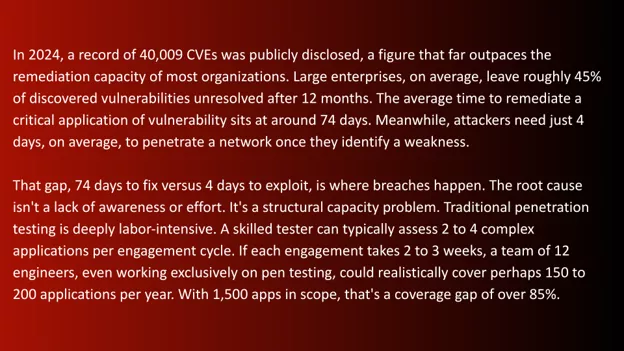
And that’s before accounting for retesting, newly deployed apps, API changes, and cloud workloads.
Why Traditional Scanning Doesn’t Close the Gap
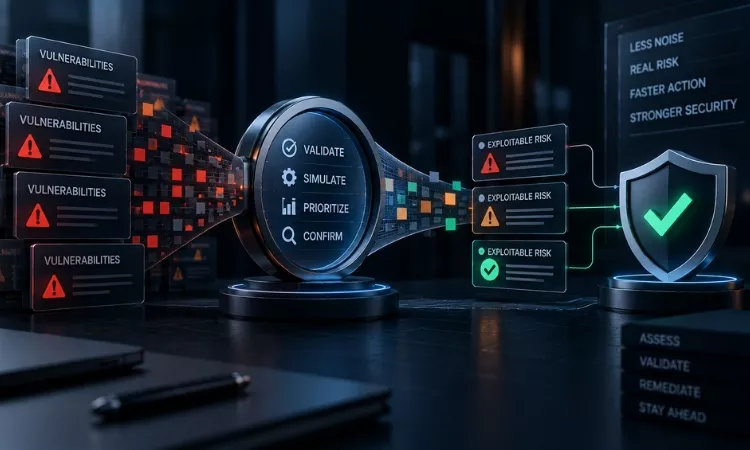
Many teams turn to automated vulnerability scanners as a stopgap. The problem? Scanners identify theoretical vulnerabilities, not confirmed exploits. They generate thousands of alerts, the vast majority of which are false positives or low-priority findings. Security teams spend enormous time triaging scanner output rather than addressing real risk.
According to the 2025 State of Pentesting Report, 67% of U.S. enterprises reported a security breach in the past two years, despite expanding their security tool stacks and managing an average of 75 different security solutions. More tools are not solving the problem. The issue is validated, exploitable risk identification, and that’s precisely where traditional approaches fall short.
The gap between “we found vulnerability” and “we confirmed it can be exploited in our environment” is enormous. Closing it requires the depth of human-style reasoning combined with the speed and scale of automation.
AI Penetration Testing: Scale Without Sacrificing Depth
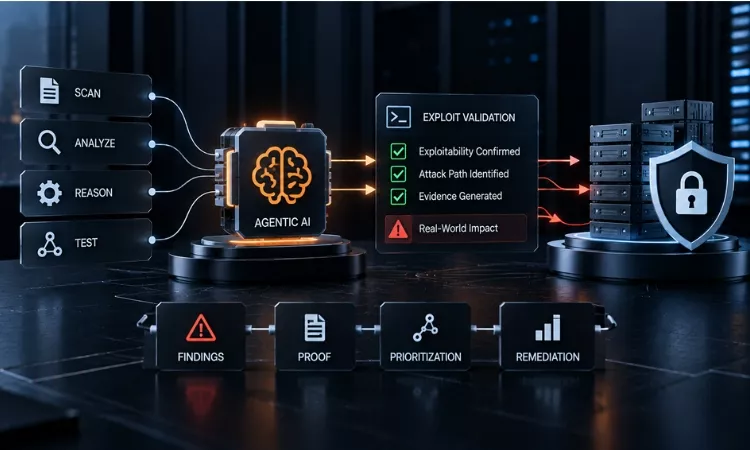
This is the core value proposition of AI-powered penetration testing as a new testing paradigm. Rather than having a human tester manually probe one system at a time, AI agents can simultaneously simulate attacker behavior across hundreds of assets, chaining vulnerabilities across systems, testing application logic, and validating whether exploits are real, not theoretical.
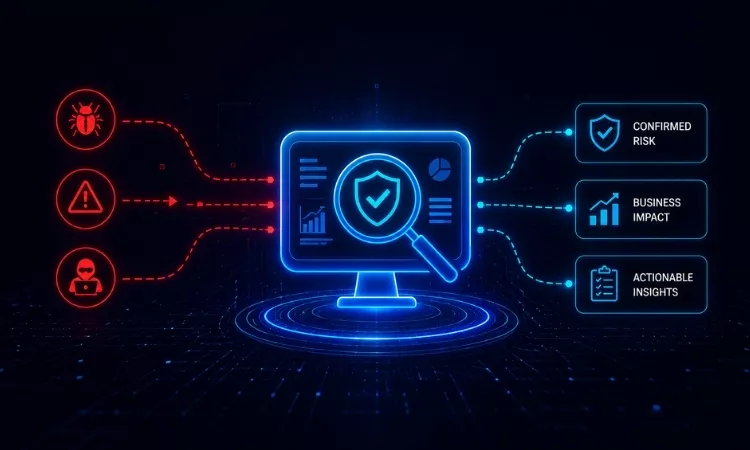
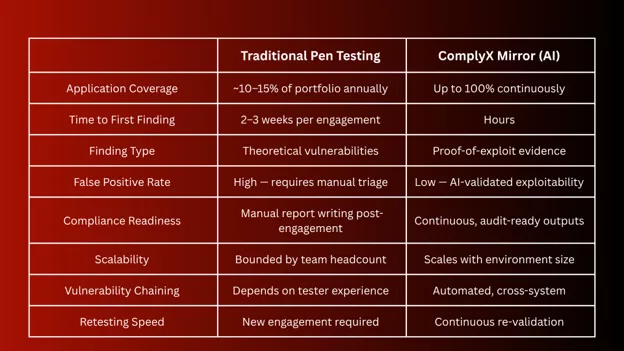
The result is proof-of-exploit evidence, not a list of potential issues. Security teams receive findings they can act on immediately, with clear context about the attack path, the conditions required for exploitation, and the business risk involved. This fundamentally changes the economics of penetration testing.
With AI pen testing, a team of 12 engineers can extend their effective coverage capacity by an order of magnitude, not by replacing security expertise, but by automating the reconnaissance, vulnerability chaining, and exploitability validation that consumes the most time in traditional engagements.
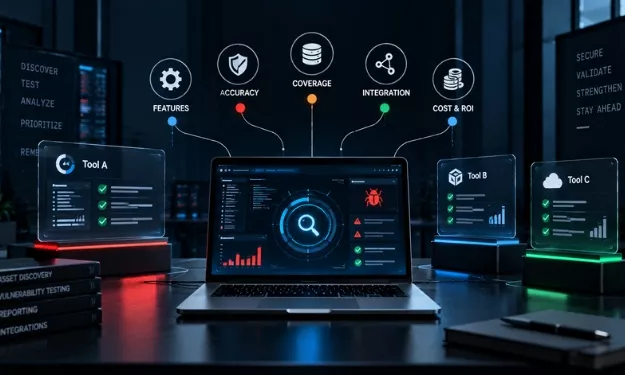
BY THE NUMBERS: Traditional Pen Testing vs. ComplyX Mirror
How ComplyX Mirror Addresses the Enterprise Backlog
ComplyX Mirror is an AI-powered penetration testing platform built precisely for this challenge. Mirror autonomously discovers, chains, and validates vulnerabilities across web applications, APIs, infrastructure, and mobile apps, delivering verified, evidence-backed findings that show which vulnerabilities pose real risk.
Unlike conventional scanners that flag theoretical weaknesses, Mirror simulates real-world attacker behavior end-to-end. Its AI agents conduct the kind of multi-step reasoning that skilled human testers apply, identifying how individual vulnerabilities can be combined across systems to create high-impact attack paths that no single-point scan would surface.
Key capabilities that directly address the backlog problem include:
- Autonomous coverage on scale. Mirror can assess large portfolios of applications continuously, eliminating the bottleneck of scheduling and conducting individual manual engagements. Teams that previously tested their most critical 10% of applications annually can now maintain ongoing visibility across their full attack surface.
- Proof-of-exploit validation. Every finding Mirror surface includes evidence of actual exploitability, not just a severity score. This eliminates the noise of false positives and allows engineers to immediately prioritize remediation based on confirmed risk rather than theoretical exposure.
- Attack path chaining. Mirror maps how vulnerabilities connect across applications, APIs, and infrastructure, mirroring the lateral movement strategies that real threat actors employ. This is particularly critical as modern enterprise environments grow more interconnected.
- Continuous, compliance-ready testing. Mirror aligns with frameworks including PCI DSS, SOC 2, and HIPAA and critically, is also architected to support DORA (Digital Operational Resilience Act) obligations for organizations operating in or serving European financial markets.
What Changes When Security Teams Test Everything
The strategic shift enabled by AI pen testing goes beyond efficiency. When security teams can realistically cover their entire application portfolio, not just the top tier, the risk of posture of the organization changes fundamentally.
Shadow IT and legacy applications that have never been formally assessed suddenly enter scope. APIs that were quietly deployed by development teams and never reviewed by security get evaluated. Mobile apps that touch customer data and were exempted from traditional testing cycles due to resource constraints get validated.
A comprehensive attack surface analysis only delivers its full value when coverage is complete. Partial coverage means partial assurance, and in security, partial assurance is a false comfort.
There is also a talent dimension to this shift. Security engineers are expensive, scarce, and in high demand. Requiring highly skilled professionals to spend most of their time on manual, repetitive testing tasks is a poor allocation of expertise. AI pen testing frees those engineers to focus on complex, judgment-intensive work, adversarial simulation design, remediation strategy, architectural risk assessment, where human expertise is irreplaceable.
From Managing Testers to Governing Agents
There is a deeper transformation embedded in this shift that goes beyond operational efficiency, and it is one that CISOs are only beginning to grapple with: as AI agents enter the security operations environment, the CISO’s role fundamentally changes.
Historically, the CISO managed people, schedules, and engagement pipelines. Penetration testing capacity is a function of team size, skill distribution, and calendar availability. The CISO’s leverage was bound by human throughput.
With AI-powered pen testing, that leverage expands dramatically, but the oversight of responsibility shifts as well. CISOs must now govern the AI agents that conduct testing: defining the scope boundaries within which agents operate, establishing escalation criteria for high-severity findings, ensuring that autonomous testing activities comply with change management policies, and validating that AI-generated evidence meets the evidentiary standards required for regulatory reporting.
This evolution leads the CISO to move from capacity management to agent governance, a role that demands a deeper understanding of how AI systems make decisions, where they can be trusted to operate autonomously, and where human judgment remains the appropriate control.
The security leaders who will manage this transition most effectively are those who begin building their AI governance posture now, alongside the AI testing capabilities that make it necessary.
The Business Case Is Clear
The economic argument for AI penetration testing is straightforward. The alternative to accepting an 85% coverage gap because manual testing cannot scale is not a cost-saving strategy. It is an unmanaged liability.
Breaches attributable to known, unpatched vulnerabilities, not zero-days, account for nearly 60% of all cyber incidents. The vulnerabilities that lead to those breaches are, by definition, findable with adequate testing. The organizations that suffer them simply ran out of capacity to test before attackers ran out of patience.
For security leaders managing large application portfolios with lean teams and increasingly complex compliance obligations across PCI DSS, SOC 2, HIPAA, and DORA, AI-powered pen testing is no longer a nice-to-have. It is the operational model that makes comprehensive security assurance achievable.
Closing the Gap Starts with Visibility
If your organization is carrying a security testing backlog today, the first step is understanding the true scope of your untested attack surface. From there, the path to coverage is clear: AI-driven penetration testing that validates real exploitability, scales with your environment, and gives your engineers the evidence they need to remediate with confidence.
| Explore ComplyX Mirror and see how AI penetration testing can help your team move from backlog to full coverage. |
Enjoyed reading this blog? Stay updated with our latest exclusive content by following us on Twitter and LinkedIn.