










TL;DR
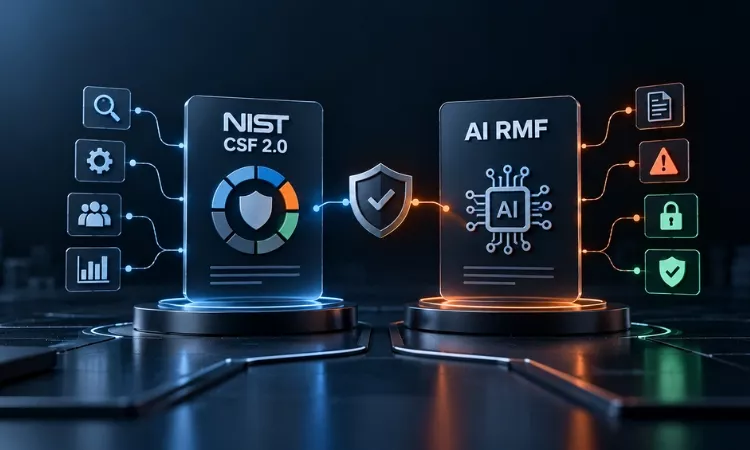
- NIST CSF 2.0 secures the systems, data, and identities AI depends on, while the AI RMF governs how AI behaves and the impact it creates; together they form one governance discipline.
- US momentum is building: Texas TRAIGA (effective January 2026) recognizes NIST AI RMF alignment as a basis for an affirmative defense, and NIST is drafting a CSF-based Cyber AI Profile.
- Start with a unified Govern Function, a complete AI inventory, and one joint gap assessment instead of running two parallel programs.
US enterprises are deploying AI across customer service, fraud detection, software development, and security operations faster than most governance programs can absorb. Security teams already manage cyber risk through the NIST Cybersecurity Framework, while AI risk often sits with data science, legal, or product teams under separate processes. That split creates blind spots: models trained on sensitive data, AI agents holding privileged access, and third-party AI services that never pass through a security review. Integrating NIST CSF 2.0 and AI RMF closes those gaps by giving leadership one governance structure for both cyber risk and AI risk.
This guide explains how the frameworks fit together and how to implement them as one auditable program.
What Are NIST CSF 2.0 and the NIST AI RMF?
NIST CSF 2.0 is a voluntary framework for managing cybersecurity risk, while the NIST AI Risk Management Framework (AI RMF 1.0) is a voluntary framework for managing the risks that AI systems pose to people, organizations, and society. Both come from the National Institute of Standards and Technology and are outcome-based rather than prescriptive.
NIST CSF 2.0, released in February 2024, organizes cybersecurity outcomes into six Functions: Govern, Identify, Protect, Detect, Respond, and Recover. These break down into 22 Categories and 106 Subcategories. The new Govern Function places cybersecurity strategy, roles, policy, oversight, and supply chain risk management at the executive level. Our guide to NIST security standards explains how these publications relate.
The NIST AI RMF, released in January 2023, uses four Functions: Govern, Map, Measure, and Manage. It defines trustworthy AI through seven characteristics: valid and reliable; safe; secure and resilient; accountable and transparent; explainable and interpretable; privacy-enhanced; and fair with harmful bias managed. NIST added the Generative AI Profile (NIST AI 600-1) in July 2024 to address risks specific to generative models.
How Do NIST CSF 2.0 and AI RMF Work Together?
NIST CSF 2.0 secures the systems and data that AI depends on, while the AI RMF governs how AI behaves and the impact it has. Security is one of the seven trustworthiness characteristics, so the frameworks overlap but do not duplicate each other.
| Area | NIST CSF 2.0 | NIST AI RMF |
| Primary focus | Cybersecurity risk to assets, data, and operations | Risks from AI design, deployment, and use |
| Core structure | Govern, Identify, Protect, Detect, Respond, Recover | Govern, Map, Measure, Manage |
| Typical owner | CISO and security team | Cross-functional AI governance group |
| Example concern | Unauthorized access to a training data store | Biased or unreliable model output |
CSF Govern and AI RMF Govern share risk appetite, accountability, and policy. CSF Identify aligns with AI RMF Map through asset inventory and context. CSF Detect and Respond extend to AI incidents such as prompt injection, data poisoning, or model misuse, which AI RMF Manage treats as risks requiring response plans.
NIST is formalizing this relationship. In December 2025, it released a preliminary draft of the Cyber AI Profile (NIST IR 8596), a CSF-based community profile organized around three focus areas: securing AI system components, conducting AI-enabled cyber defense, and thwarting AI-enabled attacks. Its comment period closed in January 2026, so treat the draft content as provisional.
Why Does NIST AI and Cybersecurity Alignment Matter for US Organizations?
Alignment matters because US regulators, customers, and courts increasingly treat NIST frameworks as the reference point for reasonable security and responsible AI. Neither is mandatory for most private companies, but both shape expectations.
Several developments raise the stakes:
- State AI legislation: The Texas Responsible Artificial Intelligence Governance Act (TRAIGA), effective January 1, 2026, provides an affirmative defense for organizations that substantially comply with the NIST AI RMF Generative AI Profile or a similar recognized framework.
- Federal direction: NIST states that the AI RMF is being revised as part of the White House AI Action Plan, so programs built on it should plan for updates.
- Disclosure expectations: Public companies must describe cybersecurity risk management and governance under SEC rules, and CSF 2.0 Govern outcomes give that disclosure a defensible structure.
- Customer due diligence: Enterprise buyers increasingly ask vendors how they govern AI.
How Should Organizations Implement NIST CSF 2.0 and AI RMF Together?
Organizations should implement both frameworks through a single governance model, using CSF 2.0 as the operating backbone and the AI RMF as the overlay for AI-specific risks. Parallel programs double assessment effort and fragment accountability.
A Six-Step NIST CSF 2.0 and AI RMF Implementation Approach
- Establish unified governance: Extend the CSF Govern Function to cover AI. Define who approves AI use cases, set AI risk tolerance, and assign executive accountability.
- Build an AI system inventory: Catalog internal models, embedded AI features in SaaS tools, AI agents, and third-party AI APIs. Record data sources, owners, and purpose.
- Create Current and Target Profiles: Use CSF Organizational Profiles to document current and desired outcomes, then add AI RMF Map and Measure outcomes for high-impact AI systems.
- Prioritize by impact: Focus first on AI systems that make or influence decisions about customers, employees, finances, or safety.
- Test and measure: Apply security testing, adversarial testing, and performance monitoring. AI red teaming and security testing validates whether models resist prompt injection, data leakage, and misuse.
- Integrate response and monitoring: Add AI incident scenarios to incident response playbooks and route model drift and misuse alerts into security monitoring.
What Evidence Supports NIST Framework Alignment?
Evidence should show governance operating in practice, including AI and cybersecurity policies, a maintained AI inventory, risk assessments for high-impact systems, CSF Current and Target Profiles, model testing results, third-party AI due diligence records, and incident response exercises that include AI scenarios.
What Are the Common Gaps in AI Risk Management Programs?
The most common gap is treating AI governance as a policy exercise rather than an operational control set. Many publish responsible AI principles but lack the inventory, testing, and monitoring to prove them.
Other recurring gaps include:
- Shadow AI: Employees use unapproved AI tools with sensitive data, outside any inventory.
- Third-party AI blind spots: Vendor contracts rarely address model training on customer data or AI-related incident notification. Mature third-party risk management should cover AI suppliers explicitly.
- Agent permissions: AI agents receive broad access without identity controls or activity logging. Our article on agentic AI security examines this risk in detail.
- Siloed ownership: Security, legal, and data science teams assess the same system separately and reach conflicting conclusions.
What Should Organizations Do Next?
Organizations should start with a joint gap assessment that measures current maturity against CSF 2.0 and the AI RMF in one exercise. The result is one prioritized roadmap instead of two disconnected reports.
For most US enterprises, the next 90 days should focus on three outcomes: an AI inventory covering internal and third-party systems, an expanded Govern Function with clear AI accountability, and validation testing for the highest-impact AI use cases. Organizations that lack internal capacity often work with a partner offering NIST CSF assessment and implementation services alongside a responsible AI practice, so cyber and AI risk are evaluated with one methodology.
Building One Governance Program for Cyber and AI Risk
NIST CSF 2.0 and AI RMF are complementary parts of one governance discipline. CSF 2.0 protects the infrastructure, data, and identities AI relies on, while the AI RMF ensures AI systems remain trustworthy, accountable, and fit for purpose. US organizations that integrate them now will be better prepared for state AI laws, revised NIST guidance, and customer scrutiny.
Ready to align your cybersecurity and AI governance programs? Ampcus Cyber helps US organizations assess maturity against NIST CSF 2.0 and the NIST AI RMF, identify priority gaps, and build a defensible roadmap.
| Talk to our NIST and AI governance specialists to schedule a joint readiness assessment. |
People Also Ask
Is the NIST AI RMF mandatory for US companies?
No. The NIST AI RMF is voluntary for private organizations. Some state laws, such as Texas TRAIGA, recognize substantial compliance with it as a basis for an affirmative defense, and many enterprise customers expect vendors to align with it.
What is the difference between NIST CSF and NIST AI RMF?
NIST CSF 2.0 manages cybersecurity risk to systems and data. The NIST AI RMF manages broader AI risks such as bias, unreliable output, lack of transparency, and harm to individuals. Security is one AI RMF trustworthiness characteristic, which is where the two frameworks connect.
Can you get certified against NIST CSF 2.0 or the AI RMF?
No. NIST does not certify organizations against either framework. Organizations demonstrate alignment through independent assessments, documented profiles, and evidence. Those needing a certifiable AI management system often pair NIST with ISO/IEC 42001.
Does the AI RMF cover generative AI and AI agents?
The Generative AI Profile (NIST AI 600-1) addresses generative AI risks such as confabulation, data privacy, and information security. Agent-specific risks like excessive permissions are best handled by combining AI RMF outcomes with CSF 2.0 identity and access controls.
How long does it take to align with both frameworks?
It depends on scope and maturity. A focused gap assessment and roadmap can typically be completed within weeks, while implementation for high-impact AI systems is an ongoing program rather than a one-time project.
Enjoyed reading this blog? Stay updated with our latest exclusive content by following us on Twitter and LinkedIn.