










TL;DR
- PCI PIN Security Requirements protect PINs and the cryptographic keys behind them through 33 requirements grouped into 7 control objectives.
- Most findings trace back to incomplete key inventories, weak dual control, and legacy key exchanges that skip key blocks.
- Named key owners, quarterly inventory reconciliation, and year-round evidence collection keep organizations ready for validation.
A payments operations director at a regional processor once prepared for an annual PIN validation, because the team had passed every earlier review. The assessor asked for a complete inventory of cryptographic keys, and the team handed over a spreadsheet that listed 41 keys. The hardware security modules held 47. Six of the extra keys belonged to a partner link that the company had retired two years earlier during a data center migration, and nobody had destroyed them or recorded who last held the components. The gap came from a migration project that changed the environment faster than the key records changed.
This is a hypothetical scenario, but it explains the real pain point mostly seen in many cases according to the reports. It is intended to explain why PCI PIN Security Requirements demand tight control over every key and device that touches a PIN. This guide explains who must comply, what the seven control objectives require, and how security and compliance leaders can prepare for a PIN assessment.
What Are the PCI PIN Security Requirements?
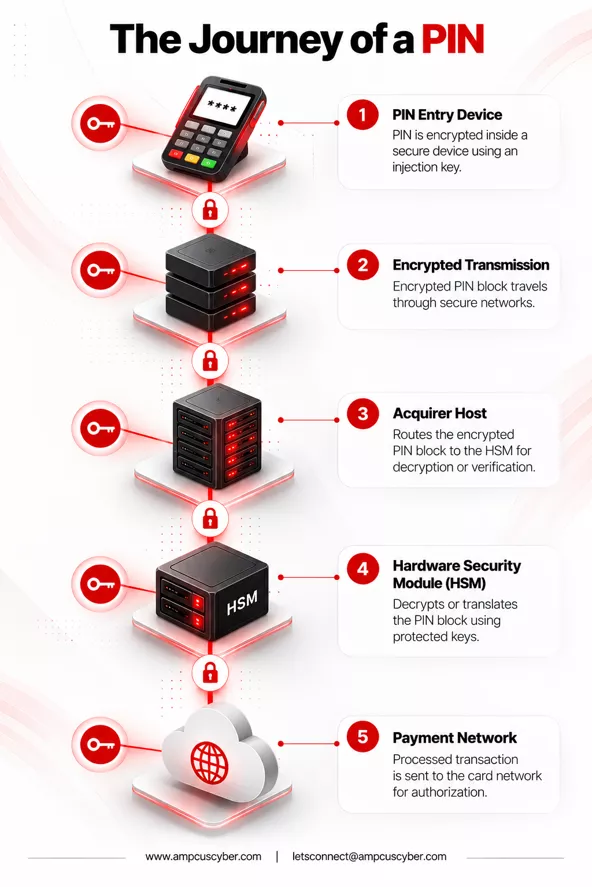
The PCI PIN Security Requirements are controls from the PCI Security Standards Council that protect PINs and the cryptographic keys that secure them during processing at ATMs and point-of-sale terminals. The standard, formally titled PCI PIN Security Requirements and Testing Procedures, currently stands at version 3.1, published in March 2021. It contains 33 requirements grouped into seven control objectives, and it covers equipment, key management, and the physical and logical protection of both. Its scope reaches PIN entry devices, hardware security modules, key injection facilities, and the networks that carry encrypted PIN blocks between them. The council built the unified standard with the ASC X9 committee, and card brand programs enforce it through their validation rules.
Who Must Comply with PCI PIN Security Requirements?
Acquirers, processors, issuers that handle PINs, and third-party service providers that touch PIN data or keys must comply, and card brand programs decide who validates and how. The scope includes ATM and POS PIN acquiring, key injection facilities, and certification and registration authorities. Brands such as Visa and Mastercard set the validation rules for their participants, so some entities complete a self-assessment while others need an assessment by a Qualified PIN Assessor. Your acquirer or network agreement states which path applies to your organization. Entities that outsource PIN processing remain responsible for confirming that their service providers comply.
What Are the Seven Control Objectives of PCI PIN?
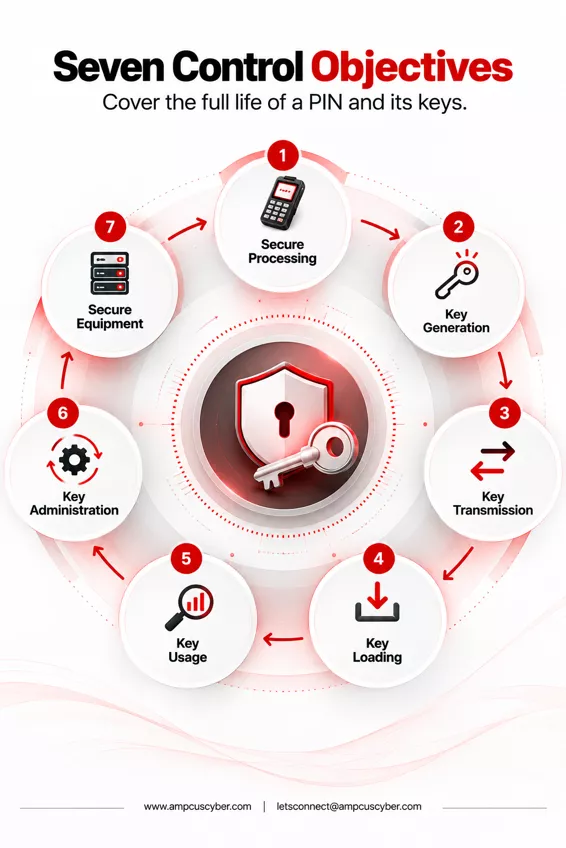
The seven control objectives cover the full life of a PIN and its keys, from processing equipment to key administration.
- Objective 1: Organizations must process PINs with equipment and methods that keep them secure.
- Objective 2: Organizations must create keys with processes that make them impossible to predict.
- Objective 3: Organizations must convey or transmit keys in a secure manner.
- Objective 4: Organizations must load keys into HSMs and PIN entry devices securely.
- Objective 5: Organizations must use keys in ways that prevent or detect unauthorized use.
- Objective 6: Organizations must administer keys securely throughout their life.
- Objective 7: Organizations must manage the equipment that processes PINs and keys securely.
How Does PCI PIN Differ from PCI DSS?
PCI PIN protects PIN data and the keys behind it, while PCI DSS protects account data across the cardholder data environment. A company can pass a PCI DSS assessment and still fail a PIN validation, because PCI PIN adds detailed rules for secure rooms, dual control, split knowledge, and approved hardware. Organizations that hold both obligations should plan the two programs together, since the same teams, systems, and evidence often serve each one. PCI PIN also sets requirements for the physical environment where keys are loaded, which sit outside the usual scope of PCI DSS work.
What Do the Key Management Requirements Demand?
The key management requirements demand that organizations generate, distribute, load, use, and destroy keys under dual control and split knowledge inside approved hardware. Key generation must occur within a PCI-approved HSM or a device certified to FIPS 140-2 Level 3 or higher. No single person can hold enough key components to reconstruct a key, and each custodian signs for the duties assigned. Key ceremonies must take place in controlled spaces with access logging, and organizations must keep records that show who attended, which components were used, and when. Entities must also keep a current key inventory that records the algorithm, key size, and purpose. These practices overlap with the key controls in PCI DSS Requirement 3, so aligning both reduces duplicate records.
Which PCI PIN Deadlines Have Already Passed?
The key block and PIN block deadlines have passed, so organizations should now operate in full compliance with both. Requirement 18-3 requires encrypted symmetric keys to live in key blocks, and it rolled out in three phases: internal connections and key storage in June 2019, external connections to networks on January 1, 2023, and merchant hosts, POS devices, and ATMs on January 1, 2025. ISO PIN block format 4 followed a similar schedule, with host decryption support due on January 1, 2023 and encryption support due on January 1, 2025. Legacy ANSI X9.17 key exchanges do not meet the requirement, so organizations that still use them should expect findings. Teams should confirm the dates that apply to their role, since acquirers, key injection facilities, and merchants carry different obligations.
How Does a PCI PIN Assessment Work?
A PCI PIN assessment is an on-site review by a Qualified PIN Assessor that tests whether your equipment, key management, and facilities meet the requirements. The work usually starts with scoping and a gap analysis, and it continues with evidence review, interviews, and observation of key ceremonies and secure rooms. The assessor documents results in a report on compliance and flags items for remediation. Card brand programs set how often you validate, and Visa expects participants to rotate their assessor company and individual assessors periodically. Typical evidence includes key inventories, custodian forms, ceremony logs, HSM and device approval records, and network diagrams that show where PIN data flows.
What Are the Most Common PCI PIN Compliance Gaps?
The most common gaps are the following:
- Incomplete key inventories.
- Weak dual control and split knowledge practices.
- Equipment that no longer holds a valid approval.
Assessors also find the following:
- Custodians without signed responsibilities.
- Secure rooms without full access logging.
- Legacy key exchanges that skip key blocks.
Mergers, data center moves, and partner migrations make these gaps worse because keys and devices change faster than records do. Security leaders can reduce this risk by reconciling the key inventory against the HSMs every quarter. An unreconciled inventory often points to a deeper process gap, because it shows that nobody owns the full lifecycle of each key.
How Can Organizations Stay PCI PIN Compliant Year Round?
Organizations stay compliant by treating key and device management as daily operations, with named owners, scheduled reviews, and evidence collected throughout the year. Assign each key and device an owner, reconcile inventories on a fixed schedule, and record every key ceremony with participants, dates, and serial numbers. Review custodian lists after every personnel change, and retire partner links with a documented key destruction step.
A GRC program that links controls, assets, and evidence gives leaders a live view of PIN readiness and removes the scramble before validation. Quarterly reviews with key custodians and infrastructure owners help teams catch process drift before an assessor does.
| Ready for your next PCI PIN validation? Connect with Ampcus Cyber’s QPA-led specialists and assess your readiness today. |
People Also Ask:
What is the PCI PIN Security Standard?
The PCI PIN Security Standard sets requirements and testing procedures for the secure management, processing, and transmission of PIN data at ATMs and point-of-sale terminals.
How many requirements does PCI PIN have?
PCI PIN has 33 requirements organized into 7 control objectives that cover equipment, key management, and the physical and logical protection of both.
What is the current version of PCI PIN?
Version 3.1, published in March 2021, is the current version at the time of writing. Check the PCI SSC Document Library for updates before you plan an assessment.
Is PCI PIN the same as PCI DSS?
No. PCI DSS protects account data in the cardholder data environment, and PCI PIN protects PIN data and the cryptographic keys, equipment, and facilities that handle it.
Who performs a PCI PIN assessment?
A Qualified PIN Assessor approved by the PCI Security Standards Council performs the assessment for entities that card brand programs require to validate through an assessor.
What is a key block in PCI PIN?
A key block is a structure that cryptographically binds a key’s usage attributes to the key. Requirement 18-3 requires encrypted symmetric keys to be managed in key blocks.
Do I need a payment HSM for PCI PIN compliance?
Yes. PIN processing needs a payment HSM certified to PCI PTS HSM or FIPS 140-2 Level 3 or higher, because general-purpose HSMs lack the required payment functions.
Enjoyed reading this blog? Stay updated with our latest exclusive content by following us on Twitter and LinkedIn.