








Most security teams still picture a breach as someone breaking through a firewall or exploiting an unpatched server. That picture is out of date. In a growing share of incidents, the attacker does not break in at all. They log in, using a username and password, an authentication token, or a session cookie that was never supposed to leave the building.
Identity has become the primary battleground in enterprise security, and the trends behind that shift are worth understanding in detail.
Why Identity Has Become the Primary Attack Surface
Every enterprise now runs on a sprawling web of identities. Employees, contractors, service accounts, API keys, and increasingly AI agents all carry credentials that grant access to systems and data. Each one of those identities is a potential entry point, and most organizations have far less visibility into them than they assume.
Cloud adoption accelerated this problem. When infrastructure lived behind a corporate firewall, network controls did most of the work of keeping attackers out. Once applications and data moved to the cloud, the login screen became the new perimeter, and a valid credential became functionally equivalent to a badge that opens every door.
Recent industry data reflects how far this shift has gone. Sophos researchers found that 67% of security incidents investigated by their incident response and managed detection teams in the past year traced back to identity-related weaknesses, including stolen credentials, brute-force activity, and missing multi-factor authentication. The same Sophos Active Adversary Report found that once inside a network, attackers reached Active Directory in an average of just 3.4 hours, turning a single compromised login into domain-wide control within a single workday.
Five Identity-Based Threat Trends Security Teams Are Tracking
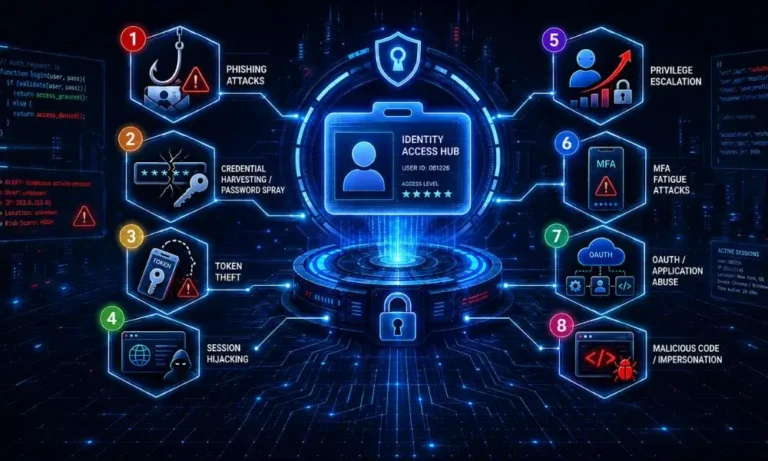
Infostealer Malware Feeding Credential Markets: Infostealers quietly harvest saved passwords, session cookies, and authentication tokens from infected devices, then sell that data in bulk on criminal marketplaces. A single infection can hand an attacker working session access that bypasses login and MFA prompt entirely, since the session was already authenticated before the theft.
MFA Fatigue And Bypass Techniques: Multi-factor authentication remains valuable, but attackers have adapted around it. Push-bombing floods a user with approval requests until they accept one out of frustration, and adversary-in-the-middle phishing kits relay a real login session in real time, capturing the MFA token along with the password. According to Verizon’s 2026 Data Breach Investigations Report, the human element remains involved in the majority of breaches, and social engineering against identity systems continues to be one of the most reliable paths in.
Session Hijacking And Token Theft: Rather than stealing a password, attackers increasingly steal the session itself. A hijacked authentication token lets an attacker act as the legitimate user without ever triggering a login prompt or an MFA challenge, which makes this class of attack particularly difficult for traditional monitoring to catch.
Non-human And Machine Identity Sprawl: Service accounts, API keys, and automation credentials often outnumber human identities inside a modern enterprise, yet they are frequently over-privileged, rarely rotated, and poorly monitored. As AI agents begin taking actions inside enterprise systems, this category of identity is expanding again, and governance has not caught up. Learn more about it in our detailed blog post.
Faster Lateral Movement After Initial Access: Once an attacker has a working identity, movement across the environment has accelerated. Shorter dwell times mean less time for defenders to detect and respond before an attacker reaches high-value systems such as Active Directory or cloud administration consoles.
Why Traditional Identity Defenses Fall Short.
Most identity programs were built to answer a narrower question: who should have access to what. That question still matters, but it does not address what happens after a credential is stolen and used exactly as an authentic login would be. The table below outlines the practical gap.
| Dimension | Traditional IAM Approach | Modern Identity Security Approach |
| Primary focus | Provisioning, password policy, access requests | Continuous detection of identity misuse and drift |
| Authentication | Password plus basic MFA (SMS or push) | Phishing-resistant methods such as passkeys and FIDO2 |
| Session monitoring | Limited, mostly login-event logging | Continuous behavioral analysis of active sessions |
| Non-human identities | Rarely governed with the same rigor as human accounts | Inventoried, rotated, and monitored alongside human identities |
| Response to compromise | Manual investigation after a reported incident | Automated detection and containment through ITDR tooling |
Building a Modern Identity Security Program
Closing this gap starts with treating identity as a continuously monitored control, not a one-time provisioning task. A Zero Trust model is a useful foundation, since it assumes no user or device should be trusted by default and requires continuous verification based on identity, device posture, and context rather than network location.
From there, phishing-resistant authentication methods such as passkeys and FIDO2 security keys remove the shared secret that attackers rely on, since the credential is cryptographically bound to the legitimate service and cannot be phished the way a password or one-time code can. Organizations running hybrid identity environments, especially those bridging on-premises Active Directory with cloud platforms like Microsoft Entra ID, also need consolidated visibility across both environments to catch suspicious activity that spans on-premises and cloud identity systems.
Governance also needs to extend beyond human accounts. As enterprises adopt autonomous AI agents that take real actions inside business systems, identity programs need frameworks purpose-built for machine and agent identities. Our detailed guide on Agentic IAM covers how this differs from managing human accounts and why legacy session-based trust models create serious exposure when applied to autonomous agents.
A mature Identity and Access Management program ties all of this together, combining lifecycle governance, least-privilege enforcement, and continuous monitoring so that access stays appropriate as roles, devices, and risk levels change.
The Business Case for Security Leaders
Identity-based threats do not announce themselves the way malware or ransomware payloads often do. A stolen credential used correctly looks identical to a legitimate login, which is exactly why detection has to shift from perimeter monitoring toward identity behavior itself. For CISOs, this reframes identity security from a compliance checkbox into one of the highest-leverage investments available, since a single compromised identity can now open a path to domain-wide access within hours.
Boards and audit committees are increasingly asking pointed questions about identity resilience, from MFA coverage to session monitoring to how machine identities are governed. Security leaders who can answer those questions with current data, rather than a policy document written years ago, are in a stronger position heading into both audits and incident response.
Ampcus Cyber helps enterprises modernize identity security with Zero Trust architecture, phishing-resistant authentication, and governance that covers human and machine identities alike.
| Talk to our identity security experts to assess where your identity program stands in the dynamic world today. |
Enjoyed reading this blog? Stay updated with our latest exclusive content by following us on Twitter and LinkedIn.