









TL;DR
- PCI DSS v4.0.1 is the only active version of the standard, and every formerly future-dated requirement has been mandatory since 31 March 2025, so assessors now test the full control set.
- The 12 requirements sit under six goals and behave as one system: a weakness in scope, identity, or logging usually surfaces across several requirements at once.
- Assessors expect proof that controls operate all year, which makes control ownership, targeted risk analysis, and continuous evidence the deciding factors in a clean assessment.
PCI DSS (Payment Card Industry Data Security Standard) is the global security standard that defines the technical and operational controls required to protect payment account data. It applies to every entity that stores, processes, or transmits cardholder data or sensitive authentication data, and to any system that can affect the security of that environment.
The PCI Security Standards Council (PCI SSC), founded by American Express, Discover, JCB, Mastercard, and Visa, maintains the standard. Card brands and acquiring banks enforce it and set validation obligations. The current version, PCI DSS v4.0.1, was published in June 2024 and became the only active version when v4.0 retired on 31 December 2024.
What Are the 12 PCI DSS Requirements?
PCI DSS requirements are the 12 principal controls, grouped under six goals, that every in-scope organization must meet to protect the cardholder data environment (CDE). Each requirement contains numbered sub-requirements and testing procedures, published in the PCI SSC Document Library. The summaries below highlight the sub-requirements assessors probe most, with a link to Ampcus Cyber’s detailed guide for each.
Objective: Build and Maintain a Secure Network and Systems
Requirement 1: Install and Maintain Network Security Controls
Requirement 1 requires network security controls (NSCs), such as firewalls, cloud security groups, and virtual network policies, that restrict traffic into and out of the CDE. Assessors look for an approved business justification for every allowed service, port, and protocol (1.2.5), NSC rule reviews at least every six months (1.2.7), and controls for devices that connect to both untrusted networks and the CDE (1.5.1). Read the full Requirement 1 guide.
Requirement 2: Apply Secure Configurations to All System Components
Requirement 2 eliminates insecure defaults by applying documented configuration standards to every in-scope component. Standards must align with industry-accepted hardening guidance (2.2.1), vendor default accounts must be removed or secured (2.2.2), only necessary services may run (2.2.4), and non-console administrative access must be encrypted (2.2.7). The common failure is configuration drift after deployment. Read the full Requirement 2 guide.
Objective: Protect Account Data
Requirement 3: Protect Stored Account Data
Requirement 3 limits what account data an organization keeps and protects whatever remains. Retention must be minimized (3.2.1), sensitive authentication data cannot be stored after authorization (3.3.1), and stored PAN must be rendered unreadable through tokenization, truncation, keyed hashes, or strong cryptography (3.5.1). Disk-level encryption now satisfies this only for removable media (3.5.1.2), and key management sits under 3.6 and 3.7. Read the full Requirement 3 guide.
Requirement 4: Protect Cardholder Data With Strong Cryptography During Transmission Over Open, Public Networks
Requirement 4 protects PAN in transit across the internet, wireless, and messaging channels. Organizations must use only trusted keys and valid, unrevoked certificates (4.2.1) and maintain an inventory of those keys and certificates (4.2.1.1). Expired certificates and legacy protocols on partner connections are frequent findings. Read the full Requirement 4 guide.
Objective: Maintain a Vulnerability Management Program
Requirement 5: Protect All Systems and Networks From Malicious Software
Requirement 5 mandates anti-malware on every in-scope system unless a documented, periodically reviewed evaluation shows the system is not at risk (5.2.3). Solutions must stay current, active, and monitored (5.3), and automated mechanisms must detect and protect personnel against phishing (5.4.1). Read the full Requirement 5 guide.
Requirement 6: Develop and Maintain Secure Systems and Software
Requirement 6 connects secure software development with timely remediation. Critical security patches are due within one month of release (6.3.3), organizations must inventory bespoke, custom, and third-party software components (6.3.2), public-facing web applications need an automated solution that detects and prevents attacks (6.4.2), and every payment page script must be authorized, integrity-checked, and inventoried (6.4.3). Read the full Requirement 6 guide.
Objective: Implement Strong Access Control Measures
Requirement 7: Restrict Access to System Components and Cardholder Data by Business Need to Know
Requirement 7 enforces least privilege through a defined access control model (7.2.1). User accounts and privileges must be reviewed at least every six months (7.2.4), application and system accounts must hold only the access they need (7.2.5), and direct query access to stored cardholder data must be restricted (7.2.6). Read the full Requirement 7 guide.
Requirement 8: Identify Users and Authenticate Access to System Components
Requirement 8 ties every action to an identifiable user. It requires unique IDs (8.2.1), passwords of at least 12 characters (8.3.6), and MFA for all access into the CDE (8.4.2). MFA systems must resist replay and bypass (8.5.1), and hard-coded passwords in scripts and applications are prohibited (8.6.2). Read the full Requirement 8 guide.
Requirement 9: Restrict Physical Access to Cardholder Data
Requirement 9 covers facilities, media, and payment devices. Organizations must control entry to sensitive areas, secure and inventory media containing cardholder data (9.4), and protect point-of-interaction devices from tampering and substitution through device lists, periodic inspections, and staff training (9.5.1). Read the full Requirement 9 guide.
Objective: Regularly Monitor and Test Networks
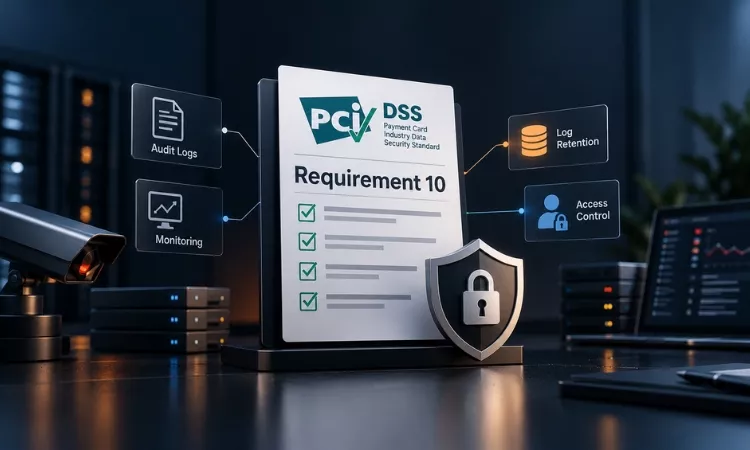
Requirement 10: Log and Monitor All Access to System Components and Cardholder Data
Requirement 10 creates the audit trail that proves every other control works. Security events must be reviewed daily (10.4.1) using automated mechanisms (10.4.1.1), logs must be retained for 12 months with three months immediately available (10.5.1), and failures of critical security controls must be detected and addressed promptly (10.7.2). Read the full Requirement 10 guide.
Requirement 11: Test Security of Systems and Networks Regularly
Requirement 11 validates controls through testing. It requires quarterly internal scans with authenticated scanning (11.3.1, 11.3.1.2), quarterly external scans by an Approved Scanning Vendor (ASV) (11.3.2), and internal and external penetration tests at least every 12 months and after significant change (11.4). It also requires weekly change detection on critical files (11.5.2) and tamper detection on payment pages (11.6.1). Read the full Requirement 11 guide.
Objective: Maintain an Information Security Policy
Requirement 12: Support Information Security With Organizational Policies and Programs
Requirement 12 is the governance layer and the one most visible to executives. It requires targeted risk analyses for flexible-frequency controls (12.3.1), annual reviews of cryptographic suites and technologies (12.3.3, 12.3.4), and executive accountability for PCI DSS (12.4.1). Scope must be confirmed at least every 12 months (12.5.2). Third-party responsibilities must be documented in a matrix (12.8.5), and the incident response plan tested annually (12.10.2). Read the full Requirement 12 guide.
What Should CISOs Prioritize Next?
CISOs should prioritize a v4.0.1 gap assessment, scope validation, and continuous evidence collection, ranked by risk and the next assessment date.
- Test the formerly future-dated controls first: 6.4.3, 8.4.2, 10.4.1.1, 11.6.1, and 12.3.1.
- Assign a named owner and an evidence cadence to each of the 12 requirements.
- Choose the right validation route early: a Report on Compliance by a Qualified Security Assessor (QSA) or a Self-Assessment Questionnaire.
- Watch PCI SSC’s work on the next version, which began with a request for comments on v4.0.1 from 3 June to 20 July 2026.
Why the 12 PCI DSS Requirements Define Payment Security Maturity
The 12 PCI DSS requirements form a single control system, and v4.0.1 judges that system on continuous operation. Organizations that treat them as connected controls, with clear scope, named owners, and year-round evidence, reduce both breach exposure and assessment risk.
| Book a PCI DSS readiness review with our experts and get a stress-test done for all 12 requirements against v4.0.1, map your true CDE scope, and deliver a prioritized remediation roadmap. |
People Also Ask
Is PCI DSS a Law?
No. PCI DSS is an industry standard maintained by PCI SSC and enforced through contracts with card brands and acquiring banks. A few jurisdictions, such as the US state of Nevada, reference it in data security laws, so legal obligations can still apply.
Does Using a Payment Processor Like Stripe Make My Business PCI Compliant?
No. A compliant processor reduces your scope, often to a shorter SAQ, but you still validate compliance for your own environment, including the web page that loads the payment form.
What Is the Difference Between an SAQ and a ROC?
An SAQ is a self-assessment completed by eligible merchants and service providers. A ROC is a detailed report completed by a QSA, or by an Internal Security Assessor where permitted, and is typically required at the highest transaction levels.
How Often Do PCI DSS Requirements Need to Be Validated?
Compliance is validated annually, but many controls run more often. Vulnerability scans are quarterly, user access reviews occur at least every six months, and penetration tests occur at least every 12 months and after significant change.
Do PCI DSS Requirements Apply to Cloud Environments?
Yes. A cloud-hosted CDE is fully in scope. The provider’s AOC covers only the controls it manages, so the customer must document the shared responsibility split and meet every requirement it owns.
Enjoyed reading this blog? Stay updated with our latest exclusive content by following us on Twitter and LinkedIn.