








TL;DR
- A managed detection and response (MDR) provider should deliver 24/7 monitoring, pre-approved containment authority, and reporting that supports regulatory timelines such as the SEC’s four-business-day Form 8-K filing requirement.
- Telemetry coverage matters more than tool count. Ask which sources are ingested across endpoints, identity, cloud, and SaaS, and which MITRE ATT&CK techniques those sources can detect.
- Contract terms determine real-world outcomes. Define measurable response commitments, containment authority, log retention, data residency, and exit provisions before signing.
Security leaders in the United States face a detection problem that headcount alone rarely solves. Attackers increasingly rely on valid credentials, living-off-the-land tooling, and cloud misconfigurations that generate little obvious malware, and the window between initial access and lateral movement can be measured in hours.
The regulatory clock has also tightened. The SEC’s cybersecurity disclosure rules require public companies to file material incidents on Form 8-K within four business days of a materiality determination, and New York’s Department of Financial Services requires covered entities to notify the department within 72 hours of certain cybersecurity events under 23 NYCRR 500.
Many organizations turn to managed detection and response to close this gap. The practical question is what the provider must deliver and how to verify it before the contract is signed.
What Does a Managed Detection and Response Provider Do?
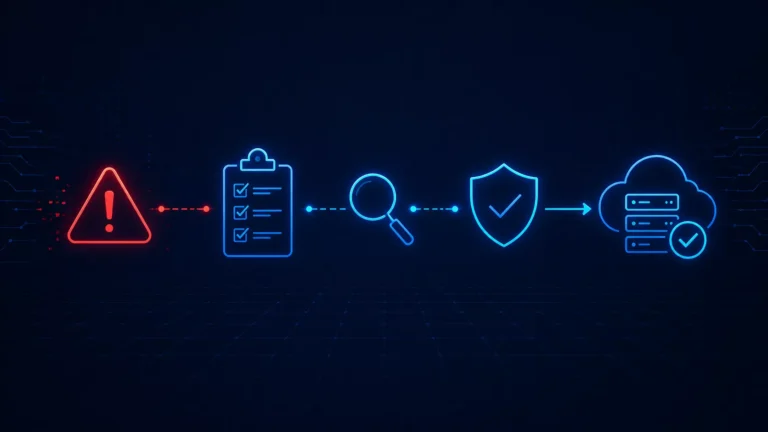
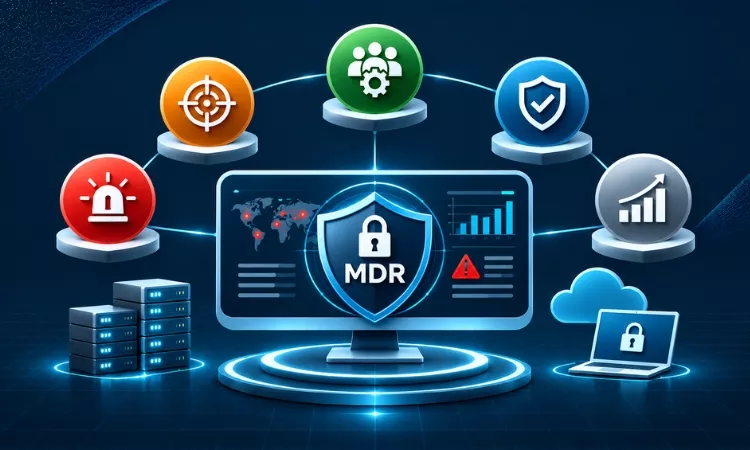
A managed detection and response provider monitors an organization’s telemetry continuously, investigates alerts, and contains threats either directly or through pre-approved procedures. Unlike a managed service that forwards alerts to an internal queue, MDR combines technology, analysts, and response actions into one accountable service.
That distinction is structural. An alert queue without authority to act shifts the response burden back to an internal team, which may be understaffed at 2 a.m. when a compromised account starts accessing file shares. NIST SP 800-61 Revision 3, published in 2025, frames incident response as part of enterprise cybersecurity risk management aligned with the CSF 2.0 functions. That framing supports treating detection and response as continuous capabilities with defined ownership, not occasional services.
Which Telemetry Sources Should an MDR Provider Cover?
A credible MDR provider should ingest telemetry from endpoints, identity platforms, cloud control planes, SaaS applications, and network sources. It should also document which sources are covered by default and which require customer onboarding.
| Telemetry Source | Detection Value | Common Gap |
| Endpoint (EDR) | Process execution, persistence, and lateral movement | Servers and unmanaged devices often excluded |
| Identity (sign-ins, privilege changes) | Credential abuse, token theft, and MFA fatigue | Conditional access logs not forwarded |
| Cloud (AWS CloudTrail, Azure Activity, Google Cloud Audit) | Privilege escalation and unauthorized resource creation | Only production accounts monitored |
| SaaS (email, collaboration, file sharing) | Mailbox rule manipulation and data exfiltration | Audit logs retained for limited periods |
| Network (DNS, firewall, VPN) | Command-and-control activity and unusual egress | High volume leads to selective ingestion |
Visibility determines detection. Endpoint-only coverage misses identity abuse, which is now a common entry point for intrusions. For example, a hypothetical healthcare organization with strong endpoint telemetry but no ingestion of Microsoft 365 audit logs would have limited visibility into mailbox rule creation, a technique often used in business email compromise. CISOs should request a coverage matrix mapped to MITRE ATT&CK tactics so that gaps are visible before an incident exposes them.
Leading Managed Detection and Response (MDR) Providers in the United States
Each of the following MDR expert combines 24/7 monitoring, human analysts, and response actions, but they differ in target market, telemetry scope, and channel model. Buyers should confirm each provider’s coverage and response commitments in writing before shortlisting.
- Rapid7: Rapid7 positions its Managed Detection and Response service as preemptive MDR, pairing 24/7 expert-led detection with exposure management. Its Active Response capability lets MDR analysts contain specific users or endpoints after validating a threat, with each action recorded in the investigation audit trail. Rapid7 reports more than 11,500 customers and was named a Leader in the 2025 Frost Radar for MDR.
- Huntress: Huntress is a Maryland-based managed cybersecurity company offering managed endpoint detection and response (EDR), identity threat detection for Microsoft 365 and Google Workspace, managed SIEM, and security awareness training. Its 24/7 security operations center combines human analysts with AI assistance, and its products are built for small and mid-sized businesses and the IT providers who serve them. The company reports protecting more than 270,000 businesses.
- Blackpoint Cyber: Blackpoint Cyber is a Denver-based managed detection and response company that serves small and mid-market businesses and their MSP partners. Its CompassOne platform combines a 24/7 security operations center with proprietary detection across networks, cloud environments, and identities. In its September 2026 ITDR announcement, Blackpoint reported identity-threat response in an average of under two minutes, and as fast as 21 seconds. Its go-to-market centers on MSP and MSSP partners.
- Ampcus Cyber: Ampcus Cyber, headquartered in Chantilly, Virginia, delivers AI-assisted, expert-led 24/7 Managed SOC services that extend an organization’s internal security team. Its portfolio includes Defender MXDR, XDR as a Service, and 24×7 incident response, alongside compliance services such as SOC 1 and SOC 2 assessment support through its Compliance Compass practice.
- Arctic Wolf: Arctic Wolf operates a cloud-native security operations platform, the Arctic Wolf Aurora Platform, that delivers MDR across networks, endpoints, and cloud environments. Its Concierge Security Team provides named security experts for advisory and operational support, and the company also offers managed risk, managed security awareness, and incident response. Arctic Wolf was named a 2026 Gartner Peer Insights Customers’ Choice for MDR and reports serving more than 10,000 organizations worldwide.
What Authority Should the Provider Have to Contain Threats?
The provider should hold documented authority to take specific containment actions, such as isolating endpoints, suspending compromised accounts, and blocking malicious indicators. These actions should operate under playbooks the customer approves in advance.
Containment speed determines how far an intrusion spreads. Ransomware can encrypt a file share in minutes, and waiting for an email approval can allow that spread to continue. Pre-approval removes that delay while keeping the customer in control of business-critical decisions. Contracts should specify which actions require customer approval, such as shutting down production systems, and which actions the provider may take immediately. Every containment action should be logged with the actor, timestamp, and justification.
Where Do MDR Engagements Commonly Break Down?
Most underperforming engagements trace back to four issues: incomplete onboarding, undefined containment authority, alert fatigue from poorly tuned detections, and contracts that do not address data residency or exit.
Onboarding gaps are the most common. When log sources are connected late or only partially, the provider inherits a blind spot it cannot detect from the outside. Alert fatigue has a similar cause. Detection rules that were never tuned to the environment generate volume that analysts learn to dismiss. Organizations that treat MDR as a purchased outcome rather than a shared operating model often discover these gaps during an incident, when there is no time to correct them.
What Should Organizations Do Next?
Before signing, CISOs should verify the provider’s coverage, response commitments, and authority in writing. The following steps convert those expectations into contract and operational requirements:
- Request a telemetry coverage matrix mapped to MITRE ATT&CK tactics, with each gap labeled.
- Require measurable SLAs with percentile reporting and defined clock start and stop points.
- Document containment authority with playbooks, approval thresholds, and action logging.
- Confirm data handling terms, including retention periods, data residency, and exit provisions that return data in usable formats.
- Run a joint tabletop exercise before go-live to test escalation paths against a realistic scenario.
| Let Ampcus Cyber be your partner in 24/7 detection and response. Talk to our team about verifiable SOC coverage. |
People Also Ask
What is the difference between MDR and a managed SOC?
Does MDR replace an internal security team?
What is a good response time for an MDR provider?
Does MDR satisfy PCI DSS intrusion detection requirements?
What should an MDR contract include for data exit?
Enjoyed reading this blog? Stay updated with our latest exclusive content by following us on Twitter and LinkedIn.