





TL;DR
- A SOC 2 Type 1 report tests whether controls are designed correctly on one date. A Type 2 tests whether they worked throughout a review period, commonly 6 to 12 months.
- Enterprise customers generally expect a Type 2. A Type 1 is often accepted as a stepping stone when you commit to a Type 2 timeline.
- Check customer contracts and questionnaires first, include only the Trust Services Categories they need, and plan for annual renewal so assurance stays continuous.
For B2B SaaS and service providers, the SOC 2 request usually arrives in a security questionnaire or a procurement checklist, often just as a deal is about to close. The buyer wants assurance that the vendor protects customer data, and the vendor wants to keep the sale on schedule. The question that follows is almost always the same: should we pursue a SOC 2 Type 1 or Type 2 report? The answer affects how quickly you can respond to customers, how much evidence you need, and whether a customer’s security team will accept the report.
What Is the Difference Between SOC 2 Type 1 and Type 2?
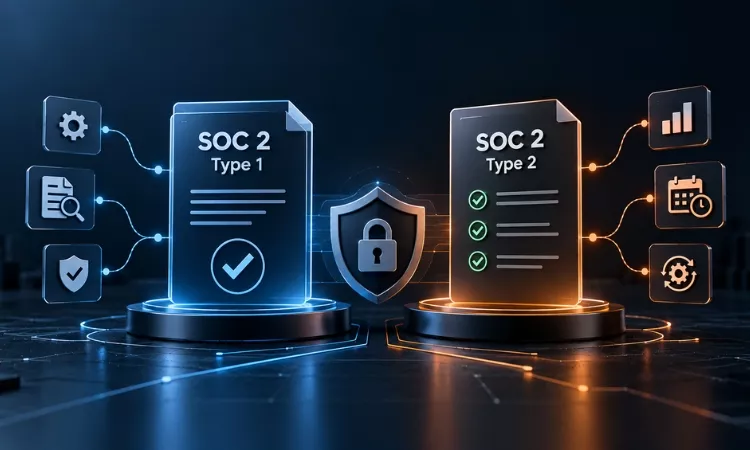
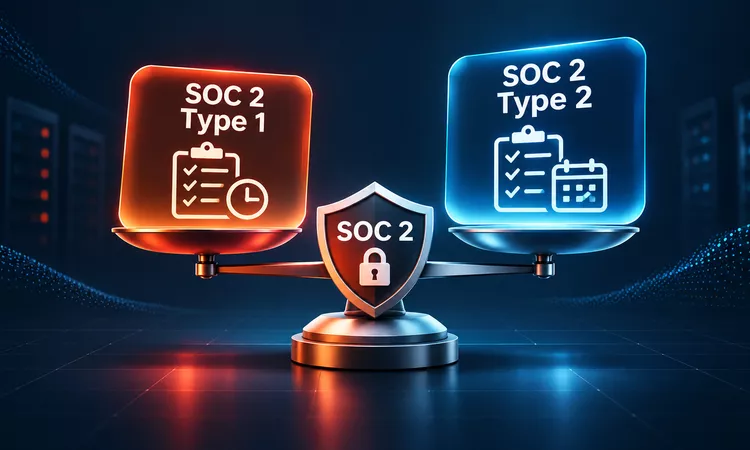
A SOC 2 Type 1 report evaluates whether controls are suitably designed at a single point in time, while a SOC 2 Type 2 report evaluates whether those controls operated effectively over a period, commonly 6 to 12 months.
Both reports are attestation engagements performed by an independent CPA firm under the American Institute of Certified Public Accountants (AICPA) framework. Both assess controls against the Trust Services Criteria. The difference is evidence: Type 1 confirms the design is sound, and Type 2 proves the controls worked consistently.
| Attribute | SOC 2 Type 1 | SOC 2 Type 2 |
| What is tested | Design of controls | Design and operating effectiveness |
| Timeframe | A specific date | A defined period, often 6 to 12 months |
| Auditor testing | Inquiry, inspection, walkthroughs | Sample-based testing across the period |
| Assurance level | Moderate | Higher |
| Time to first report | Shorter | Longer, because the period must elapse |
| Typical use | First report, early-stage deals | Enterprise procurement, renewals |
What Does a SOC 2 Type 1 Report Cover?
A SOC 2 Type 1 report covers management’s description of the system and whether the controls in that description are suitably designed to meet the selected Trust Services Criteria as of a specific date.
The auditor reviews policies, configurations, and procedures, and confirms that the controls exist and are designed appropriately. The auditor does not test whether those controls ran consistently over time. For example, a Type 1 can confirm that a quarterly access review process exists, but it cannot confirm that the reviews happened every quarter.
A Type 1 report is useful when:
- A customer needs evidence quickly and accepts a Type 1 as an interim step
- The organization is new to SOC 2 and wants to validate its control design first
- Systems or controls have changed significantly and need a design baseline
What Does a SOC 2 Type 2 Report Cover?
A SOC 2 Type 2 report covers everything in a Type 1, plus the auditor’s testing of whether controls operated effectively throughout the review period.
The auditor selects samples across the period, such as user access approvals, change tickets, vulnerability scans, incident records, and employee onboarding and offboarding, and tests them against the stated controls. Any exceptions are documented in the report, along with management’s responses where provided.
A Type 2 report generally includes:
- The independent service auditor’s report and opinion
- Management’s assertion
- The system description, including complementary user entity controls (CUECs) and any subservice organizations
- The tests of controls and their results
Review periods are generally 6, 9, or 12 months, with 12-month reports the most common. Because there is no SOC 2 “certification,” organizations typically renew the report annually so coverage stays continuous. Management can issue a bridge letter to cover the short gap between the end of one period and the next report, typically up to three months.
Which SOC 2 Report Do Your Customers Want?
Enterprise customers generally expect a SOC 2 Type 2 report, because it shows controls working over time. A Type 1 is often accepted as a temporary step when a vendor commits to a Type 2 within a defined timeframe.
What your customers want depends on who they are and what you handle for them:
- Enterprise and regulated buyers, such as financial services and healthcare organizations, usually expect a Type 2 and may review exceptions in detail.
- Mid-market buyers may accept a Type 1 with a written commitment and timeline for Type 2.
- Early-stage or low-risk engagements may accept a Type 1 or a completed security questionnaire.
The fastest way to know is to review recent security questionnaires, master service agreements, and vendor onboarding requirements from key customers and prospects. Many contracts specify the report type, the Trust Services Categories, and the required renewal frequency.
When It Makes Sense to Start With Type 1
As a hypothetical example, a SaaS startup with a large enterprise deal pending may complete a Type 1 to unblock the sale, then begin its Type 2 review period immediately afterward. This approach works when the controls are already operating, so the Type 2 period can start without redesign.
When to Go Straight to Type 2
If customers already require Type 2 and your controls are mature, a Type 1 may add cost without adding much value. Some organizations begin a shorter initial review period, such as three to six months, to produce a first Type 2 sooner. Confirm with your auditor and key customers that a shorter period will be accepted.
Which Trust Services Criteria Should Your SOC 2 Report Include?
Every SOC 2 report includes the Security category, also known as the Common Criteria. The other four categories are optional and should match the commitments you make to customers.
- Security: Protection against unauthorized access (required)
- Availability: System uptime and resilience commitments
- Processing integrity: Complete, accurate, and timely processing
- Confidentiality: Protection of information designated as confidential
- Privacy: Collection, use, retention, and disposal of personal information
The Trust Services Criteria were issued in 2017, and the AICPA revised the supporting points of focus in 2022 without changing the criteria themselves. Adding categories expands scope, evidence, and audit effort, so include only the categories that customers and contracts need. Our SOC 2 compliance audit checklist covers scoping in more detail.
What Are the Common SOC 2 Type 1 and Type 2 Mistakes?
The most common mistakes come from poor scoping, weak evidence habits, and treating the report as a one-time project.
- Choosing Type 1 when key customers have already stated they require Type 2
- Starting a Type 2 period before controls are operating, which creates exceptions
- Adding optional Trust Services Categories that no customer requires
- Collecting evidence manually at the end of the period
- Overlooking subservice organizations, such as cloud providers, and the choice between carve-out and inclusive methods
- Letting the report lapse, which leaves customers without current assurance
What Should Organizations Do Next?
Start with a readiness assessment that maps your current controls to the Trust Services Criteria, then choose the report type based on customer requirements and control maturity.
- Review customer contracts and questionnaires to confirm required report type and categories.
- Define the system boundary, services, and subservice organizations in scope.
- Run a readiness assessment and close design gaps.
- Decide whether a Type 1 is needed as an interim step.
- Set the Type 2 review period and automate evidence collection.
- Engage an independent CPA firm and plan annual renewal.
Organizations that already hold ISO 27001 can reuse much of their control environment, as shown in our SOC 2 to ISO 27001 crosswalk report. Ampcus Cyber’s SOC 2 compliance services SOC 2 Compliance Service support readiness assessments, gap remediation, and continuous evidence management so organizations reach their first Type 2 with fewer exceptions.
Choosing Between SOC 2 Type 1 and Type 2
The SOC 2 Type 1 vs Type 2 decision comes down to what your customers require and how mature your controls are. Type 1 proves good design and can unblock early deals, while Type 2 proves controls work over time and is the report enterprise buyers generally expect. Organizations that plan for Type 2 from the start spend less time on rework and keep customer assurance continuous.
Know which SOC 2 report your customers will accept, and get ready for it.
| Ampcus Cyber’s SOC 2 readiness assessment maps your controls to the Trust Services Criteria, identifies design gaps, and builds a realistic path to your first Type 2 report. Book a SOC 2 readiness assessment. |
People Also Ask
Is SOC 2 Type 2 better than Type 1?
Type 2 provides stronger assurance because it tests whether controls worked over a period. Type 1 only confirms they were designed correctly on one date. Which one is “better” depends on what your customers require.
Can I skip SOC 2 Type 1 and go straight to Type 2?
Yes. A Type 1 isn’t a prerequisite. Organizations with operating controls often go straight to a Type 2 review period.
How long is a SOC 2 report valid?
SOC 2 reports don’t have a formal expiration date, but customers typically expect a report covering a recent period. Most organizations renew annually and use a bridge letter to cover short gaps.
What is a SOC 2 bridge letter?
A bridge letter is a statement issued by management, not the auditor. It covers the gap between the end of the last SOC 2 review period and the current date, typically up to three months, and confirms whether controls have materially changed.
Who can perform a SOC 2 audit?
Only an independent, licensed CPA firm can issue a SOC 2 report. Consultants and compliance platforms can support readiness, but they can’t issue the attestation.
What is the difference between SOC 2 and SOC 3?
A SOC 2 report contains detailed control descriptions and test results and is shared with specific customers, usually under NDA. A SOC 3 is a shorter, general-use summary that can be shared publicly.
Enjoyed reading this blog? Stay updated with our latest exclusive content by following us on Twitter and LinkedIn.