









We’ve all seen the classic phishing email: clunky grammar, an urgent request from a “CEO” using a generic Gmail address, and a sketchy link promising a free iPad. For years, corporate cybersecurity training taught us to look for these exact red flags.
But if you are still relying on bad spelling to detect a phishing attack, it is time for a reality check.
Welcome to the world of AI-powered phishing. By leveraging Large Language Models (LLMs), cybercriminals have traded broken English for native-level fluency and automated precision. Phishing attacks are no longer just a numbers game, they have become hyper-realistic, deeply personalized, and incredibly difficult to detect.
Let’s pull back the curtain on how generative AI is reshaping the threat landscape and what it means for your digital security.
What is AI-Powered Phishing?
Traditional phishing relies on volume. Attackers blast thousands of generic emails hoping a tiny fraction of recipients will bite. Spear-phishing is more targeted, but it requires hours of manual reconnaissance to research a single victim.
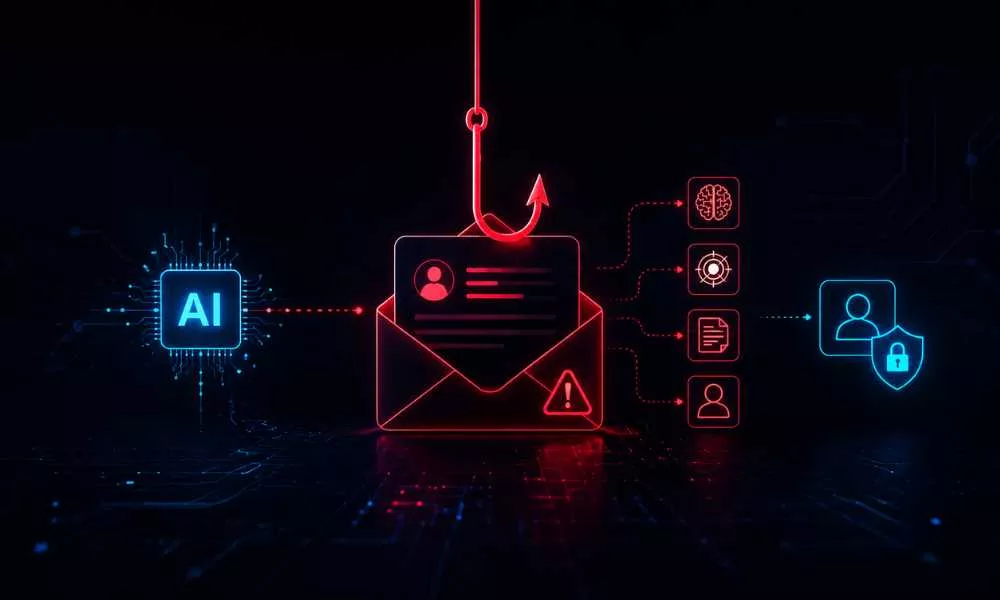
AI-powered phishing obliterates this bottleneck. It combines the massive scale of traditional phishing with the hyper-personalization of spear-phishing. By utilizing advanced LLMs (including specialized “dark” models), attackers can scan public data, mimic professional writing styles, and generate tailored lures in seconds.
According to research from IBM X-Force, a human analyst takes roughly 16 hours to craft a high-quality, targeted phishing email. An LLM can generate an equally convincing email in just 5 minutes. That represents a staggering 192x speed increase for threat actors, approximately.
How LLMs Make Phishing Attacks Hyper-Realistic
LLMs excel at understanding context, tone, and human psychology. When bad actors weaponize these capabilities, the traditional “tells” of a scam instantly vanish.
1. Flawless Language and Localized Fluency
Historically, many cybercriminals operated from non-English-speaking regions, resulting in awkward phrasing that gave them away. LLMs provide instant, native-level fluency in dozens of languages. Whether it’s corporate jargon, regional slang, or specific industry acronyms, AI writes perfectly polished copy that blends seamlessly into your inbox.
2. Automated Reconnaissance at Scale
Before writing a single line, AI tools can scrape LinkedIn profiles, corporate “About Us” pages, recent press releases, and leaked databases. The LLM digests this massive amount of unstructured data to build an instantaneous profile of the target, identifying their role, who they report to, what projects they are working on, and their company’s internal vocabulary.
3. Hyper-Personalization (Pretext Engineering)
Instead of a generic “Update your password” prompt, an LLM can craft an email tailored to your exact professional reality, for example: “Hi Sarah, I noticed your presentation at the Q3 marketing summit yesterday. Could you review these updated compliance guidelines before we finalize the budget?”
Because the context is entirely real, your psychological defense barriers naturally drop.
4. Continuous Adaptive Testing (A/B Testing)
Cybercriminals are treating phishing like digital marketing. They use AI to rapidly generate dozens of variations of a campaign, altering subject lines, urgency levels, and narratives (e.g., HR updates vs. IT service tickets). By analyzing which versions bypass filters and secure the most clicks, the AI continuously refines the attack loop.
Side-by-Side: Traditional vs. AI-Powered Phishing
To understand just how stark this evolution is, look at how the fundamental traits of social engineering have shifted:
| Feature | Traditional Phishing | AI-Powered Phishing (LLM-Driven) |
| Grammar & Tone | Frequent typos, awkward wording, generic greetings. | Grammatically flawless, highly professional, matches organizational tone perfectly. |
| Targeting | Mass-blast, “one-size-fits-all” templates. | Hyper-personalized using scraped social media and corporate data. |
| Production Speed | High effort for targeted attacks; manual research takes hours. | Instantaneous; generated at machine speed (seconds per variant). |
| Click-Through Rates | Average open/click rates hover around 12%. | Skyrockets to over 54% due to credible, highly specific personalization. |
| Filter Evasion | Easily caught by signature-based content filters. | Polymorphic content changes with every email, bypassing traditional static filters. |
Beyond Text: The Rise of Multimodal AI Attacks
It is no longer just about email. Cybercriminals are layering LLMs with other advanced AI technologies to build multi-channel attack chains:
- AI Voice Cloning & Deepfakes: Attackers require only a few seconds of public audio (from a webinar, podcast, or social media video) to clone an executive’s voice. They combine this with LLM scripts to launch highly deceptive Business Email Compromise (BEC) attacks, sometimes even utilizing deepfake video calls to authorize multi-million-dollar transfers.
- AI-Generated Runtime Code: Recent cybersecurity research highlights novel techniques where a seemingly benign web page calls trusted LLM APIs dynamically. Once the victim opens the page, the LLM generates malicious JavaScript in real time directly inside the browser. Because the network traffic comes from a trusted AI domain, traditional network filters see nothing wrong.
How to Defend Against the AI Threat Matrix
If the human eye can no longer spot the difference between a real email and an AI-generated fake, relying on legacy security awareness training is a losing battle. Organizations must fight AI with AI.
- Deploy Behavioral AI Detection: Traditional filters look for known malicious links or specific text strings. Modern email security must use machine learning and LLMs defensively, analyzing baseline communication patterns, sender behavioral history, and subtle anomalies in intent to flag threats before they reach the user.
- Implement Out-of-Band Verification: Establish strict corporate policies that require independent verification for high-risk actions. If an executive texts, emails, or calls asking for an urgent wire transfer or a credential reset, verify it via a secondary, pre-established channel (like an internal corporate messaging platform or an in-person confirmation).
- Enforce Zero-Trust Architecture: Implement robust Multi-Factor Authentication (MFA), continuous session monitoring, and strict access controls. Assume that credentials will be targeted and ensure that a single compromised account cannot compromise the entire enterprise network.
The Bottom Line
AI-powered phishing has turned deception into an industrialized science. Cybercriminals no longer need to be master social engineers; they just need a well-engineered prompt.
As these hyper-realistic attacks become the baseline standard, staying safe requires shifting from a mindset of “does this look fake?” to “can I verify this identity?” By combining defensive AI tools with rigid validation protocols, your organization can stay a step ahead of the algorithms.
AI is changing phishing. Is your security strategy keeping pace?
Train your workforce to recognize and respond to modern AI-powered phishing attacks through realistic simulations and continuous security awareness programs.
| Strengthen Your Human Firewall. Talk to Our Security Experts |
Enjoyed reading this blog? Stay updated with our latest exclusive content by following us on Twitter and LinkedIn.