








What Is the Purdue Model?
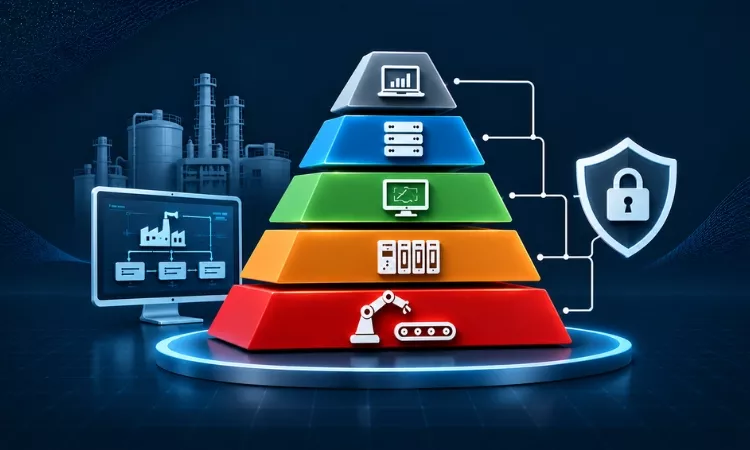
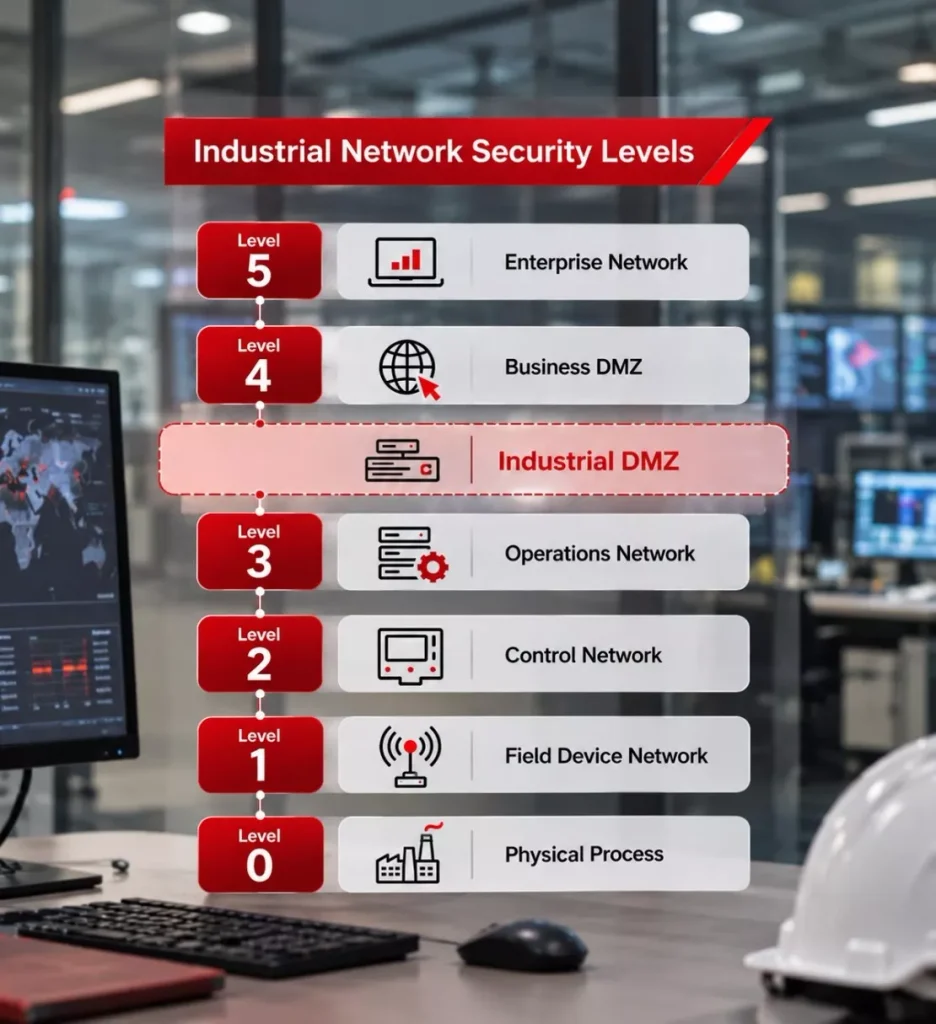
The Purdue Model is a layered reference architecture for industrial control systems. It arranges OT and IT functions into levels from 0 to 5, with an industrial DMZ at Level 3.5. Security leaders use it to define network zones, plan segmentation, and place controls where data crosses between levels.
Purdue University researchers developed the model in the 1990s as part of the Purdue Enterprise Reference Architecture. It runs from physical process equipment at Level 0 up to enterprise systems at Level 5. Its value today lies in giving engineers and security teams a common reference point for where trust boundaries belong.
Why Do Industrial Networks Still Rely on a Layered Model?
Layering limits how far a compromise can travel. Each boundary becomes a point where traffic can be inspected, filtered, or blocked. A flat OT network lets one infected engineering workstation reach every PLC and historian on site, which turns a single endpoint incident into a plant-wide event. NIST SP 800-82 Rev. 3 continues to describe OT architecture in layered terms, which keeps the model useful for auditors who expect evidence of segmentation. The model also gives plant engineers and IT teams one map, so both groups discuss risk using the same terms.
What Are the Levels of the Purdue Model?
Each level carries different assets, availability requirements, and security priorities. Controls should reflect those differences rather than applying one policy across the whole site. The table below summarizes the standard structure.
| Level | Name | Typical Components | Primary Security Priority |
| 0 | Physical Process | Sensors, actuators, motors, valves | Physical integrity and tamper detection |
| 1 | Basic Control | PLCs, RTUs, DCS controllers | Control logic integrity and change control |
| 2 | Supervisory Control | HMIs, SCADA servers, engineering workstations | Access control and session monitoring |
| 3 | Site Operations | Historians, MES, batch servers, patch servers | Controlled data egress and segmentation |
| 3.5 | Industrial DMZ | Jump hosts, data diodes, reverse proxies | Brokered connections with no direct IT-to-OT sessions |
| 4 | Enterprise Business Systems | ERP, planning, business analytics | Identity governance and least privilege |
| 5 | Enterprise Network | Corporate cloud, internet-facing services | Perimeter defense and threat detection |
How Do Security Zones and Conduits Map to Purdue Levels?
Security zones group assets that share a risk profile and a security requirement. Conduits are the controlled communication paths between zones. The ISA/IEC 62443 series formalizes this approach and assigns target security levels from SL 1 to SL 4. Purdue levels provide a starting point, but zones often span more than one level. A safety zone, for example, may include Level 1 controllers and the Level 2 engineering workstations used to program them.
To map zones effectively, follow these steps:
- Inventory every asset and assign it to its Purdue level.
- Group assets by consequence of failure, not only by level.
- Define each conduit and document the protocols, ports, and business purpose it carries.
- Assign a target security level to each zone and verify that the conduits enforce it.
Where Should the Industrial DMZ Sit in the Purdue Model?
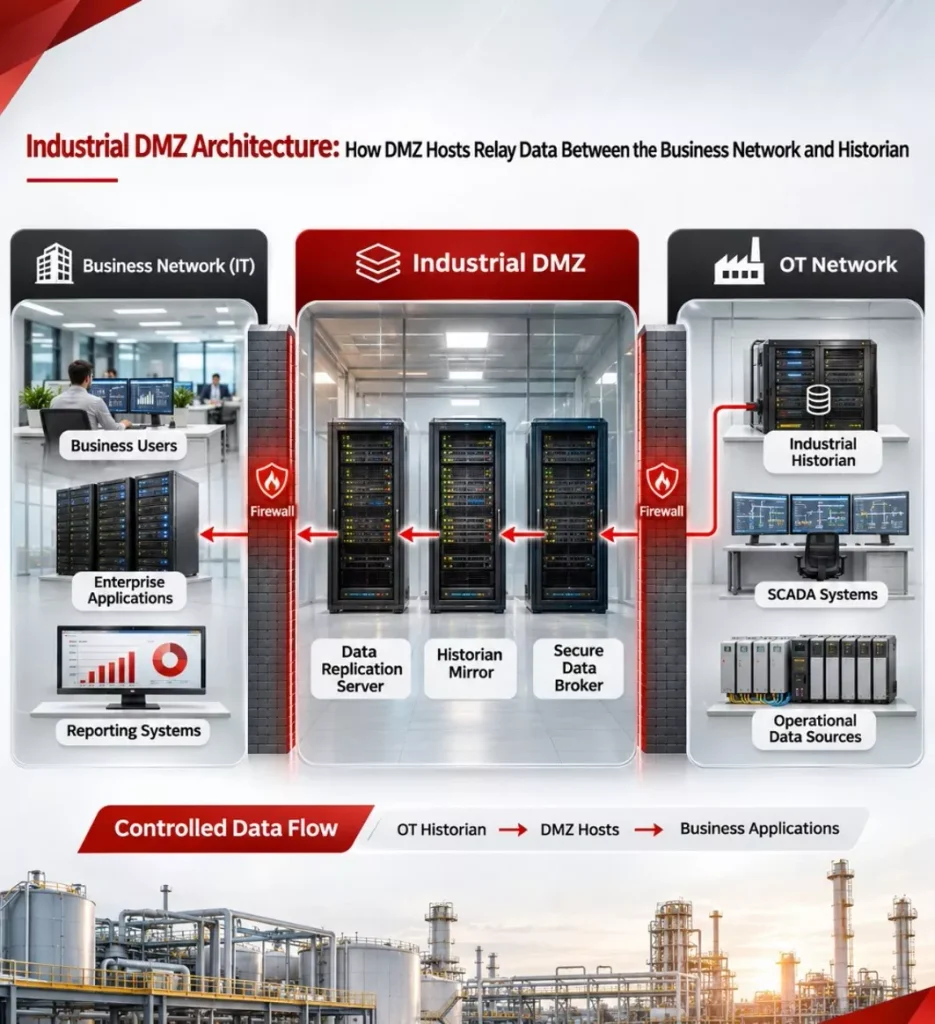
The industrial DMZ sits between Level 3 and Level 4 and brokers every data flow between OT and IT. No system on either side opens a direct session to the other. This placement matters because most OT compromises begin on the IT side. The CISA industrial control systems resources document repeated incidents in which ransomware on business networks forced precautionary shutdowns of physical operations. In 2021, Colonial Pipeline halted fuel flows after ransomware reached its IT environment, even though its OT systems were not directly encrypted. A properly built DMZ gives the operator a defined point to sever IT-to-OT traffic while keeping controlled visibility into production.
What Are the Most Common Purdue Model Gaps?
Assessments of industrial environments tend to surface the same five weaknesses. Each one removes a boundary that the model depends on.
- Flat Level 2 networks: HMIs and engineering workstations share a broadcast domain with unrelated devices, so lateral movement faces no barriers.
- Vendor remote access that bypasses the DMZ: Remote support tools installed directly on controllers create sessions that skip monitoring entirely.
- Dual-homed engineering workstations: A single workstation connected to both IT and OT networks becomes a bridge that attackers can use.
- Unmanaged historians with cloud synchronization: Level 3 servers often replicate data to external services without documented conduit rules.
- Shared credentials across levels: Reused accounts remove the accountability the model is meant to enforce.
Why Is Architectural Visibility a Board-Level Governance Requirement?
Architecture diagrams that stay in engineering folders do not satisfy regulators or boards. A current Purdue map, tied to documented conduits and security level targets, gives a risk committee a way to test assumptions. It shows which zones hold consequence-critical functions, which boundaries carry vendor access, and where evidence is missing. That visibility turns OT risk from an abstract concern into a set of decisions with owners and deadlines.
The Purdue Model remains useful because it gives organizations a shared structure to build on. Standards such as IEC 62443 and NIST SP 800-82 Rev. 3 supply the requirements, and disciplined operations supply the proof. Organizations that connect the three can answer a board’s core question with evidence rather than assurance.
| Schedule an OT Security Architecture and Segmentation Assessment to map your Purdue zones with Ampcus Cyber. |
People Also Ask
What is the difference between the Purdue Model and IEC 62443?
The Purdue Model is a structural reference that organizes OT by function. IEC 62443 is a standard that defines security requirements for zones, conduits, and components.
Is the Purdue Model still relevant for modern OT?
Yes. Many organizations still use it as a common vocabulary, although cloud and IIoT architectures often need additional zone definitions.
What is Level 3.5 in the Purdue Model?
Level 3.5 is the industrial DMZ. It separates OT and IT networks and brokers any data exchange between them.
How much is spent on securing AI?
Gartner forecasts spending on securing AI will reach almost $4.8 billion in 2027, up 68.7% from 2026, and nearly $7.7 billion in 2028.
What is the difference between a security zone and a conduit?
A zone is a group of assets with shared security requirements. A conduit is the controlled communication path between two zones.
Does the Purdue Model apply to cloud-based industrial systems?
The model still applies conceptually, but cloud-connected historians and edge devices usually require conduit rules that the original design did not address.
Enjoyed reading this blog? Stay updated with our latest exclusive content by following us on Twitter and LinkedIn.