










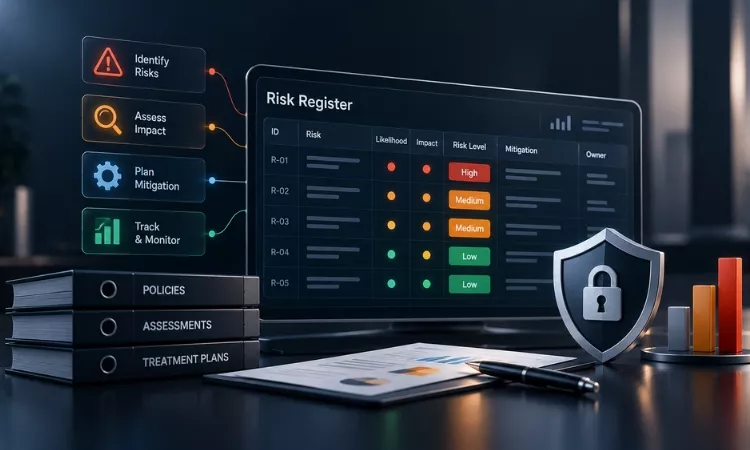
Most security teams can name their top risks in a leadership meeting, yet far fewer can show where those risks are recorded, who owns each one, and what has changed since the last audit. That gap widens as organizations add cloud workloads, SaaS vendors, and AI tools faster than governance processes can track them. Boards, regulators, and cyber insurers now expect documented proof that cyber risk is identified, scored, and treated on a defined schedule. The risk register is the document that meets that expectation and gives auditors and executives one trusted view of exposure.
What Is a Risk Register in Cybersecurity?
A risk register is a structured record that lists every identified risk to an organization along with its likelihood, impact, owner, treatment plan, and current status. In cybersecurity, each entry describes how a specific threat could exploit a weakness and damage an asset the business depends on. The register brings scattered findings from audits, penetration tests, and vendor reviews into one prioritized view that leadership can act on. NIST positions the cybersecurity risk register as the link between technical risk and enterprise risk management in NIST IR 8286A Rev. 1.
Why Does Every Security Program Need a Risk Register?
Every security program needs a risk register because it creates a single source of truth for deciding where limited budget and attention should go. Without one, priorities tend to follow the loudest stakeholder or the most recent incident. A maintained register also gives auditors traceable evidence that risks are identified, assessed, and treated, which strengthens audit readiness across ISO 27001, SOC 2, PCI DSS, and HIPAA engagements. For CISOs, it offers a defensible way to explain risk acceptance decisions to the board.
What Should a Cybersecurity Risk Register Include?
A cybersecurity risk register should include fields that describe the risk, score it, assign accountability, and track treatment through to closure. The template below reflects the columns we use most often when building registers for clients aligned to ISO 27001 and NIST.
| Field | What It Captures |
| Risk ID | A unique reference such as CR-014 |
| Risk Scenario | Threat, vulnerability, affected asset, and business consequence |
| Asset or Process | The system, data set, vendor, or process at risk |
| Inherent Likelihood and Impact | Scores from 1 to 5 before controls |
| Inherent Risk Score | Likelihood multiplied by impact, from 1 to 25 |
| Existing Controls | Safeguards already reducing the risk |
| Treatment Decision | Mitigate, transfer, avoid, or accept |
| Action Plan and Due Date | Specific tasks with a target date |
| Risk Owner | A named, accountable individual |
| Residual Risk Score | The score remaining after planned controls |
| Status and Review Date | Current state and date of last review |
This structure also supports clauses 6.1.2 and 6.1.3 of the ISO/IEC 27001 standard, which require organizations to identify risk owners and produce a risk treatment plan.
How Do You Create a Risk Register Step by Step?
You create a risk register by defining your scoring method first and then identifying, scoring, and assigning each risk before setting a review cadence.
- Agree on the methodology: By defining a 5×5 scale and the score at which a risk escalates to leadership.
- Map critical assets: That support revenue, operations, and regulatory obligations.
- Write scenario-based statements: That describe a threat exploiting a vulnerability to affect an asset.
- Score inherent risk: Before controls so leadership sees the full exposure.
- Map controls and choose a treatment: Using frameworks such as the NIST security standards.
- Assign owners and dates: So, every action has a named person and a deadline.
- Calculate residual risk: Record the next review date.
From our experience, impact definitions carry more weight than any other part of the method. A level 5 impact should be tied to concrete business terms, such as a regulatory notification or an outage of a revenue-generating system beyond an agreed number of hours.
How is a Risk Register Different from a Risk Assessment and a Risk Matrix?
A risk assessment is the process that identifies and evaluates risks, while the risk register is the living record that stores those results and tracks what happens next. A risk matrix is the scoring grid that plots likelihood against impact and assigns a severity band. In simple terms, the assessment produces the findings, the matrix scores them, and the register keeps them accountable over time. A structured risk assessment and management program connects all three.
Who Owns the Risk Register and How Often Should It Be Updated?
The CISO or head of GRC typically owns the register, while each risk belongs to the leader who controls the affected asset. Critical and high risks should be reviewed monthly, and the full register should be reviewed at least quarterly. Updates should also follow major incidents, new vendor onboarding, and new regulatory obligations. One gap we see repeatedly in register reviews is risk acceptance without an expiry date, which allows a temporary exception to become a permanent exposure.
When Should You Move from a Spreadsheet to a GRC Platform?
You should move to a GRC platform once your register spans several frameworks, business units, or a vendor portfolio too large to update by hand. Spreadsheets suit a first register, although version conflicts and stale scores appear as it grows.
Turn your risk register into a board-ready decision tool by speaking with Ampcus Cyber’s risk experts, who build and score registers aligned to ISO 27001, NIST, and your business priorities.
| Reach SAMA CSF Maturity Level 3 with confidence by talking to Ampcus Cyber’s Saudi compliance specialists about a tailored gap assessment. |
People Also Ask
Is a risk register mandatory for ISO 27001?
ISO 27001 requires documented risk assessment results and a risk treatment plan. Most organizations meet both requirements through a well-maintained risk register.
What is the difference between inherent and residual risk?
Inherent risk is the exposure before controls are applied. Residual risk is what remains afterward, and leadership compares it against risk appetite.
Can I use Excel as a risk register?
Excel works well for a first register or a smaller organization. Most teams outgrow it once several risk owners need to update entries across multiple frameworks.
What is the difference between a risk register and an issue log?
A risk register tracks events that could happen, while an issue log tracks problems that have already occurred.
How does a risk register connect to risk appetite?
The register compares each residual score against the appetite threshold, so any risk above it needs further treatment or formal executive acceptance.
Enjoyed reading this blog? Stay updated with our latest exclusive content by following us on Twitter and LinkedIn.