









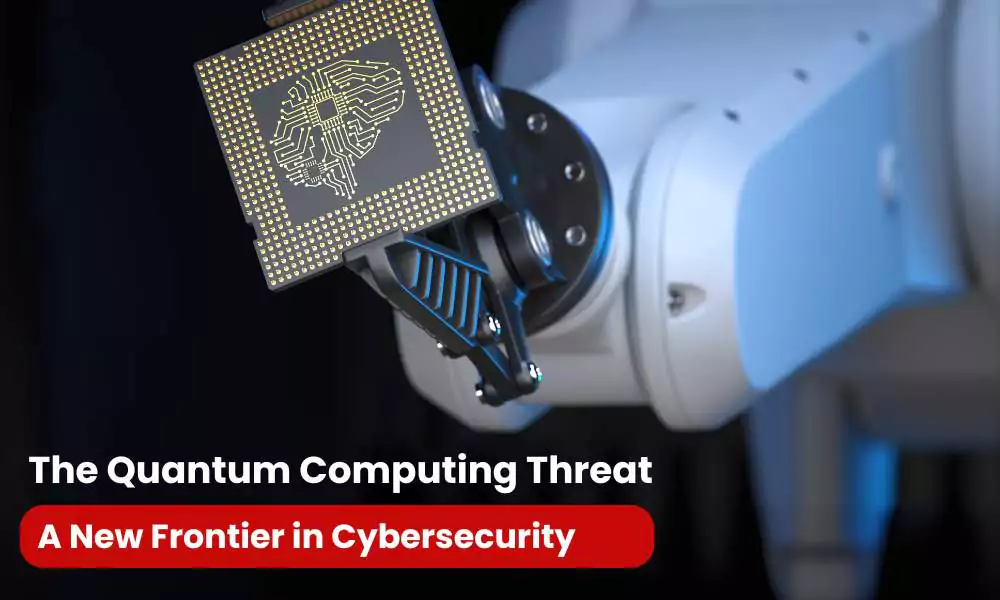
As quantum-computing research accelerates, defenders must rethink every assumption that underpins modern data protection. Quantum processors promise game-changing breakthroughs, yet that same extraordinary processing power undercuts the cryptographic foundations that safeguard global commerce, government secrets, and everyday digital life. The window to prepare is open now, but it is narrowing quickly.
Quantum Computing in Plain English
Classical machines store information in bits, either 0 or 1. Quantum computers use qubits, which exploit two fundamental quantum principles:
- Superposition – a qubit can represent 0 and 1 simultaneously, multiplying computational bandwidth.
- Entanglement – two qubits can become linked so that a change in one instantly affects the other, even across great distances.
Because qubits explore many possibilities at once, certain problems, such as large-number factorization, chemistry simulations, and complex optimizations, collapse from “millions of years” to “minutes.” That quantum speed-up is called quantum advantage, and when it exceeds any classical alternative, researchers dub it quantum supremacy.
Why Today’s Encryption Is at Risk?
Most Internet security relies on math that is extremely hard for classical computers but trivial for a large-scale quantum machine:
| Algorithm | Classical security assumption | Quantum threat |
| RSA | Factoring a 2,048-bit integer is infeasible | Shor’s algorithm factors it in polynomial time |
| Elliptic Curve Cryptography (ECC) | Discrete-log problem is hard | Shor’s algorithm solves it efficiently |
| Symmetric ciphers (AES-256, SHA-2) | Brute force requires 2ⁿ work | Grover’s algorithm halves the key strength |
Attackers know this. Nation-state actors already “steal now, decrypt later,” stockpiling high-value ciphertext to crack once quantum hardware matures.
The Post-Quantum Cryptography (PQC) Race
To counter the looming risk, the U.S. National Institute of Standards and Technology (NIST) launched a global competition. In 2024, NIST selected draft standards such as CRYSTALS-Kyber (key encapsulation) and CRYSTALS-Dilithium (digital signatures). These rely on hard lattice problems believed to resist both classical and quantum attacks. Other promising families include:
- Hash-based signatures (e.g., SPHINCS+)
- Code-based schemes (e.g., Classic McEliece)
- Multivariate-quadratic equations (e.g., Rainbow*)
Crypto-agility, the ability to swap algorithms without rebuilding entire systems, will be a core design principle for the next decade.
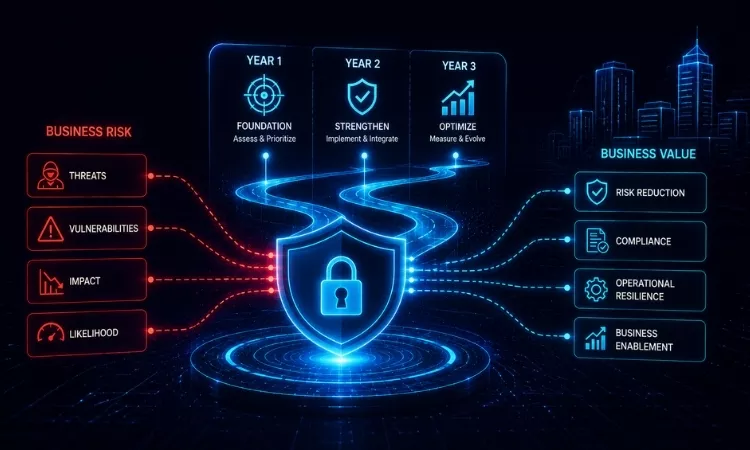
A Practical Roadmap to Quantum-Safe Security
- Create a cryptographic inventory
Map every protocol, certificate, hardware security module (HSM), and supply-chain integration that uses public-key cryptography. - Prioritize by shelf-life and value
Long-lived secrets (e.g., healthcare records, state secrets) must move first; a seven-year breach-horizon is common for regulated data. - Adopt hybrid encryption
Run traditional RSA/ECC in parallel with PQC so systems remain interoperable during migration. - Embed crypto-agility
Use abstraction layers and automated certificate-management platforms to swap algorithms quickly. - Test at scale
Simulate Shor-level attacks in a lab; measure latency, key sizes, and bandwidth overhead. - Govern for resilience
Update risk registers, vendor contracts, and incident-response playbooks to include quantum scenarios.
Quantum Technology as a Defensive Ally
Quantum innovation also strengthens cyber-defenses:
- Quantum Key Distribution (QKD) – uses the laws of physics to detect eavesdropping; any interception disturbs the quantum state and is immediately visible.
- Quantum Random Number Generators (QRNGs) – provide provably unpredictable entropy for keys, defeating many side-channel attacks.
- Quantum-enhanced machine learning accelerates pattern analysis so SOC teams can hunt threats that would overwhelm classical analytics.
Sector-Specific Risk Snapshots
- Financial Services – Large transaction logs and long-term archival data make banks prime “harvest now” targets. Post-quantum TLS and crypto-agile core banking rails are urgent.
- Healthcare – Patient data retains value for a lifetime; HIPAA and GDPR regulators may soon mandate quantum-safe transport for electronic health records.
- Critical Infrastructure – Power-grid controls often run embedded devices with limited processing power, complicating PQC rollouts, necessitating lightweight algorithms and vendor coordination.
- Public Sector & Defense – Classified communications already plan for 30-50-year confidentiality. Agencies must budget for both PQC upgrades and secure quantum channels.
Overcoming Implementation Hurdles
| Challenge | Mitigation |
| Qubit fragility & error rates slow commercial timelines | NIST’s conservative migration schedule buys buffer time, but don’t assume indefinite delays |
| Talent gap in quantum engineering | Partner with academia, launch cross-training for existing cryptographers |
| Performance overhead (larger key sizes, handshake latency) | Deploy hardware accelerators and cache session keys |
| Vendor ecosystem lag | Insert PQC requirements in RFPs; run interoperability pilots with cloud and IoT suppliers |
| Regulatory uncertainty | Track standards bodies (NIST, ETSI, ISO) and align internal policies with their drafts |
Conclusion: From Quantum Anxiety to Quantum Advantage
Scalable quantum computers won’t appear overnight, yet the data we protect today must remain confidential for decades. Organizations that act before quantum supremacy arrives will avoid a frantic, costly scramble later. The strategic steps are clear:
- Inventory and prioritize cryptographic assets now.
- Build crypto-agile architectures ready to drop in PQC algorithms.
- Leverage quantum innovations such as QKD to gain a defensive edge.
By treating the quantum revolution as an opportunity, not merely a threat, security leaders can harden trust foundations and position their enterprises for the next era of innovation.
| Want to safeguard your data against the coming quantum wave? Connect with our cybersecurity experts now. |
Enjoyed reading this blog? Stay updated with our latest exclusive content by following us on Twitter and LinkedIn.