








Most security teams discover their detection gaps during an actual incident, which is the most expensive and least forgiving way to learn. Breach and Attack Simulation, commonly shortened to BAS, exists to close that gap earlier, giving CISOs and security leaders continuous, evidence-based proof of whether their controls stop real attack techniques rather than a checklist of theoretical protections.
What Is Breach and Attack Simulation (BAS)?
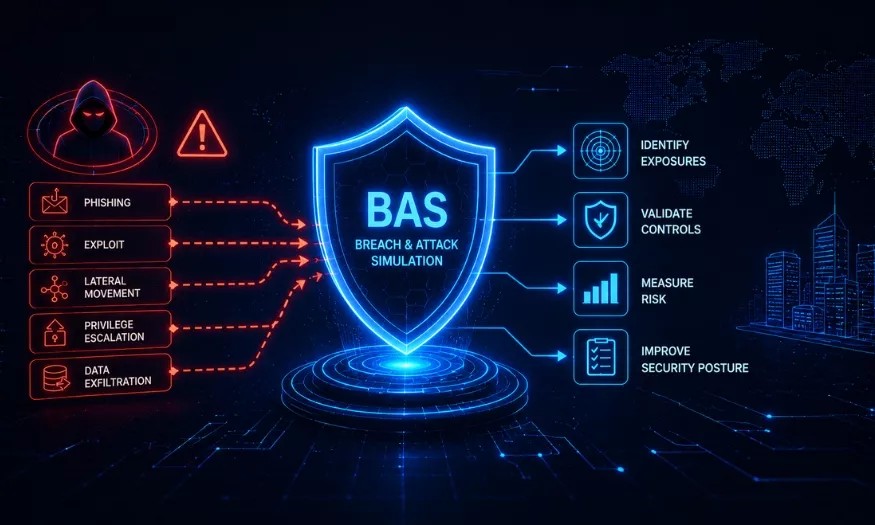
Breach and Attack Simulation is an automated security testing approach that continuously mimics real-world attacker tactics, techniques, and procedures against an organization’s own environment to validate whether existing security controls detect and stop them. Rather than waiting for an annual penetration test or a live breach to expose weaknesses, BAS platforms run controlled, repeatable attack scenarios around the clock and report exactly which techniques succeeded, which were blocked, and which went undetected.
Why Does BAS Matter for Enterprise Security Teams?
Security stacks have grown dense, with dozens of tools layered across endpoints, networks, identity, and cloud, yet misconfigurations and detection gaps still slip through unnoticed for months at a time. BAS matters because it converts assumptions about security posture into measurable evidence collected on a continuous basis rather than a single point in time. This is especially valuable for organizations already investing in advanced penetration testing, since BAS fills the gaps between those periodic engagements with ongoing validation.
How Does Breach and Attack Simulation Work?
A BAS platform runs simulated attack scenarios, such as malware execution, lateral movement, data exfiltration, or phishing payload delivery, inside a controlled environment without causing actual harm to production systems. Each simulation is mapped to a known adversary technique, executed against live security controls, and scored based on whether the control detected, blocked, or missed it entirely. Results feed into a dashboard that shows security teams precisely where detection engineering, tool configuration, or response procedures need attention, and the same scenarios can be rerun after remediation to confirm the fix closed the gap.
BAS vs. Penetration Testing vs. Red Teaming: What Is the Difference?
BAS, penetration testing, and red teaming all validate security controls, but they differ in frequency, depth, and purpose. Mature programs use all three together rather than treating them as interchangeable options.
| Dimension | Breach and Attack Simulation (BAS) | Penetration Testing | Red Teaming |
| Frequency | Continuous, automated, often daily | Periodic, typically once or twice a year | Periodic, usually annual or semi-annual |
| Execution | Automated platform runs predefined scenarios | Human testers manually probe systems | Human operators emulate a full adversary campaign |
| Primary goal | Validate whether known techniques are detected and blocked | Discover exploitable, sometimes novel, vulnerabilities | Test detection and response under realistic, stealthy attack pressure |
| Coverage | Broad, mapped to MITRE ATT&CK technique library | Narrow but deep, focused on specific systems | Narrow, focused on a full attack chain |
| Defender awareness | Known internally, part of routine validation | Usually scoped and known in advance | Often unannounced to test real response |
| Best for | Ongoing proof that controls work between engagements | Finding unknown, exploitable weaknesses | Testing people, process, and detection together |
Penetration testing is deeper and more creative in finding unknown weaknesses, while BAS provides the breadth, consistency, and frequency that a point-in-time engagement cannot match. Red teaming answers whether a determined attacker with time and creativity could succeed, as covered in our introduction to red team exercises, while BAS answers whether known techniques are consistently caught by current controls. Organizations exploring AI-driven testing platforms like Mirror are already seeing BAS and penetration testing converge into a single continuous validation motion.
What Are the Core Components of a BAS Program?
A functional BAS program is built on four pillars:
- Scenario library: A collection of attack scenarios mapped to real adversary techniques, kept current as the threat landscape evolves.
- Execution Engine: The platform layer that safely runs those scenarios in production or production-like environments without causing harm.
- Scoring and Reporting: A layer that shows detection versus miss rates in a format leadership and analysts can both use.
- Remediation workflow: A routing mechanism that sends findings directly to the teams responsible for fixing them.
Integration with the security information and event management platform and the security operations center is essential, since BAS results are only useful if they connect directly to the detection and response workflows that need improvement, a maturity dimension we explore in our guide to SOC maturity assessment.
How Does BAS Fit Into Continuous Threat Exposure Management (CTEM)?
Breach and Attack Simulation sits inside the validation stage of Continuous Threat Exposure Management, a broader program that scopes, discovers, prioritizes, validates, and mobilizes fixes for exposures on an ongoing cycle, as detailed in our CTEM guide. Within that cycle, BAS proves whether an exposure flagged by vulnerability scanning or attack surface management is truly exploitable and whether current controls would catch an attempt to abuse it, preventing security teams from spending remediation effort on theoretical risks.
What Frameworks Guide Breach and Attack Simulation?
Most BAS platforms build their scenario libraries directly from the MITRE ATT&CK framework, a knowledge base of adversary tactics and techniques drawn from real-world observed intrusions, maintained by the MITRE Corporation. Mapping simulations to specific ATT&CK techniques gives security teams a shared vocabulary for reporting results to leadership and comparing coverage across tools. The Cybersecurity and Infrastructure Security Agency publishes guidance on mapping adversary behavior to ATT&CK consistently, which BAS teams can use to keep their scenario libraries accurate and their reporting defensible during audits or board reviews.
How Do You Measure BAS Effectiveness?
Three metrics matter most for tracking whether a BAS program is delivering real improvement over time:
- Detection Rate: The percentage of simulated techniques that security tools correctly identified, out of the total number tested.
- Mean Time to Detect (MTTD): How quickly an alert was generated once a simulated technique executed, measured in minutes or hours.
- Control Coverage: How many MITRE ATT&CK techniques the organization has tested against with evidence, as opposed to techniques assumed to be covered based on vendor marketing alone.
Tracking these three metrics over time reveals whether security investments are closing real gaps or simply adding tools without improving outcomes.
What Are Common Challenges in BAS Implementation?
Many BAS programs stall because findings pile up faster than security teams can remediate them, turning a validation tool into another source of alert fatigue. Scenario libraries can also grow stale if they are not updated as adversary techniques evolve, giving a false sense of coverage. Some organizations run BAS in isolated test environments that do not reflect real production configurations, which quietly defeats the entire purpose of continuous validation. Clear ownership, realistic scoping, and a direct feedback loop into the SOC are what separate BAS programs that drive real improvement from ones that generate reports nobody acts on.
Who Should Own a BAS Program in an Organization?
BAS typically sits with the security operations or detection engineering team, since they are best positioned to act on findings that reveal gaps in monitoring and alerting. The CISO retains overall accountability for the program’s coverage and maturity, while collaboration with vulnerability management and third-party risk functions ensures findings connect to the organization’s broader risk picture rather than existing in a silo.
How Can Organizations Get Started with BAS?
Organizations new to BAS should start by mapping their most critical assets and the adversary techniques most relevant to their industry, rather than attempting to test every possible scenario at once. Pairing BAS with periodic advanced penetration testing and structured red team exercises builds a layered validation program that catches both known technique gaps and novel attack paths. Ampcus Cyber helps enterprises design and operationalize this kind of continuous validation program, connecting simulation results directly to measurable improvements in detection and response.
| Want to know whether your controls stop real attack techniques under pressure? Talk to Ampcus Cyber to build a breach and attack simulation program that delivers evidence, not assumptions. |
Enjoyed reading this blog? Stay updated with our latest exclusive content by following us on Twitter and LinkedIn.