









What is CTEM?
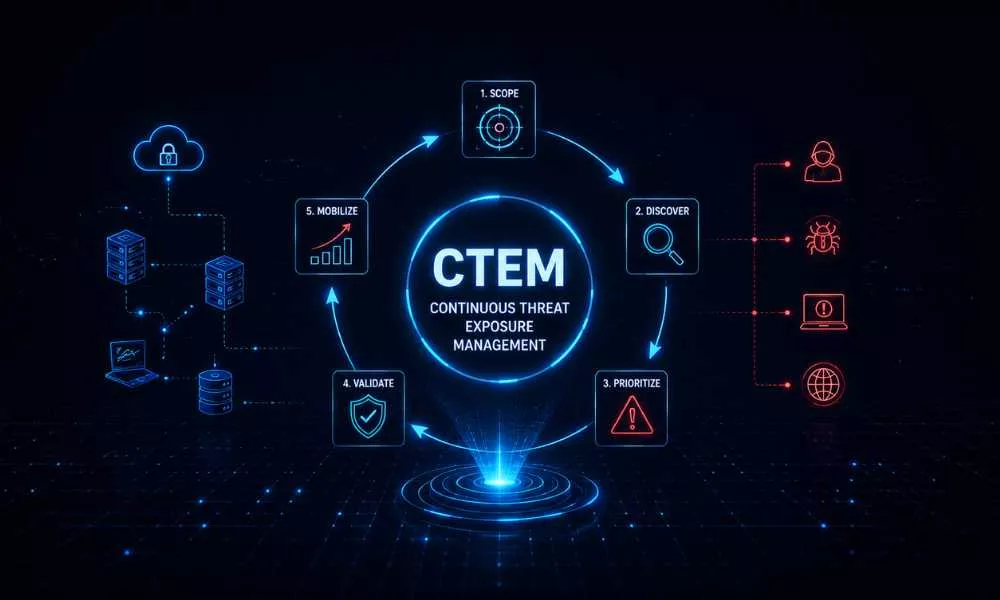
Continuous Threat Exposure Management (CTEM) is a structured, iterative cybersecurity program discipline, formalized by Gartner in 2022, that shifts organizations from periodic, compliance-driven vulnerability scanning to a continuous, attacker-centric exposure reduction model. Its core question: of the tens of thousands of exposures in our environment right now, which specific subset is reachable, weaponizable, and consequential enough to demand immediate action?
CTEM integrates existing capabilities including SIEM, scanners, and penetration testing, into a coherent risk-reduction cycle. Unlike classical VM, which orders findings by CVSS score with no environmental context, CTEM evaluates whether a finding is reachable by a threat actor, whether a weaponized exploit exists in the wild, and what the downstream business consequence of exploitation would be. Only findings scoring meaningfully on all three axes enter the priority pipeline.
Why CTEM Is Operationally Urgent: Key Metrics
- 5–7% of CVEs are actively exploited (CISA KEV analysis, 2025). Targeting only this subset reduces patch workload by >90% while addressing peak-risk exposures.
- Median time-to-exploitation for weaponized CVEs compressed from 45 days (2020) to 12 days (2025), CTEM’s continuous cycle is designed to close this window before adversaries operationalize it (Rapid7, 2025).
- 62% of initial access vectors now involve identity-based attacks (AiTM phishing, Kerberoasting, OAuth token theft), yet fewer than 30% of organizations include identity in their VM scope (Verizon DBIR 2025).
What Are The Five Stages of CTEM
The CTEM cycle operates across five functional stages. Discovery and prioritization run continuously in parallel; validation cycles are rolling; full re-scoping occurs quarterly or on material business events.
| Stage | Core Question | Key Inputs | Key Outputs | Owner |
| 1. Scoping | What matters to the business? | BIA, Crown Jewels register, data flow diagrams | Tiered asset groups, risk appetite statement | CISO / Business |
| 2. Discovery | What do we have and what is exposed? | EASM, CMDB, cloud APIs, identity directories, SBOM | Unified asset & exposure inventory | Security Arch / VM |
| 3. Prioritization | Which exposures are real risk right now? | EPSS, CISA KEV, threat intel, reachability, asset criticality | Risk-ranked remediation backlog | VM / Threat Intel |
| 4. Validation | Are the findings exploitable? | BAS platform, pen test results, attack path graphs | Confirmed exploitable paths, control gaps | Red Team / OffSec |
| 5. Mobilization | How do we close it and prove it? | Validated findings, SLA policy, ITSM integration | Closed exposures, MTTR metrics, scope feedback | SecOps / DevSecOps |
Why CTEM Matters in 2026
Modern attack surfaces span cloud workloads, remote endpoints, shadow IT, third-party integrations, open-source code, and AI-powered applications. Legacy vulnerability scanners produce point-in-time snapshots that are outdated at the moment they are generated.
Three realities drive the case for CTEM:
- The average enterprise carries tens of thousands of open vulnerabilities at any given time, yet only a small fraction is ever actively exploited in the wild.
- Patch cycles routinely lag weeks or months behind public disclosure, giving adversaries a usable window.
- Attackers do not target the longest CVE list. They target the most accessible, most impactful path to their objective.
Organizations that operationalize CTEM consistently report dramatic reductions in their exploitable attack surface and significantly improved Mean Time to Remediate. Independent industry research has projected that mature CTEM programs can reduce breach of likelihood by a factor of three compared to ad-hoc patching approaches.
The 5 Stages of the CTEM Framework
1. Scoping
Scoping defines what the program will assess. It requires business context, not just a technical asset list. Security teams work with business stakeholders to identify which assets, processes, and ecosystems matter most and would cause the greatest damage if compromised. A bank might scope payment systems and customer APIs first. A hospital might prioritize EHR platforms and connected medical devices.
2. Discovery
Discovery inventories all assets, identities, vulnerabilities, and misconfigurations within scope. It covers external attack surfaces, internal infrastructure, identity and access exposures, supply-chain risks, and cloud misconfigurations. Discovery must be continuous because new assets appear daily.
3. Prioritization
This is where CTEM separates itself most sharply from conventional vulnerability management. Instead of ranking findings by CVSS alone, CTEM weighs:
- Exploitability: Is a weaponized exploit available?
- Reachability: Can an attacker actually reach the asset?
- Business Impact: What would compromise cost the organization?
- Threat Intelligence Context: Are adversaries actively targeting this?
- Compensating Controls: What existing defenses already reduce real risk?
The result is a prioritized list dramatically shorter, and far more actionable than the raw vulnerability count.
4. Validation
Validation proves whether prioritized exposures are genuinely exploitable. This stage uses Breach and Attack Simulation, Advanced Penetration Testing, Red Team Assessments, and attack path analysis to map multi-step exploitation chains. Validation prevents teams from wasting effort on theoretical risks.
5. Mobilization
Mobilization bridges the gap between security findings and remediation action. It includes contextualized fix guidance for owning teams, ticketing integration, SLA tracking, and feedback loops back into scoping. Without mobilization, even the best findings are never closed.
Is Your Current Vulnerability Management Falling Short?
Periodic scans leave critical exposure windows open for weeks. Explore Ampcus Cyber’s CTEM-aligned Threat & Vulnerability Radar Services.
CTEM vs. Vulnerability Management: Key Differences
| Dimension | Traditional VM | CTEM |
| Cadence | Periodic scans | Continuous, always-on |
| Prioritization | CVSS score | Exploitability + reachability + business impact |
| Scope | Internal IT | Full attack surface (cloud, identity, supply chain) |
| Validation | Rarely included | Core stage (BAS, pen test, red team) |
| Remediation | Ticket and hope | Coordinated mobilization workflows |
| Threat Intelligence | Occasional | Continuous integration |
| Attack Path Analysis | Not included | Integral to validation |
| Output | Vulnerability reports | Prioritized, validated remediation programs |
Traditional VM tells you what is broken. CTEM tells you what matters, why, and what to do about it, continuously.
Key Components of a CTEM Program
A mature exposure management platform brings together several disciplines working in concert:
- Attack Surface Management (ASM): continuous discovery of internet-facing and shadow assets, the foundation of a proactive security posture.
- Risk-Based Vulnerability Management (RBVM): CVE discovery enriched with real-world exploitability data.
- Threat Intelligence: context on active campaigns and weaponized exploits.
- Breach and Attack Simulation (BAS): automated validation against MITRE ATT&CK techniques.
- Identity Security Posture Management: addressing identity as the new perimeter.
- Cloud Security Posture Management: continuous cloud configuration assessment.
- Penetration Testing and Red Teaming: human-led validation of complex attack paths.
- SIEM and SOAR: integration that drives mobilization at scale.
Implementation Roadmap
A phased approach that demonstrates measurable MTTR and attack surface reduction within 90 days delivers greater value than an over-engineered broad rollout. Extend timelines rather than compress quality when under-resourced.
| Phase | Timeline | Key Deliverables |
| 1 — Foundation | Months 1–3 | NIST CSF 2.0 maturity assessment; Crown Jewels register with stakeholder sign-off; EASM + authenticated scanning for pilot scope; EPSS/KEV integration in RBVM; SLA policy and ITSM integration |
| 2 — Capability Build | Months 4–8 | BAS deployed; first external attack surface pen test; TI feed operationalized; BloodHound AD assessment; automated mobilization cycle; MTTR baseline established and reported monthly |
| 3 — Maturity | Months 9–18 | Scope expanded to Tier-2, supply chain, OT/ICS; full red team assessment; quarterly purple team cadence; SBOM/container scanning in CI/CD; executive dashboard with business-contextualized KPIs |
Benefits of Implementing CTEM
- Reduced breach of risk through focused remediation of genuinely exploitable exposures.
- Improved security efficiency with less false-positive chasing and more meaningful work.
- Faster Mean Time to Remediate (MTTR) via streamlined mobilization workflows.
- Stronger board-level communication anchored in business impact, not CVE counts.
- Built-in alignment with PCI DSS v4.0, NIST CSF 2.0, HIPAA, and ISO 27001.
- An operationalized proactive security posture that shrinks the attack surface before adversaries can exploit it.
Challenges in CTEM Adoption
Common obstacles include organizational silos between security, IT, and DevOps; finding fatigue from immature prioritization; tool integration complexity; specialized skill requirements for validation; and continuous change management of an ever-shifting attack surface. A qualified cybersecurity partner accelerates the path to maturity by providing the expertise and operational frameworks internal teams often lack.
How to Get Started with CTEM
- Assess your current state against the five CTEM stages.
- Define your first scope. External attack surfaces are a natural starting point.
- Enhance discovery capability across cloud, identity, and third-party assets.
- Implement risk-based prioritization that moves beyond CVSS.
- Add validation through BAS and penetration testing.
- Operationalize mobilization with workflows, SLAs, and metrics.
- Expand and mature across the full enterprise environment.
CTEM and Compliance
CTEM aligns naturally with major regulatory frameworks. PCI DSS v4.0 demands targeted risk analysis and continuous vulnerability assessment. NIST CSF 2.0 emphasizes ongoing risk management and supply chain risk. HIPAA requires ongoing risk analysis, and ISO/IEC 27001:2022 adds controls around threat intelligence, all which CTEM operationalizes in an auditable way.
Ampcus Cyber’s services including Compliance Compass and Governance Engine connect your CTEM program to these compliance obligations, ensuring security investments deliver regulatory value alongside risk reduction.
Conclusion
CTEM is not a product. It is a program discipline that transforms how organizations understand and manage security risk. By replacing periodic, reactive vulnerability management with a continuous, attacker-centric model, CTEM gives security teams the clarity and operational focus they need to meaningfully reduce breach risk.
Ampcus Cyber’s Threat & Vulnerability Radar services, support every stage of your CTEM journey.
| Contact Ampcus Cyber Today and get a CTEM program tailored to your environment and risk profile. |
Enjoyed reading this blog? Stay updated with our latest exclusive content by following us on Twitter and LinkedIn.